
Baize
Baize
Knower of All Ghosts and Spirits, Cataloger of Ten Thousand Demons
Shanhaijing Original Text
帝巡狩,东至海,登桓山,于海滨得白泽神兽,能言,达于万物之情。——《轩辕本纪》
The Yellow Emperor went on an inspection tour, traveling east to the sea. He ascended Mount Huan, and on the shore encountered the divine beast Baize. It could speak, and possessed knowledge of the nature of all things under heaven.
The Emperor went on an inspection tour, traveling east to the sea. He ascended Mount Huan, and on the shore encountered the divine beast Baize. It could speak, and possessed knowledge of the nature of all things under heaven. — Chronicles of the Yellow Emperor
Identity
Lion's body with a human face, covered in snow-white fur, twin horns on its forehead, piercing eyes like torches, radiating an aura of wisdom
Knows the nature of all things, possesses the names and weaknesses of every demon and ghost, speaks human language
Wisdom, warding off evil, the power of knowledge
Legend
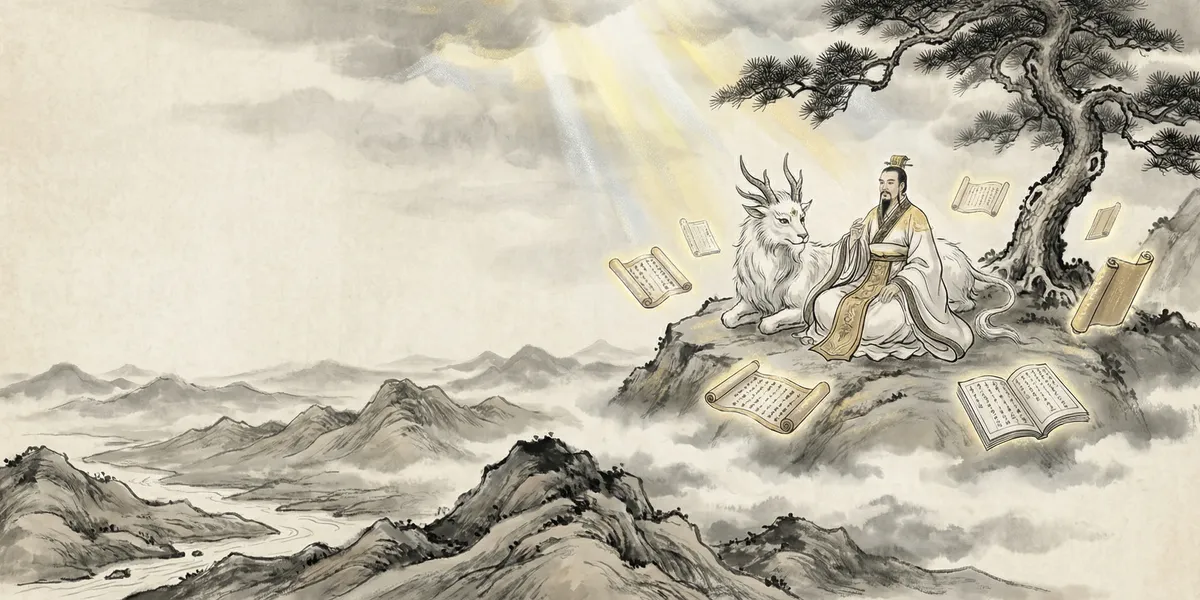
Every mythological system has its warriors, its tricksters, its tyrants. But only Chinese mythology has a divine beast whose superpower is being a living encyclopedia. Meet the Baize (Baize) — it knows the details of every demon, every ghost, every evil spirit in existence, and exactly how to defeat each and every one of them.
The Baize's most essential legend comes from texts like the "Chronicles of the Yellow Emperor" (Xuanyuan Benji). The story goes that the great Yellow Emperor (Huangdi) — the mythological progenitor of Chinese civilization — was on an inspection tour of his realm when he traveled east to the seashore, ascended Mount Huan (Huan Shan), and encountered an extraordinary divine beast: the Baize. It had the body of a lion, covered in pure white fur, a human face with twin horns, and eyes that radiated an inner light capable of seeing through every illusion.
But what truly made the Baize extraordinary was not its appearance but its voice. It could speak human language, and it possessed knowledge without equal in the world. The Baize told the Yellow Emperor about every supernatural being in existence — a total of eleven thousand, five hundred and twenty (11,520) types of demons and ghosts (yaoguai guimei). For each one, it described in detail that entity's appearance, behavior, habitat, weaknesses, and the methods for repelling or defeating it.
The Yellow Emperor, recognizing the priceless value of this knowledge, immediately ordered his scribes to record everything the Baize said. The result was the legendary "Baize Tu" (Chart of the Baize) — essentially the world's first monster encyclopedia. Although the original text has been lost to the currents of history, it was cited repeatedly in countless later works and became one of the most important texts in Chinese demonology and folk belief.
For centuries, the "Baize Tu" was not merely a reference book — it was a survival guide. Ordinary people kept copies or summaries of it in their homes, believing that knowing a demon's name gave them the power to overcome it. This idea — that naming a thing strips it of its terror — runs deep in Chinese folk belief. If you know what a ghost is called and what it fears, it cannot harm you. By bestowing this knowledge upon humanity, the Baize essentially equipped an entire civilization with weapons against supernatural threats.
The Baize's image itself also became a powerful apotropaic (bixie) talisman. During the Tang and Song Dynasties, people pasted images of the Baize on their doors, walls, and even embroidered it on clothing and military banners. Carrying a Baize image was believed to make you "invisible" to evil spirits — not because the Baize was a fierce warrior, but because demons feared being identified. A being that knows your true name and your weaknesses is, to a demon, far more terrifying than any sword.
The Baize's appearance underwent significant evolution throughout Chinese history. In early depictions, it was portrayed as a majestic lion-like beast with human facial features — wise and solemn. By the Ming and Qing Dynasties, some painters began depicting it with ox or goat characteristics, sometimes with multiple eyes covering its body — each eye representing its ability to perceive different types of supernatural beings. Some versions show it with six or even eight eyes arranged in rows — a visual metaphor for omniscience.
While texts like the "Classic of Mountains and Seas" do not directly record this beast under the name "Baize," later scholars integrated the narrative of the Yellow Emperor's seashore encounter with older legends. Daoist texts such as the "Yunji Qiqian" (Seven Tablets of the Cloudy Satchel) gave the Baize additional religious significance, viewing it as a prophetic beast bestowed by heaven upon enlightened rulers — only a virtuous ruler could encounter the Baize, just as only a virtuous age could see a Qilin.
What makes the Baize unique in world mythology is its role. It is not a warrior, not a guardian, not a judge. It is a teacher. Its gift to humanity was not strength or magic — but information. In a world swarming with demons, the Baize says: you don't need to be stronger than your enemies; you only need to understand them. Knowledge itself is the ultimate weapon.
East vs West
The Greek Sphinx is the Baize's closest Western counterpart — both are hybrid creatures, both associated with profound knowledge. But their relationships to knowledge are diametrically opposed. The Sphinx crouches before the gates of Thebes posing riddles: answer correctly and you pass; answer wrong and it eats you. Knowledge is a barrier, a test, a weapon wielded against humans. The Sphinx hoards wisdom and punishes those who lack it.
The Baize does precisely the opposite. It actively seeks out the human ruler and shares everything it knows — the complete intelligence on 11,520 types of demons, given freely. The Sphinx is a gatekeeper; the Baize is an open library. The Sphinx uses knowledge to destroy; the Baize uses knowledge to protect. This reflects a profound cultural difference: in Greek mythology, wisdom is dangerous and must be won through suffering; in Chinese mythology, wisdom is generous and flows naturally toward those with the virtue to receive it. The Sphinx asks, "Are you worthy?" The Baize says, "Come, everything I know is yours."
Modern Influence
The Baize's legacy runs deep in Japanese yokai (yokai) culture, where it is known as "Hakutaku" and appears frequently in supernatural folklore and art. The Baize's concept of "cataloging all demons" directly inspired the "bestiary" and "encyclopedia" mechanics in countless video games and anime — from the Pokedex to monster compendiums in RPGs of every stripe. In Chinese folk belief, Baize door paintings and protective talismans remain part of apotropaic customs in some rural areas. In Chinese web fiction and mobile games, the Baize is typically portrayed as a wise advisor or omniscient NPC — the character who provides the protagonist with crucial intelligence at pivotal moments. During the COVID-19 pandemic in 2020, the Baize image unexpectedly went viral on social media, recast by netizens as a "plague-banishing divine beast" — perfectly echoing its original job description of banishing evil from millennia ago.
 QilinBack to CompendiumAzure Dragon
