
Qilin
Qilin
The Beast of Benevolence, Herald of a Golden Age
Shanhaijing Original Text
麟、凤、龟、龙,谓之四灵。——《礼记·礼运》
The Qilin, the Phoenix, the Tortoise, and the Dragon are called the Four Sacred Creatures — the most revered beings between heaven and earth.
The Qilin, the Phoenix, the Tortoise, and the Dragon — these are called the Four Sacred Creatures. — Book of Rites, Chapter of Ceremonial Usages
Identity
Dragon's head, deer antlers, ox tail, horse hooves, body covered in shimmering fish-like scales, a single soft horn on its forehead that harms nothing, wreathed in auspicious clouds
Distinguishes good from evil, perceives fortune and misfortune, harms no living thing, walks without treading on living grass — its very appearance is a divine omen from heaven
Benevolence, peace, the birth of a sage, flourishing descendants
Legend
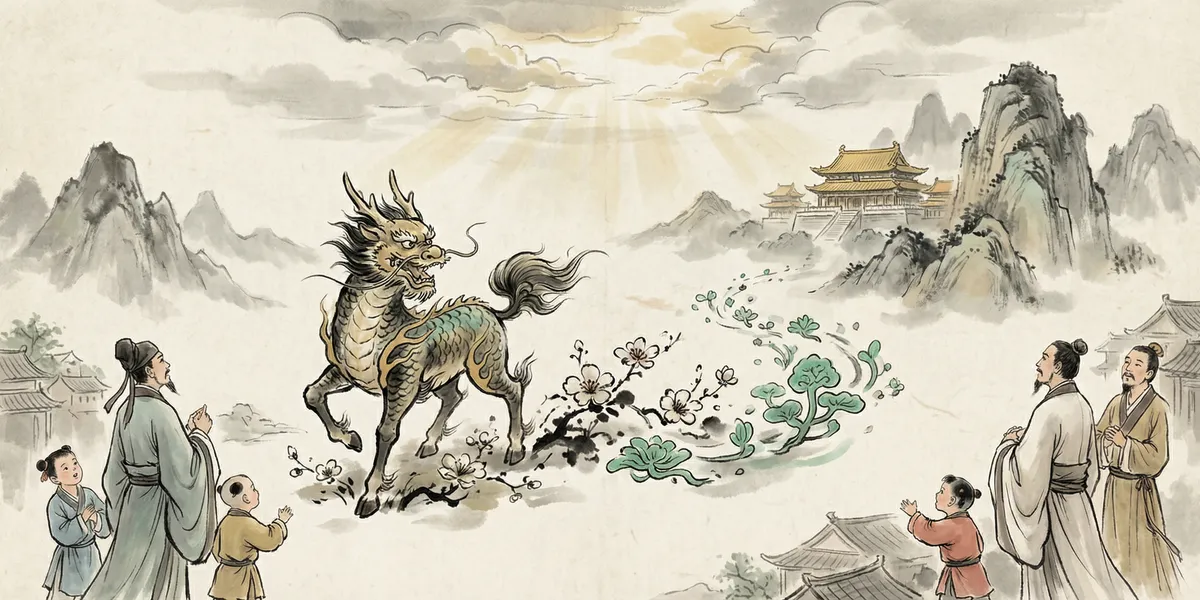
In a mythological world populated by fire-breathing dragons and man-eating monsters, the Qilin (Qilin) is almost impossibly gentle. This is a divine beast so kind it refuses to step on living grass, so compassionate it will not eat any living creature. It is the embodiment of "ren" (benevolence) — the highest Confucian virtue — walking between heaven and earth clad in dragon scales and treading upon auspicious clouds.
The Qilin is one of the traditional "Four Sacred Creatures" (Si Ling), ranked alongside the dragon, phoenix, and tortoise. But while the dragon represents imperial power and the phoenix represents grace, the Qilin represents something far rarer: moral perfection. Its appearance in the human world is a cosmic-level event — foretelling the birth of an extraordinary sage or the dawn of a Golden Age (taiping shengshi).
The most famous Qilin visitation in Chinese legend is intimately tied to Confucius (Kongzi). According to tradition, on the eve of Confucius's birth in 551 BCE, a Qilin descended to earth bearing a jade book (yushu) in its mouth, inscribed with a prophecy about the coming of a great sage. This legend gave rise to the deeply rooted belief in "Qilin Song Zi" (Qilin Delivers Children) — the faith that the Qilin brings exceptional children to virtuous families. To this day, Qilin images appear in Chinese weddings and at celebrations for newborns, carrying the wish that the child will be as virtuous as a sage. And in Confucius's old age, according to the "Spring and Autumn Annals" (Chunqiu), someone in the state of Lu captured a Qilin. Confucius wept bitterly upon seeing it, believing the Qilin's capture in an age of chaos to be an ill omen, and he laid down his brush, never again writing in the Annals — this is the famous "Huo Lin Juebi" (Capturing the Qilin, Laying Down the Brush).
The name itself contains an elegant detail: "qi" (qi) refers to the male, and "lin" (lin) to the female. Like the Fenghuang, the Qilin is a pair in harmonious yin-yang balance. Over time, the two merged into a single concept, but this dual nature remains inscribed in the name.
In appearance, the Qilin is a magnificent chimera — bringing together the finest qualities of multiple noble animals. Classical descriptions give it a dragon's head (longtou), deer antlers (lujiao), ox tail (niuwei), horse hooves (mati), and a body covered in gleaming fish scales (yulin). A single horn rises from its forehead, and some texts say this horn is fleshy and soft — because even its horn is designed to cause no harm. Some accounts describe it as surrounded by sacred flames or trailing auspicious clouds wherever it walks. The "Shuowen Jiezi" defines "qi" simply as "the beast of benevolence" — one phrase that captures its entire essence.
In ancient Chinese politics, the Qilin was no laughing matter. An emperor who claimed to have seen a Qilin was essentially declaring that he had received heaven's approval. Qilin sightings would be recorded in official histories as auspicious omens (xiangrui), and its absence during troubled times was noted with equal solemnity. It was, in effect, a living seal of the Mandate of Heaven.
The most delightful chapter in the Qilin's history occurred in 1414. The great navigator Zheng He (Zheng He) returned from a voyage to East Africa and presented a live giraffe to the Yongle Emperor (Yongle Di). The court was astonished. The giraffe — towering in stature, gentle in temperament, patterned hide, horn-like protrusions atop its head — bore a startling resemblance to classical descriptions of the Qilin. Court painters created portraits, and ministers submitted congratulatory memorials. The Yongle Emperor — to his credit — modestly declined to acknowledge it as a true Qilin. But the association stuck. To this day, the word for "giraffe" in Japanese and Korean is literally "Qilin" (kirin/girin) — a linguistic fossil commemorating that extraordinary moment when a real animal walked into mythology.
The "Book of Rites" (Liji) states: "The Qilin, the Phoenix, the Tortoise, and the Dragon are called the Four Sacred Creatures." The Qilin stands first, testament to its exalted status. The Qilin endures because it represents an ideal that never goes out of fashion: true power is gentle, true strength needs no destruction, and the clearest sign of a golden age is not military conquest but moral flourishing. In a world that often glorifies ferocity, the Qilin quietly insists: compassion is the highest form of power.
East vs West
The Western Unicorn is the Qilin's most natural counterpart — both have a horn, both are gentle, both are associated with purity, and both reveal themselves only to the virtuous. But beneath the similarities lie fundamental differences in cultural function. The Unicorn is about personal purity — it approaches virgins, symbolizes innocence, and in the modern age dwells in fairy tales and children's bedrooms. It is private and individual.
The Qilin operates on the scale of civilization. Its appearance validates not one person's purity but the moral order of an entire era. It is a political and cosmic symbol: when the Qilin walks, heaven endorses the emperor, crops will flourish, and a sage is about to be born. The Unicorn whispers to a single pure soul; the Qilin announces to the entire world: virtue is reigning. In appearance, too, there is a marked difference: the Unicorn is essentially a horse with a horn — elegance in simplicity. The Qilin is a dazzling composite of dragon, deer, ox, horse, and fish — a creation that unifies the animal kingdom in a single body, reflecting the Chinese philosophical ideal of "harmony amid diversity."
Modern Influence
Huawei named its flagship mobile processor "Kirin" (Qilin), making this mythological name one of the most frequently encountered Chinese myth terms in global tech. In Japan, Kirin Beer has used the Qilin as its name and logo since 1888, arguably the world's longest-running mythological brand identity. Traditional "Qilin Delivers Children" imagery remains a staple at Chinese weddings and newborn celebrations. The bronze Qilin statue standing guard before the Palace of Compassionate Tranquility (Cining Gong) in the Forbidden City welcomes millions of visitors annually, quietly upholding the way of benevolence at the very heart of imperial power. In film, television, and gaming, the Qilin appears frequently in xianxia dramas and online games, serving as an important cultural symbol in titles like "Honor of Kings."
Related Characters
 TaotieBack to CompendiumBaize
