
Taotie
Taotie
The Insatiable Devourer of Antiquity
Shanhaijing Original Text
有兽焉,其状如羊身人面,其目在腋下,虎齿人爪,其音如婴儿,名曰狍鸮,是食人。——《山海经·北山经》(注:狍鸮即饕餮之别称)
There is a beast with a body like a sheep and a human face, its eyes set beneath its armpits, with tiger's teeth and human claws. Its cry sounds like a baby. It is called Paoxiao, and it devours humans.
There is a beast with a body like a sheep and a human face, its eyes set beneath its armpits, with tiger's teeth and human claws. Its cry sounds like a baby. It is called Paoxiao, and it devours humans. — Classic of Mountains and Seas, Chapter of the Northern Mountains (Note: Paoxiao is another name for the Taotie)
Identity
A massive beast face — only a head without a body, the most recognizable motif in bronze casting: symmetrical bulging eyes, curling horns, and a gaping maw baring its fangs
Devours all things, never sated — its greed is a force that could swallow heaven and earth
A warning against greed, the majesty of power, the solemnity of ritual sacrifice
Legend
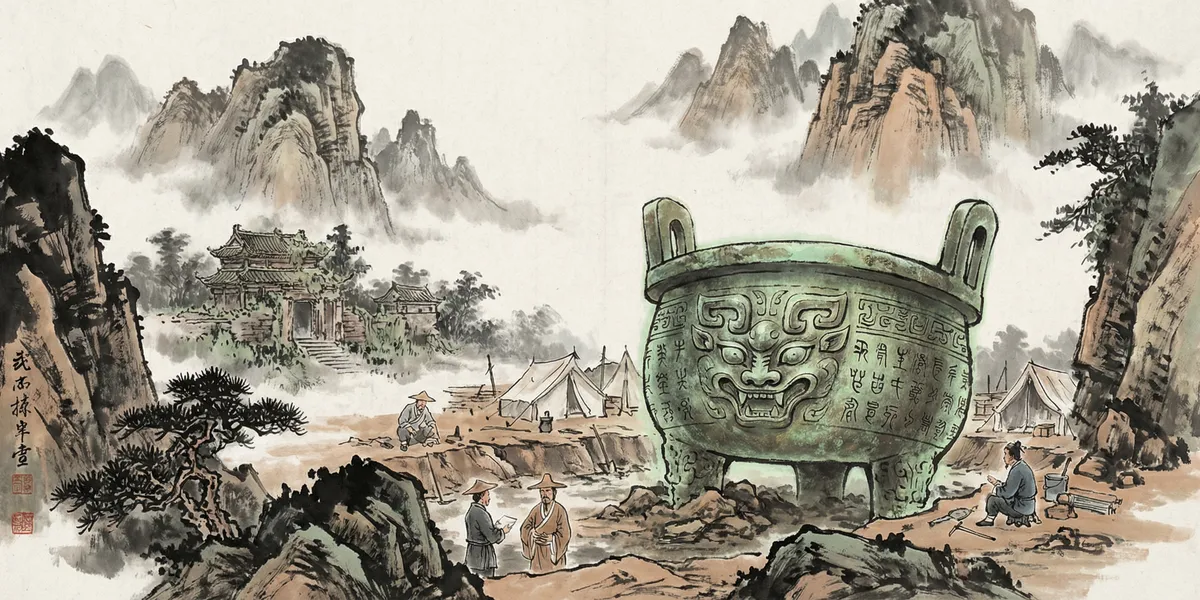
If you have ever stood before a Shang Dynasty bronze vessel in a museum and been startled by the massive, patina-covered beast face staring back at you — congratulations, you have already met the Taotie (Taotie). This three-thousand-year-old "meme" cast onto bronze may be the most widely disseminated and longest-surviving visual symbol in Chinese civilization.
The Taotie comes from impressive lineage. It is said to be one of the Nine Sons of the Dragon (Long Sheng Jiu Zi), having inherited the very worst trait of the dragon's personality: an insatiable appetite. How gluttonous was this creature? Legend has it that after devouring everything edible under heaven and still not being satisfied, it finally ate its own body, leaving nothing but a bare, disembodied head — a mouth that can never close. This is why the Taotie pattern (Taotie Wen) on bronze vessels is always a symmetrical beast face without a body: bulging eyes, curling horns, a gaping maw baring its teeth, looking ready to swallow everything in sight.
The Taotie pattern appears on virtually every important bronze ritual vessel (liqi) of the Shang Dynasty (c. 1600-1046 BCE) and Zhou Dynasty (c. 1046-256 BCE). Note — these were not everyday cooking pots but the most sacred objects used to offer sacrifices to heaven, earth, and ancestors. Casting the embodiment of "greed" onto the most solemn sacrificial vessels is a choice whose implications have fascinated scholars for millennia. Some believe the Taotie pattern served an apotropaic (bixie) purpose, using a ferocious face to frighten away evil spirits. Others see it as a warning to rulers: "Control your desires, or you will destroy yourself like the Taotie." Still others interpret it as a symbol of power itself — majestic, inviolable, awe-inspiring.
In the "Classic of Mountains and Seas" (Shanhai Jing), there is a creature called the Paoxiao, which later scholars like Guo Pu identified as another name for the Taotie. The original text describes it as "shaped like a sheep with a human face, its eyes set beneath its armpits, with tiger's teeth and human claws, its cry sounding like a baby" — a sheep's body with a human face, eyes growing from its armpits, tiger fangs with human claws, crying like an infant, and it eats people. The imagery would be S-tier material for a modern horror film.
The "Zuo Zhuan" (Commentary of Zuo) provides yet another origin story: the Taotie was a degenerate descendant of the Jinyun Clan (Jinyun Shi), so greedy and wicked that the sage Emperor Shun classified it among the Four Fiends (Si Xiong), exiling it along with Qiongqi, Taowu, and Hundun to the far corners of the earth to guard the borders against demons and monsters. Even in exile they were assigned a job — that efficiency is very "Chinese-style management."
The Taotie's most delightful cultural legacy is its transformation from a symbol of horror to a symbol of fine dining. "Taotie shengyan" (a Taotie feast) is now the go-to phrase for describing a lavish banquet, and "lao tao" (old glutton) has become an affectionate term for seasoned gourmands. An ancient fiend consumed by its own appetite has become the patron saint of foodie culture — quite possibly the most endearing reputation rehabilitation in Chinese cultural history.
East vs West
Western culture has its own profound narratives about gluttony. In Dante's "Inferno," the third circle of Hell is reserved for the punishment of gluttons, guarded by the three-headed dog Cerberus. Christian tradition lists "Gluttony" as one of the Seven Deadly Sins, with an unambiguous stance: gluttony is a sin, period. Even in Norse mythology, gold is often cursed — Andvari's ring, Fafnir's hoard — wealth always comes paired with destruction. But the Taotie occupies a far more nuanced position in Chinese culture. It certainly represents greed, but it was never cast into Hell. Instead, it was cast onto the most sacred sacrificial vessels, enthroned on the very surface of objects that bridge heaven and earth. Cerberus guards the gates of punishment; the Taotie guards the gates of wisdom. The West says "you will suffer for your greed"; China says "look greed in the face, then transcend it." This is not indulgence but a deeper strategy of awakening: placing the most dangerous desire in the most solemn position, forcing everyone to confront it directly.
Modern Influence
The Taotie returned to global attention in Zhang Yimou's 2016 film "The Great Wall," where hordes of Taotie monsters besieging the Great Wall created a spectacular visual. In everyday language, "Taotie shengyan" is standard copy for virtually every food show and restaurant advertisement, while "lao tao" is a badge of honor for food bloggers. The Taotie pattern from Shang and Zhou bronze vessels has been widely adapted for museum merchandise — from bookmarks to phone cases to tea sets. A three-thousand-year-old warning about greed has become one of China's most recognizable cultural aesthetic symbols.
 Nine-Tailed FoxBack to CompendiumQilin
