
Nine-Tailed Fox
Nine-Tailed Fox
The Bewitching Fox Spirit of a Thousand Years
Shanhaijing Original Text
又东三百里,曰青丘之山。有兽焉,其状如狐而九尾,其音如婴儿,能食人;食者不蛊。
Three hundred li further east stands Mount Qingqiu. There is a beast there, shaped like a fox but with nine tails. Its cry sounds like a baby. It can devour humans, but those who eat its flesh will be protected from evil and poison.
Three hundred li further east stands Mount Qingqiu. There is a beast there, shaped like a fox but with nine tails. Its cry sounds like a baby. It can devour humans, but those who eat its flesh will be protected from evil and poison.
Identity
White fox form with nine magnificent tails, able to transform into a woman of peerless beauty, golden eyes that entrance the soul
Bewitching illusions, infinite shapeshifting, a thousand years of cultivation, the power to captivate hearts and minds
The coexistence of beauty and danger, temptation, wisdom, the duality of feminine power
Legend
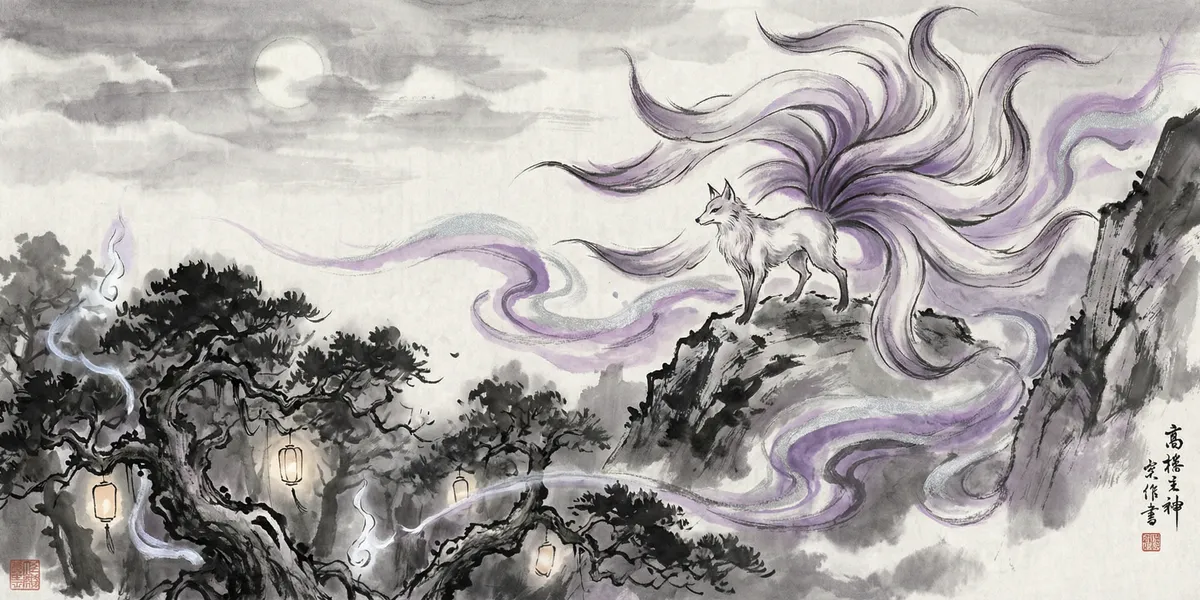
If there is one character in Chinese mythology that people simultaneously love and loathe, it has to be the Nine-Tailed Fox (jiuwei hu). This thousand-year-old fox spirit went from being an auspicious sacred beast in high antiquity to becoming the very byword for kingdom-toppling seductress — a reputation reversal more dramatic than any celebrity's public downfall.
The Nine-Tailed Fox first appears in the "Classic of Mountains and Seas" (Shanhai Jing): "On Mount Qingqiu, there is a beast shaped like a fox but with nine tails; its cry sounds like a baby; it can devour humans, but those who eat its flesh will be protected from evil and poison." Note that last part — "those who eat its flesh will be protected" — eating it was actually a form of protection! During the pre-Qin era and the two Han dynasties, the Nine-Tailed Fox was an entirely positive figure. It was an auspicious omen (xiangrui), heralding the coming of a golden age. Legend has it that when the Great Yu (Da Yu) was taming the floods and passed by Mount Tushan, a nine-tailed white fox appeared before him. Yu took this as heaven's will, married the Lady of Tushan (Tushan Shi), and their descendants founded the Xia Dynasty. So you see, the Nine-Tailed Fox originally played celestial matchmaker for dynastic founders.
So how did it turn villainous? The key figure is Daji (Daji). In the narrative of "Investiture of the Gods" (Fengshen Yanyi), the goddess Nuwa (Nuwa) saw that King Zhou of Shang (Shang Zhouwang) had inscribed a blasphemous poem in her temple. Enraged, she dispatched the Nine-Tailed Fox to bewitch King Zhou and hasten the fall of the Shang Dynasty. The fox possessed the body of the beautiful Daji, and from there began a reign of unspeakable tyranny. At Daji's urging, King Zhou built the Wine Pool and Meat Forest (jiuchi roulin) and invented the Paoluo Punishment (paoluo zhi xing) — a bronze pillar slathered in oil and placed over burning coals, forcing prisoners to walk across it until they slipped and were burned alive. The loyal minister Bigan (Bi Gan) was cut open to see if he truly had the legendary "seven-aperture exquisite heart." The son of the Earl of the West, Ji Chang (Ji Chang), was made into meat pies and his father forced to eat them. These horrifying tales permanently welded the words "Nine-Tailed Fox" to the concept of "hongyan huoshui" — a beautiful woman who brings calamity to nations.
But if you think the Nine-Tailed Fox is merely a villain's tool, you are underestimating this thousand-year-old fox spirit. In the Qing Dynasty writer Pu Songling's (Pu Songling) "Strange Tales from a Chinese Studio" (Liaozhai Zhiyi), the fox spirit's image underwent a subtle but profound transformation. The fox maidens in this book include kind and devoted lovers, chivalrous heroines, and some who understand loyalty and righteousness even better than the scholars beside them. The laughing fox girl in "Yingning" is the picture of innocent joy; the fox maiden in "Xin Siniang" sacrifices herself to save her husband. These stories upend the stereotype that fox spirits must inevitably bring harm, revealing the depth of feeling and tenderness possible between demon and human.
Looking at it from a cultural foundation, the system of fox cultivation is remarkably complete. An ordinary fox, after a hundred years of spiritual cultivation (xiulian), can take human form; after five hundred years, it can understand human affairs; after a thousand years, it becomes a Nine-Tailed Celestial Fox with powers that reach the heavens. Each tail represents a century of accumulated practice; nine tails mean cultivation is complete. In Daoist (Daojia) thought, the fox's path of cultivation mirrors the human quest for enlightenment and immortality — both require long periods of discipline, perseverance, and awakening. But ironically, no matter how long the cultivation or how great the power, the fox in orthodox narratives is forever classified as "yao" (demon), never accepted by the mainstream. This tragic undertone — having striven for a thousand years and still being discriminated against — is the most emotionally resonant core of the Nine-Tailed Fox story.
The term "huli jing" (fox spirit) remains very much alive in everyday Chinese, used to describe women who seduce others with their beauty. While the term carries obvious gender bias, it also reflects how deeply the Nine-Tailed Fox is engraved in cultural memory — an eternal symbol of the intertwining of beauty, intelligence, and danger.
East vs West
The Nine-Tailed Fox's most direct cross-cultural counterpart is the Japanese Kyubi no Kitsune. Japanese fox culture derives directly from China, but during its transmission developed a broader moral spectrum — Japanese foxes can be benevolent servants of the god Inari or mischievous wild foxes. The Chinese Nine-Tailed Fox, after the Tang Dynasty, was almost universally portrayed as a dangerous enchantress. In Western mythology, the closest equivalent to the Nine-Tailed Fox is the Siren of Greek mythology — both use irresistible charm to lead people to their doom. But the Siren's seduction is through song, essentially a sensory-level enchantment; the Nine-Tailed Fox's seduction is all-encompassing — beauty, intelligence, and emotional manipulation combined in a far more complex psychological game. The more important distinction is that Sirens are purely monstrous from start to finish, with no space for sympathy; the Nine-Tailed Fox underwent a complete transformation from sacred to demonic, and in "Strange Tales" even displays genuine love and sacrifice. This complexity — being both a femme fatale and a devoted lover — makes the Nine-Tailed Fox a far more three-dimensional cultural symbol than any Western enchantress.
Modern Influence
The Nine-Tailed Fox is one of the hottest mythological archetypes in contemporary Chinese pop culture. The xianxia drama "Eternal Love" ("Three Lives Three Worlds, Ten Miles of Peach Blossoms") features the fox clan as its central setting and became a sensation across Asia. Fox-themed characters in mobile games like "Honor of Kings" and "Genshin Impact" consistently dominate popularity polls. Among younger generations, the term "huli jing" is gradually being destigmatized, sometimes even carrying a playful connotation of being "beautiful and clever." The idiom "hu jia hu wei" (a fox borrowing the tiger's might) remains a commonly used expression for describing those who bully others by borrowing someone else's authority. In tattoo art, guochao fashion, and illustration, the Nine-Tailed Fox is among the most popular Chinese mythological motifs. Korean dramas like "My Girlfriend Is a Gumiho" further demonstrate that this myth originating from China has become shared cultural heritage across the entire East Asian cultural sphere.
Related Characters
 Fenghuang (Chinese Phoenix)Back to CompendiumTaotie
