
Nuwa
Nüwa
The Holy Mother Who Sculpted Humanity from Clay
Domain
The earth and all living beings; the origin of humanity
Role
Sculpted humans from clay, smelted stones to mend the heavens
Weapon
Five-Colored Stones — divine stones smelted to patch the sky
Appearance
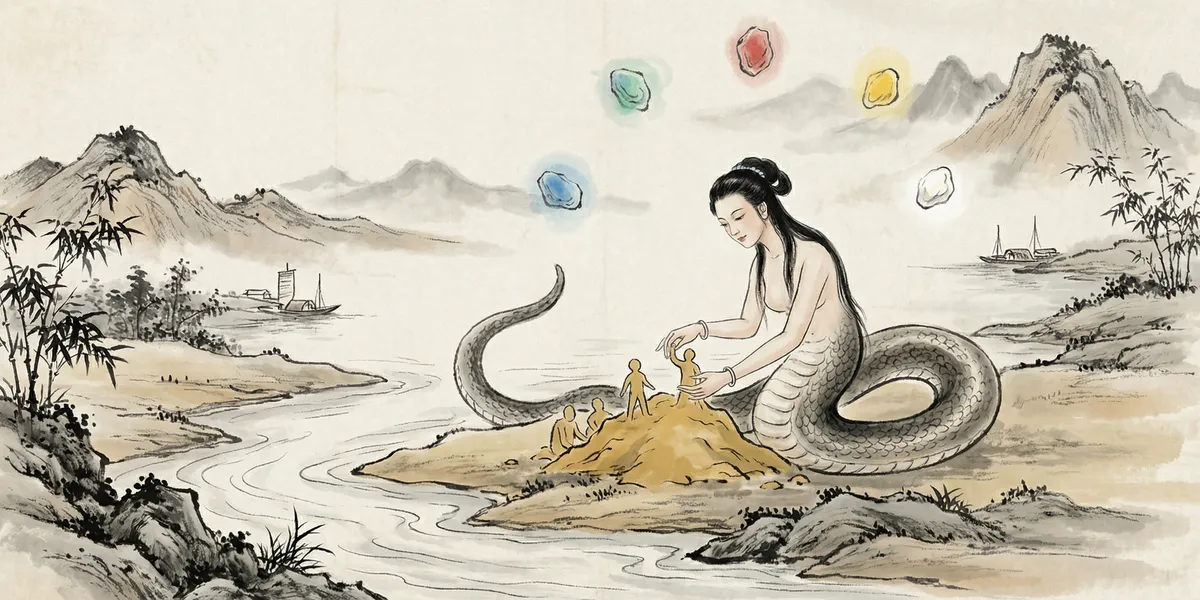
Human head on a serpent's body, a gentle face wreathed in radiant five-colored light
Legend
After Pangu transformed his body into the heavens and the earth, the world was beautiful — but desperately lonely. The mountains were magnificent, the rivers flowed with grace, the wind whistled through canyons with haunting echoes — but there was no audience. The world was like a meticulously curated art gallery with nobody inside: beautiful, but pointless.
Then Nüwa arrived.
Ancient texts are remarkably consistent about her appearance: a human head on a serpent's body (rén shǒu shé shēn) — a dignified woman from the waist up, with a sinuous snake tail below. Think of an elegant mermaid, except swap the fish tail for a serpent's body. The "Shanhai Jing" (Classic of Mountains and Seas) describes her as "human-faced, serpent-bodied." In later artistic depictions, she is often surrounded by radiant five-colored light, her expression both gentle and awe-inspiring.
Nüwa wandered alone through this beautiful but empty world, gazing at mountains, rivers, birds, and beasts, always feeling that something was missing. Animals were charming enough, but they couldn't think, couldn't speak, couldn't tell stories, couldn't marvel at the beauty of a flower. She decided the world needed beings capable of experiencing beauty and creating it.
So she walked to the banks of the Yellow River (Huáng Hé), crouched down, scooped up a handful of yellow clay, and began to sculpt. She carefully shaped two legs, two arms, a head, a face — then gently blew a breath of air onto the little clay figure. The figure blinked, looked around, and smiled. The world's first human being was born. The "Fengsu Tongyi" (Comprehensive Meaning of Customs) records: "It is commonly said that when heaven and earth first opened and there were no people, Nüwa kneaded yellow earth to make humans."
Nüwa was delighted. She sculpted another, then another, each one meticulously crafted and unique. But a problem arose — handcrafting was painfully slow. Even at goddess-level speed, shaping them one by one, how many eons would it take to populate this vast earth?
So Nüwa devised a clever shortcut: she picked up a length of rope, dipped it in mud, and flung it through the air. Every droplet that hit the ground became a person. But these "flung" humans weren't quite as refined as the hand-sculpted ones. The ancient explanation is delightfully candid: the hand-sculpted ones became nobles (guìzú); the rope-flung ones became commoners (píngmín).
Was this story endorsing social hierarchy, or was it slyly mocking aristocratic pretension? "You think you're so special? You're just a slightly better-shaped mud doll." Scholars have debated this for thousands of years without reaching a verdict — but it's precisely this ambiguity that gives the story its charm.
Yet Nüwa's greatest feat wasn't creating humanity — it was saving it.
The sky collapsed. Not metaphorically. Literally. The pillars supporting the heavens shattered, ripping open enormous gashes in the sky. Water poured down from above in torrents; fires raged across the land; savage beasts ran wild; humanity faced total annihilation. The "Huainanzi" (Discourses on the Overview of Darkness) records the catastrophe in vivid detail: "The four corners of the sky collapsed, the nine provinces of the earth split open; heaven could not cover all, earth could not carry all; fire blazed without ceasing, water flooded without stopping."
Nüwa didn't hesitate. She gathered five colors of stone — the Five-Colored Stones (wǔcǎi shí) — and smelted them in a great furnace, then patched the torn sky piece by piece with the molten stone. This is "Nüwa mends the heavens" (Nǚwā bǔ tiān), one of the most spectacular images in all of Chinese mythology.
But her work didn't stop there: she slew a giant tortoise and used its four legs to re-erect the pillars of heaven; she killed a rampaging black dragon that had been terrorizing humanity; she dammed the floods with ash from burned reeds. She wasn't just patching a hole — she was restoring the structural integrity of the entire universe.
What makes Nüwa truly great isn't the magnitude of her power, but the motivation behind it all. She created humans because she was lonely, because she craved companionship; she saved them because she loved them, because she couldn't bear to lose them. In Chinese culture, Nüwa represents maternal love (mǔ'ài) on the grandest possible scale. She's not the kind of creator who builds a world and walks away without looking back — she creates, nurtures, and protects, standing forever alongside her children.
East vs West
East · Nuwa
Western counterpart: prometheus
The closest Western counterpart to Nüwa is Prometheus — both fashioned humanity from clay and both cared deeply for their creations. But the differences are striking. Prometheus was chained to Mount Caucasus for stealing fire for humans: every day an eagle tore out his liver, and he endured eternal torment. Nüwa was never punished — in the Chinese mythological framework, creating and saving humanity is inherently righteous. There is no jealous supreme deity seeking to suppress human progress.
The more critical distinction lies in the completeness of the role. Prometheus is responsible only for "creation" — he shaped humans and gave them fire, but saving the world is not his job. Nüwa holds the dual role of creator and savior — she made humanity, then when the sky cracked and the earth split, she personally patched the heavens. She is both the architect and the emergency repair crew. This reflects a distinctive quality of maternal deities in Chinese culture: they are not single-function entities but all-encompassing guardians — giving life, sustaining life, and defending life, all within a single role. By comparison, the maternal functions in Greek mythology are distributed across multiple goddesses (Gaia for the earth, Demeter for the harvest, Hera for marriage), while Nüwa embodies all of them at once.
Modern Influence
"Nüwa mends the heavens" is one of the most widely used allusions in the Chinese language, meaning to turn the tide through extraordinary effort and repair a desperate situation. In gaming, Nüwa is a classic character in titles like "Honor of Kings" and "Gods and Demons," and the Five-Colored Stones are the archetypal "heaven-mending divine stone" item in Chinese fantasy fiction. In film and television, virtually every production involving primordial mythology features Nüwa. The annual Third Day of the Third Lunar Month "Nüwa Temple Fair" remains a thriving tradition in Henan and Shanxi provinces, and is listed as a national intangible cultural heritage. In the contemporary context of rising female empowerment, Nüwa's image as the "Holy Mother of China" is frequently invoked in cultural campaigns around Women's Day and Mother's Day, symbolizing the unity of creative power and protective strength.
Related Characters
 PanguBack to CompendiumThe Jade Emperor
