
Pangu
Pangu
The World-Splitting Primordial Giant
Domain
The moment when primordial chaos first parted, before heaven and earth were separated
Role
Split heaven from earth, transformed his body into all things in creation
Weapon
Heaven-Opening Axe — the divine weapon that cleaved chaos and separated heaven from earth
Appearance
A towering giant with prominent horns, clad in animal skins, standing between heaven and earth
Legend
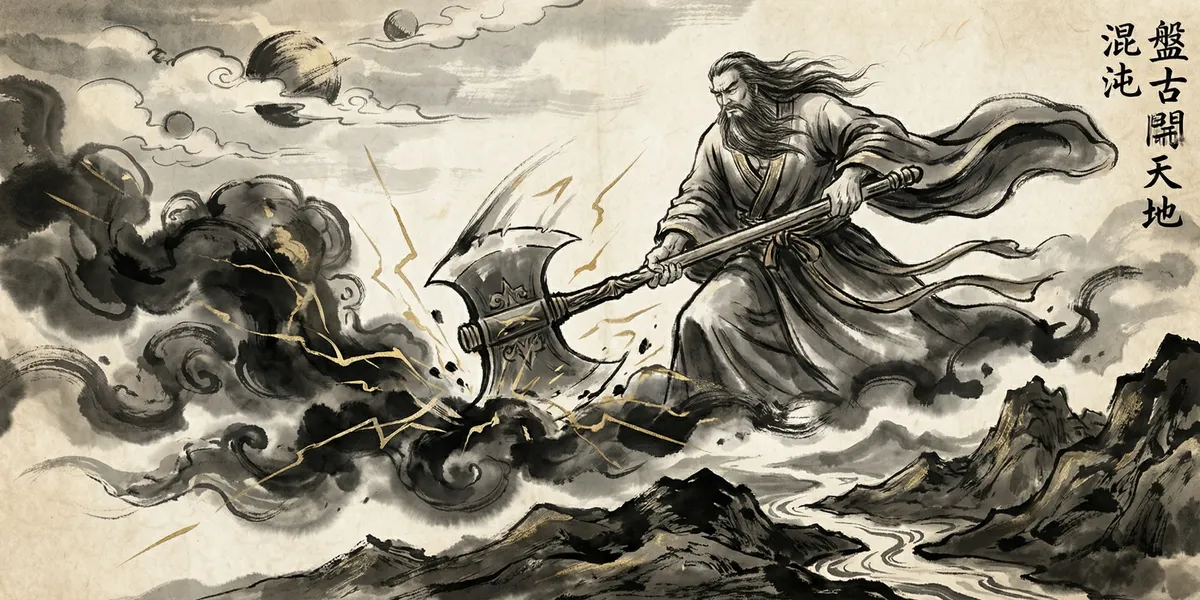
Before everything that ever was, there was no light, no sound, not even a concept of "before" — only a state of primordial Chaos (hundun). Imagine it as a colossal cosmic egg, all of existence compressed inside, with no way to tell up from down, left from right, or you from me. And at the very center of this egg, a giant had been sleeping for exactly eighteen thousand years. His name was Pangu.
As for why Pangu woke up, the ancient texts don't say for certain. Maybe he'd slept enough. Maybe he had a nightmare. Maybe he simply felt too cramped. In any case, one day Pangu opened his eyes and found himself trapped in an endless, boundless darkness — he couldn't see anything, couldn't feel anything, and even breathing felt like drinking a bowl of thick paste. The sensation was probably worse than being squeezed flat in a Beijing subway during morning rush hour.
So Pangu made a perfectly reasonable decision: he grabbed a massive axe (ju fu) that had appeared from who-knows-where and swung it with all his might.
That one swing shattered everything. Chaos was split in two: the light, clear matter floated upward and became the sky (tian); the heavy, murky matter sank downward and became the earth (di). This is the origin of "kai tian pi di" — the opening of heaven and earth. For the first time, the universe had a distinction between "up" and "down," a boundary between light and dark. The earliest written account comes from Xu Zheng's "Sanwu Liji" during the Three Kingdoms period: "Heaven and earth were in chaos like a chicken's egg. Pangu was born within. After eighteen thousand years, heaven and earth opened — the clear yang became heaven, the murky yin became earth."
But there was a problem. The newly separated heaven and earth were like two magnets, desperately trying to snap back together. Pangu had no choice but to stand between them, his feet on the earth and his hands holding up the sky, using his own body to keep them apart. He stood like this for another eighteen thousand years. Every day, the sky rose one zhang (about 3.3 meters) higher, the earth grew one zhang thicker, and Pangu's body grew one zhang taller. Do the math: eighteen thousand years times three hundred sixty-five days — Pangu ultimately grew to ninety thousand li tall.
Picture this: a giant at the center of the universe, completely alone — no companions, no rest, no weekends, no food delivery — just standing there holding everything apart for eighteen thousand years. This kind of dedication puts any modern overworked employee to shame.
When the sky was high enough and the earth thick enough that they would never close together again, Pangu's mission was complete. And then — he collapsed.
But Pangu's death is the most magnificent chapter in Chinese mythology. He didn't vanish — he became everything in the world. The "Wuyun Linian Ji" records: his left eye became the sun (taiyang), his right eye became the moon (yueliang); his exhaled breath became wind and clouds; his voice became thunder; his flowing blood became rivers and seas; his veins became roads; his muscles became farmland; his hair and beard became the stars across the sky; his skin and body hair became grass and trees; his teeth and bones became metals and minerals; even his sweat became rain and dew.
Yes, the ancients even said the parasites on his body became humans — not the most elegant detail, but that's how straightforwardly the ancients told their stories.
Pangu's story tells us something profound about the Chinese concept of creation: the world was not "commanded" into existence but "sacrificed" (fengxian) into being. There was no deity on high who simply said "let there be light" and called it a day. Instead, a giant exhausted every last ounce of his life, offering every inch of his body to this world. Every mountain you see, every river you cross, every breeze that touches your face — according to this myth — is Pangu.
This is one of the first myths Chinese children hear, and it shaped a deeply rooted cultural idea: great creation comes from total sacrifice. The birth of the universe happened not because of the exercise of power, but because of one life's unreserved giving.
East vs West
East · Pangu
Western counterpart: atlas
The most direct Western counterpart to Pangu is Atlas from Greek mythology — both are giants who physically hold up the heavens with their bodies. But their motivations are completely different. Atlas carries the sky as punishment: after the Titans lost their war against the Olympians, Zeus sentenced him to bear the heavens forever — it is a curse. Pangu's support of the sky was a voluntary choice. No one forced him, no one judged him. He saw chaos, decided to bring order, and used his own body to complete the task. Atlas is "enduring"; Pangu is "giving."
The deeper difference lies in the creation model itself. In the Book of Genesis, God creates through speech — "Let there be light, and there was light" — with a clear subject-object relationship between creator and creation, the creator remaining forever transcendent above the world. In the Pangu myth, the creator ultimately merges into the world itself; all things in heaven and earth are literally his body. This reflects the core Chinese philosophical concept of "tianren heyi" — the unity of heaven and humanity: the creator and the created world are not opposed but are one and the same. Western creation emphasizes "power" and "command"; Chinese creation emphasizes "fusion" and "sacrifice." This difference profoundly shaped how the two civilizations understand the relationships among the universe, nature, and humanity.
Modern Influence
"Pangu kai tiandi" (Pangu opens heaven and earth) is one of the most widely known idioms in Chinese, used to describe any pioneering, unprecedented achievement. In gaming, Pangu is a popular character in Honor of Kings ("Wang Zhe Rongyao"), and his giant axe — the Heaven-Opening Axe (kaitian fu) — is a classic divine weapon archetype in Chinese fantasy novels and games, referenced in virtually every cultivation novel. Pangu's creation myth is a mandatory selection in primary and middle school Chinese textbooks, serving as most Chinese people's first encounter with mythology. In popular culture, the phrase "kai tian pi di" frequently appears at tech product launches, business promotions, and sports commentary, evolving from a mythological allusion into a universal cultural symbol representing breakthrough and creation from zero to one.
Related Characters
 Niulang and ZhinvBack to CompendiumNuwa
