
Niulang and Zhinv
Niu Lang Zhi Nu, The Cowherd and the Weaver Girl
The Eternal Love That Meets Once a Year Across the Milky Way
Domain
Love and weaving
Role
Eternal lovers on opposite banks of the celestial river
Weapon
None
Appearance
The Cowherd is a humble man carrying a shoulder pole; the Weaver Girl is a celestial beauty holding a shuttle
Legend
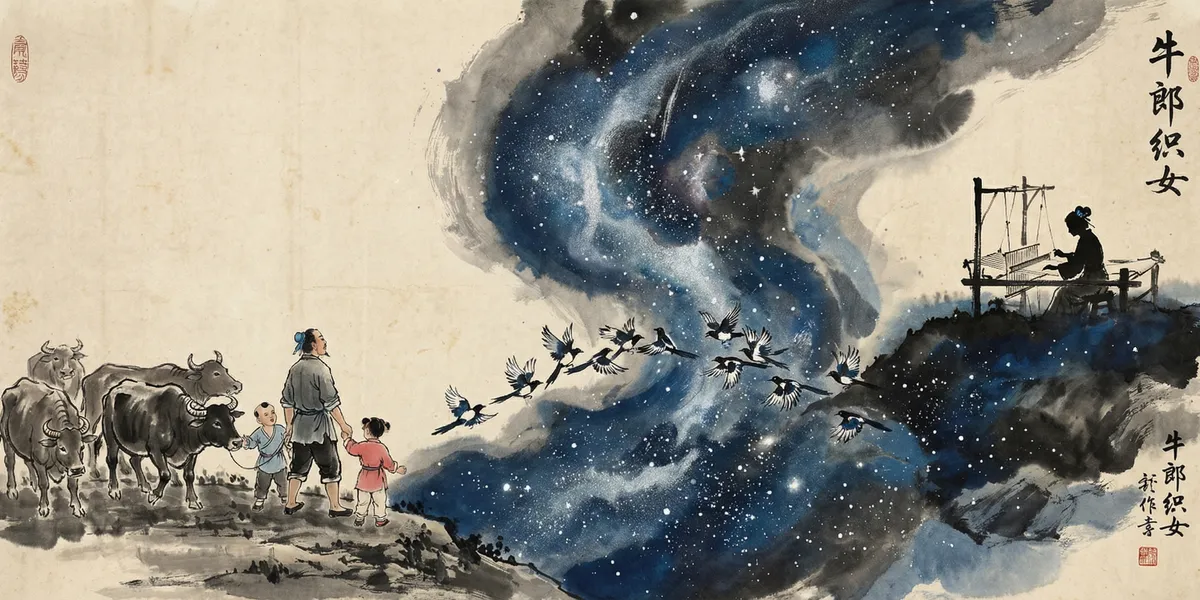
The tale of the Cowherd and the Weaver Girl (Niú Láng Zhī Nǚ) is one of the oldest love legends in China and the origin story of the Qixi Festival (Qī Xī Jié) — Chinese Valentine's Day. Two stars gaze at each other from opposite sides of the Milky Way, allowed to meet only once a year on a bridge of magpies. This is a romance on an astronomical scale — literally an "interstellar long-distance relationship."
The story begins with the Cowherd. His real name has been lost to time — everyone just calls him Niulang (Niú Láng, "the boy who herds cows"), because that's exactly what he was. His background was miserable: orphaned young, he lived with his older brother and sister-in-law. They treated him cruelly and eventually kicked him out of the house, giving him nothing but an old ox and a broken cart. If Chinese mythology had a "Cinderella" competition, Niulang would be the male champion.
But this ox was no ordinary cow. It was originally the Golden Bull Star (Jīn Niú Xīng) from heaven, banished to the mortal world for violating celestial regulations. This ox could talk, and possessed wisdom far beyond bovine comprehension. One day, the ox spoke up and told Niulang something that would change his destiny: "Tomorrow evening, celestial maidens will descend to bathe in the Milky Way. Go and hide the pink silk robe — the maiden who wears it will stay and become your wife."
By modern standards, this advice is admittedly a bit problematic, but within the ancient narrative framework it was seen as destiny's arrangement. Niulang did as told. Seven celestial maidens floated down to the banks of the celestial river, removed their heavenly garments, and waded in to play. Niulang secretly took the pink robe.
When the maidens finished bathing and dressed to fly home, one alone couldn't find her garment — this was the Weaver Girl (Zhī Nǚ), granddaughter of the Queen Mother of the West (Wáng Mǔ Niáng Niáng), the most skilled weaving goddess in all of heaven. Without her celestial robe, she couldn't fly back.
Niulang stepped out. And here the story takes a beautiful turn: the Weaver Girl wasn't frightened or angry. She was moved by Niulang's honesty and kindness. They began to talk and found their hearts perfectly matched. One was the loneliest weaver in heaven (weaving all day, every day, without so much as a holiday), the other was the loneliest herder on earth (abandoned by his own family, with no one to turn to). Two lonely souls found each other on the banks of the celestial river.
They married. Life was simple but filled with happiness. Niulang farmed, Zhinv wove, and they had two adorable children, a boy and a girl. This was perhaps the warmest part of the entire story — the simple joys of mortal life, the mundane details of rice and firewood, a loving couple and children underfoot. Zhinv gave up the silks and jade of heaven, content to live an ordinary life on earth.
But heaven does have an HR department. Zhinv's unauthorized descent, her marriage to a mortal, her years of absence from her cosmic loom — all of this eventually reached the ears of the Queen Mother. She was furious. In her view, this wasn't just a family matter; it was a serious violation of celestial order. A heavenly maiden marrying a cowherd? The mismatch of status extended to the cosmic level.
The Queen Mother descended to the mortal world herself, seized Zhinv by the arm, and dragged her back toward heaven. Zhinv struggled and screamed, the two children on the ground wailed their hearts out. Niulang chased after them, but how can a mortal keep up with a goddess?
At the critical moment, the old ox spoke one last time. These were his final words: "I am dying. After I die, wear my hide on your back, and you will be able to fly into the sky and chase your wife." The ox said this and died. Niulang, through his tears, took the ox's hide and draped it over his shoulders, placed his two children in baskets on either end of a carrying pole — one on each side — and flew into the sky.
He caught up. He really did. Across the vast heavens, he spotted Zhinv being dragged away by the Queen Mother. They drew closer and closer, reaching out, about to touch hands—
At that most agonizing moment, the Queen Mother pulled the golden hairpin (jīn zān) from her head and slashed it across the sky. A flash of silver light, and from nothing a vast, churning river appeared between heaven and earth — this is the Milky Way (Yín Hé), the very river of stars we see in the night sky. Niulang and Zhinv were separated forever on opposite banks.
Niulang on this side, Zhinv on that side. The children cried in their baskets, Zhinv wept across the river, Niulang wept too. The family's grief moved every living being between heaven and earth. The first to act were the magpies (xǐ què) — every magpie in the world flies to the Milky Way on the seventh day of the seventh lunar month and forms a bridge with their bodies — the Magpie Bridge (què qiáo). On this one day, Niulang and Zhinv cross the bridge and reunite. Just one day. Then the bridge dissolves, the magpies scatter, and the couple separates once more, to wait another three hundred sixty-five days.
According to the *Book of Songs* (Shijing): "There is the Milky Way in heaven, reflecting its light below. The Weaver Star tilts this way, working her shuttle seven times a day." This is the earliest literary reference to the Weaver Star, dating back more than 2,700 years. And indeed, Altair (the Cowherd Star) and Vega (the Weaver Star) sit on opposite sides of the Milky Way, roughly 16 light-years apart. The universe uses the most literal distance to illustrate what it means to be "so close yet worlds apart."
Every year on the seventh of the seventh month, the Chinese celebrate Qixi. If it rains on that day, people say those are tears of joy shed by the reunited couple; if the sky is clear, they look up and search for the two brightest stars on either side of the Milky Way. Young women traditionally thread needles by moonlight on this night, praying for hands as skillful as the Weaver Girl's — this is the custom of "praying for skill" (qǐ qiǎo).
The Cowherd and Weaver Girl story has endured for millennia because it speaks to the heart of everyone who has ever loved across distance: people who love each other may not always be together, but as long as each holds the other in their heart, one meeting a year is better than being together but strangers.
East vs West
East · Niulang and Zhinv
Western counterpart: Romeo & Juliet
The most direct Western comparison for Niulang and Zhinv is Shakespeare's Romeo and Juliet — both are lovers torn apart by external forces, both face fierce opposition from "parental" authority. But the endings diverge dramatically: Romeo and Juliet choose mutual suicide, achieving eternal togetherness through death; Niulang and Zhinv choose to live, maintaining their love through one annual meeting across an indefinite future. Western tragic aesthetics emphasize "better broken jade than intact tile" — death before dishonor; Chinese tragic aesthetics lean toward "endurance while holding onto hope."
Another fascinating parallel is the Greek myth of Orpheus and Eurydice. Orpheus descends to the underworld to rescue his wife but at the last moment looks back, losing her forever. Niulang also chases his wife into the sky and, at the very last instant, is cut off by the Milky Way. Both stories share that cruel twist of "almost succeeded." But Orpheus's failure is attributed to personal weakness (he couldn't resist looking back), while Niulang's failure is attributed to the crushing force of authority (the Queen Mother's golden hairpin). Greek tragedy interrogates human flaws; Chinese tragedy interrogates social order — the true villains tearing lovers apart are the gulf of class and the arbitrariness of power.
There is also a deeper cultural difference: in Western mythology, a mortal pursuing the love of a deity is usually seen as hubris (like Ixion pursuing Hera). In Chinese narrative, while love between mortals and immortals is forbidden, the story's sympathies always stand with the lovers, and the authority that enforces the prohibition becomes the target of criticism.
Modern Influence
The Qixi Festival is the most direct cultural legacy of the Cowherd and Weaver Girl story. In recent years, driven by commercial promotion, Qixi has developed into China's "Valentine's Day," with sales of flowers, chocolate, and gifts surging every year on this date. In 2006, Qixi was inscribed on China's first National Intangible Cultural Heritage list. In astronomy education, Altair and Vega are the first two stars Chinese children learn to identify, and "finding Niulang and Zhinv on opposite sides of the Milky Way" is practically a standard summer evening activity for Chinese families. In popular culture, the story has been adapted into countless films, stage productions, and songs, with the image of the "Magpie Bridge meeting" becoming a romantic symbol for overcoming obstacles and conquering adversity. It's worth noting that China's Tiangong space station also pays homage to this legendary tradition in its naming — and when Chinese astronauts cross the real Milky Way in space, the legend of Niulang and Zhinv has finally journeyed from myth to reality.
Related Characters
 Bai SuzhenBack to CompendiumPangu
