
Chang'e
Chang'e, The Moon Goddess
The Lonely Queen Who Flew to the Moon
Domain
The Moon
Role
Immortal Goddess of the Lunar Palace
Weapon
None
Appearance
An ethereal moon goddess of celestial grace
Legend
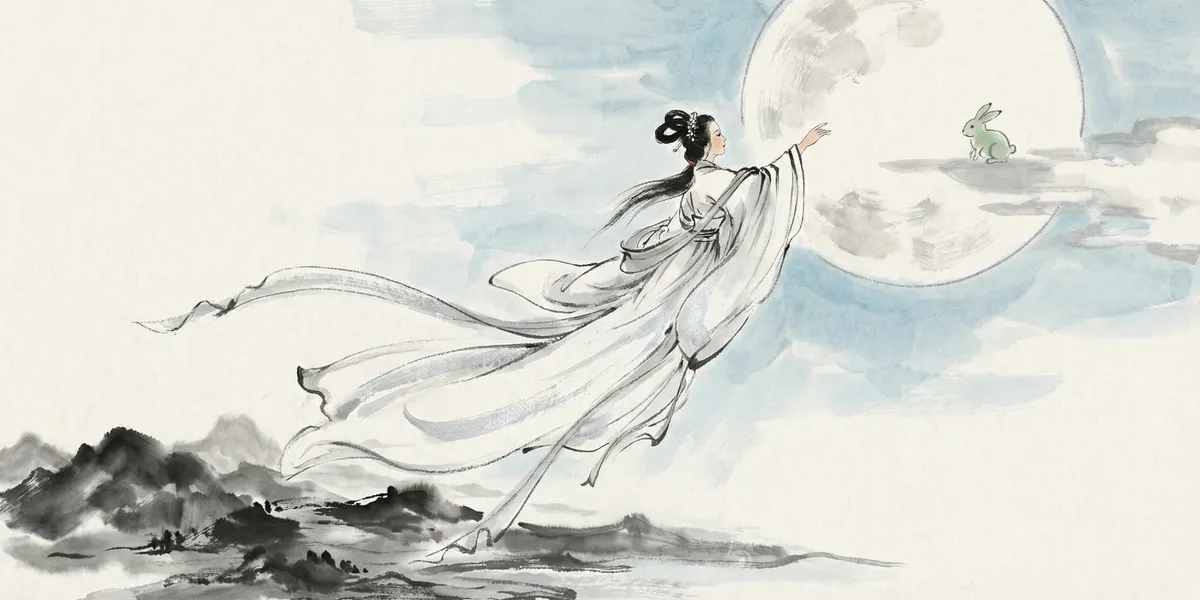
The story of Chang'e (Cháng'é) is probably the most frequently adapted legend in all of Chinese mythology. Every version is a bit different, much like every family's recipe for braised pork — but the core ingredients are always the same: one woman, one bottle of elixir, one moon, and a regret that spans heaven and earth.
First, the backstory. Chang'e was originally a celestial maiden, married to the famous divine archer Hou Yi (Hòu Yì). The couple lived in heaven, their days comfortable beyond measure — immortal, bathed in ethereal qi, occasionally attending the Queen Mother of the West's Peach Banquet (pántáo huì), posting selfies to the immortal social feed. Life was good.
Then Hou Yi went and did something big: he shot down nine of the Celestial Emperor's sun-sons. In the mortal world, this was a monumental feat of heroism; in heaven, it was basically a massacre. The Emperor was enraged and banished both Hou Yi and Chang'e to the mortal realm, stripping them of their immortal status. Going from eternally youthful deities to aging, ailing, mortal humans — that kind of downgrade hits harder than moving from a penthouse to a basement apartment.
Chang'e did not adjust well to mortal life. According to ancient texts, she had been the most beautiful celestial maiden in the Cold Moon Palace, accustomed to gentle breezes, bright moonlight, and jade terraces. Suddenly facing rice and firewood, mosquito bites, and the general inconveniences of human society, she was internally devastated. But she was Hou Yi's wife, so she gritted her teeth and endured.
Hou Yi knew his wife was suffering, and he desperately searched for a way back to immortality. He crossed mountains and survived near-death experiences, finally obtaining the elixir of immortality (bù sǐ yào) from the Queen Mother of the West (Xī Wáng Mǔ) on Mount Kunlun. The Queen Mother's exact words were reportedly: "If two share this potion, both will gain eternal life; if one takes it alone, that person will ascend to heaven as an immortal." Hou Yi brought the elixir home, carefully stored it away, and planned to pick a good day for them both to take it — eternal life, growing old together.
Here comes the critical twist. Hou Yi had a student named Peng Meng (Péng Méng) — a man of bad character and insatiable greed. He waited until Hou Yi was out hunting, then burst into their home, knife in hand, and demanded that Chang'e hand over the elixir. Facing this armed intruder, Chang'e made the decision that would change her life forever — she opened the box and swallowed every last drop.
The effect was immediate. Chang'e's body grew lighter. Not "cheerful" lighter — literally, physically weightless. She began to rise, first a few inches off the ground, then a few feet, then through the roof, through the clouds, higher and higher. According to the *Huainanzi*: "Yi requested the elixir of immortality from the Queen Mother of the West; Chang'e stole it and fled to the moon." Two key characters here: "stole" and "fled" — and those few words have fueled endless debate for millennia.
Did she "steal" it — meaning was she selfish, choosing her own beauty and immortality over her husband? Different eras have given radically different answers. Han Dynasty versions tend to portray her as selfish, betraying her husband for the sake of her own eternal youth. Post-Tang Dynasty versions gradually shift to sympathy, suggesting she was forced to swallow the elixir to prevent it from falling into evil hands. In modern times, many scholars and authors prefer to grant her agency — perhaps she was tired of the drudgery of mortal life, perhaps she felt suffocated in the marriage; flying to the moon was a choice she made for herself.
Chang'e ultimately landed on the moon. The Lunar Palace (yuè gōng) is beautiful, but also desperately lonely. Her only neighbors are a jade rabbit (yù tù) who pounds medicine day in and day out, and a woodcutter named Wu Gang (Wú Gāng) who was condemned to chop down a tree that eternally regrows. Three souls exiled by fate, living in the loneliest place in the universe, each repeating an endless routine.
Back on earth, Hou Yi came home to find his wife had become a silhouette on the face of the moon. Heartbroken beyond measure, he set out her favorite foods and flowers in the courtyard, burning incense and praying toward the moon. The villagers were so moved by his devotion that they began to imitate him. This, it is said, is the origin of the Mid-Autumn Festival (Zhōng Qiū Jié) — people gathering on the night of the full moon, eating mooncakes (yuè bǐng), admiring the moon, and commemorating this couple separated by heaven and earth.
Chang'e's story endures because it has no simple right or wrong. Is she victim or deserter? Devoted wife or selfish immortal? Every era reinterprets her according to its own values, while she remains silent in the Moon Palace, neither defending nor repenting. Perhaps that is the true nature of the moon — what you see in it depends on what's in your own heart.
East vs West
East · Chang'e
Western counterpart: Selene / Artemis
Chang'e is often compared to the Greek moon goddess Selene, but this comparison is somewhat superficial. Selene actively drives her moon chariot across the night sky — her identity is innate and self-determined. Chang'e, whether by force or by choice, arrived at the moon passively — the very act of "fleeing to the moon" carries a sense of haste and helplessness. She is not the moon's mistress; she is more like its prisoner.
A deeper comparison might be with Persephone. Both were torn from their original lives and placed in a lonely realm — Persephone in the underworld, Chang'e in the Lunar Palace. But Persephone at least gets to return to the surface for six months each year and reunite with her mother; Chang'e is exiled forever — no holidays, no family visits. This absolute nature of the separation is a hallmark of Chinese tragedy: it doesn't give you total despair. Instead, it lets you see what you've lost forever but can never reach — the moon hangs there every night, but you can never get to it.
This aesthetic of "visible yet unreachable" has its own term in Chinese culture: "gazing at the moon and longing for the distant." In Western mythology, separation usually results from divine punishment or a hero's mistake. Chinese narrative tends to frame separation as fate — it's not that anyone did something wrong; it's simply the will of heaven, beyond human power to reverse. This attitude toward destiny is deeply rooted in the Daoist philosophy of "following the natural way."
Modern Influence
Chang'e's most prominent presence in contemporary China is undoubtedly the Chinese lunar exploration program — the "Chang'e Project" (Cháng'é Gōngchéng). From Chang'e-1 through Chang'e-6, China named its lunar probes after this moon goddess, while the lunar rovers were named "Jade Rabbit." The naming is both a romantic cultural tribute and carries a subtle humor: we finally have the technology to go to the moon and check whether Chang'e is actually there. Every Mid-Autumn Festival, Chang'e's image appears on mooncake gift boxes, holiday advertisements, and all manner of cultural merchandise, making her the single most iconic visual symbol of the festival. In film and television, Chang'e is a regular fixture in mythology dramas, from the classic *Journey to the West* to modern xianxia web series, with her image reinterpreted across countless productions. In recent years, an increasing number of feminist perspectives have begun to re-examine Chang'e — liberating her from the frame of "abandoned wife" or "selfish runaway" and granting her narrative autonomy as an independent woman making her own choices.
Related Characters
 Hou YiBack to CompendiumJiang Ziya
