
Jiang Ziya
Jiang Zi Ya, The Prime Minister of the Gods
The Old Master Who Held the Whip and Determined the Fate of Heaven
Domain
The Investiture of the Gods
Role
Military strategist and commander of all the gods
Weapon
The God-Beating Whip
Appearance
A transcendent elder with flowing white beard, whip in hand
Legend
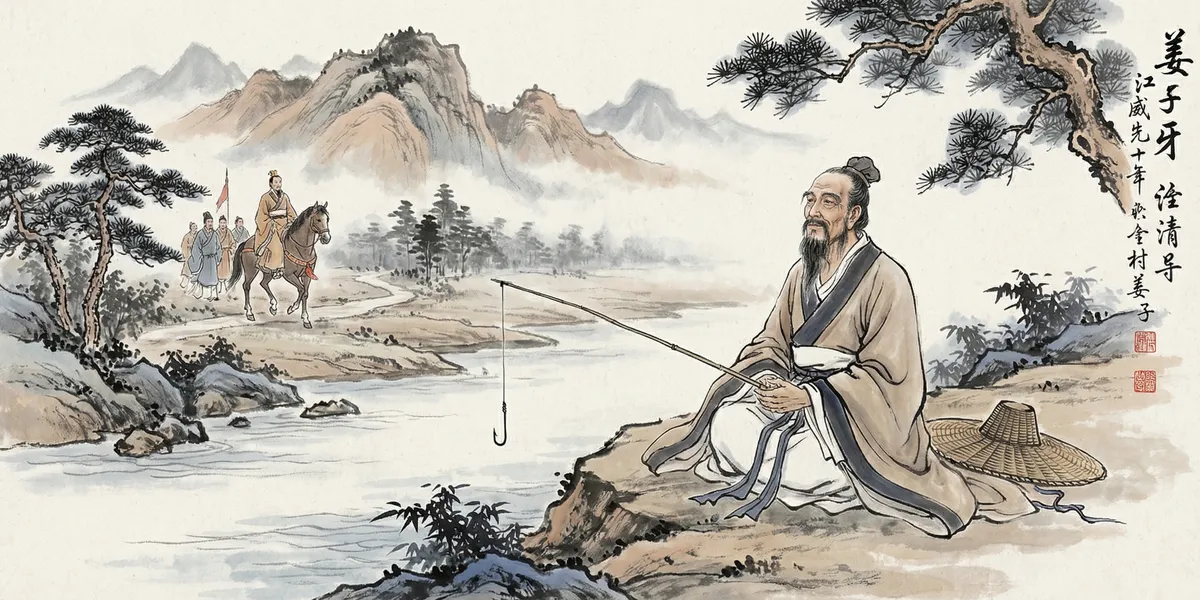
If Chinese mythology had a "Late Bloomer Hall of Fame," Jiang Ziya (Jiāng Zǐyá) would be the eternal number one. This gentleman's first seventy-two years of life can be summed up in four words: absolutely nothing accomplished. He lost money in business, couldn't sell meat as a butcher, made bamboo sieves that nobody would buy, and even his wife couldn't stand him and walked out. And yet, at seventy-two, this very same man flipped the switch, becoming the most legendary military strategist in Chinese history — and moonlighting as Heaven's "Director of Human Resources."
Jiang Ziya's given name was Jiang Shang, courtesy name Ziya, and his Daoist title was Flying Bear. He was of the Jiang clan and Lu lineage, which is why he's also called Lu Shang or Lu Wang. Later generations honored him as "Jiang Taigong" (Jiāng Tài Gōng). According to the *Records of the Grand Historian*: "He was widely learned and well-read, and once served the tyrant King Zhou" — meaning in his youth he actually worked for the infamous tyrant, but quickly left in disgust at the king's debauchery.
What followed was a long hibernation. Various ancient texts record his many failed ventures: he sold meat in Zhaoge (it went rancid before anyone bought it), opened a shop in Mengjin (went bankrupt), and eventually even his wife, Lady Ma, decided he was hopeless and walked out on him. Later, after Jiang Ziya successfully conducted the Investiture of the Gods, Lady Ma came crawling back wanting to reconcile. Jiang Ziya dumped a basin of water on the ground and said: "If you can put this water back in the basin, we'll get back together." This is the origin of the famous idiom "spilled water cannot be retrieved" (fu shui nan shou) — once it's over, it's over, especially when your ex-husband just got promoted to Celestial HR Director.
At seventy-two, Jiang Ziya did something everyone thought was insane: he went to the banks of the Wei River and started fishing with a straight hook. No bait, no curved hook, and the hook dangled three feet above the water's surface. Passersby thought he'd lost his mind and asked: "Old man, how do you expect to catch fish like that?" He replied breezily: "Those willing will bite." This line became one of the most famous sayings in Chinese: "Jiang Taigong goes fishing — the willing take the bait" (Jiāng Tài Gōng diào yú, yuàn zhě shàng gōu).
He wasn't fishing for fish. He was waiting for King Wen of Zhou, Ji Chang (Zhōu Wén Wáng). King Wen was searching for a worthy sage to help him overthrow the tyrannical Shang Dynasty. His own father — the "Taigong" (Grand Duke) — had once prophesied: "A sage will come to Zhou, and Zhou shall rise." When King Wen passed by the Wei River and saw this white-haired elder calmly fishing with a straight hook, they spoke at length, and the king was overjoyed, declaring: "My Grand Duke has longed for you!" — which is why Jiang Ziya is also called "Taigong Wang" (the one the Grand Duke awaited).
From that point, the seventy-two-year-old Jiang Ziya began the magnificent second act of his life. He first helped King Wen bide his time and build strength. After King Wen's death, he served King Wen's son, King Wu (Zhōu Wǔ Wáng), and launched the famous Battle of Muye (Mùyě Zhī Zhàn), overthrowing the corrupt and brutal Shang Dynasty in one decisive strike.
But in *Investiture of the Gods* (Fēng Shén Yǎn Yì), the Ming Dynasty mythological novel, the Shang-Zhou war gets upgraded into a cosmic-scale battle between gods and demons. Two great immortal factions — the Elucidation Sect and the Interception Sect — enter the fray. Immortals and demons pile in from every direction, divine weapons fly across the sky, magical formations stack upon formations — essentially the Chinese version of the Avengers' final showdown. And Jiang Ziya? He's the supreme commander of this entire divine war.
He wields the God-Beating Whip (dǎ shén biān), a divine weapon personally bestowed by the Primordial Heavenly Worthy, specifically designed to "discipline" unruly immortals and demons — imagine your boss giving you a whip to keep all the company's immortals in line. Nezha (Né Zhā), Yang Jian (Yáng Jiǎn), Lei Zhenzi, Huang Feihu, Tu Xingsun — a whole crew of temperamental superpowered beings, all under Jiang Ziya's command. The management difficulty of this job, translated to modern corporate terms, is roughly equivalent to simultaneously managing six unicorn startup founders.
After winning the war, Jiang Ziya received the most important mission ordained by heaven: the Investiture. Holding the Investiture Scroll (Fēng Shén Bǎng), he assigned 365 fallen warriors to divine positions in the heavenly bureaucracy according to their merits and deeds — Thunder God, Fire God, Plague God, God of Wealth, star deities, door gods — essentially the entire pantheon of Chinese folk religion was "arranged" by Jiang Ziya on that single day.
Here's the interesting part: Jiang Ziya assigned every position and left none for himself. When someone asked, "Taigong, what position did you appoint yourself to?" he just smiled and said he didn't need one. There's an even more entertaining folk legend: Jiang Ziya had originally planned to keep the Jade Emperor's throne for himself, but someone named "Zhang Youren" rushed in and sat down first. Regardless of the version, Jiang Ziya ultimately chose to exist outside the system — he invested every god in heaven but remained above the divine bureaucracy himself.
This choice is quintessentially Chinese. In a culture that prizes "establishment positions" and "rank," voluntarily giving up the highest seat is the truest mark of wisdom. As Laozi wrote: "By putting himself last, he ends up first; by putting himself outside, he preserves himself." Jiang Ziya's wisdom lies not in what he gained, but in what he gave up.
East vs West
East · Jiang Ziya
Western counterpart: Moses
Jiang Ziya is most often compared to Gandalf from *The Lord of the Rings* — both are white-haired elders who turn the tide at critical moments, guiding the side of righteousness to victory through wisdom rather than brute force. But Gandalf is fundamentally a mysterious wizard who operates on instinct and appears at will; Jiang Ziya is more like a wily CEO-cum-Chief-of-Staff who builds organizational structures, allocates human resources, devises grand strategy, and even handles the post-war "personnel arrangements" personally. When Gandalf can't handle something, he sends Aragorn. When Jiang Ziya can't handle something, he makes an Excel spreadsheet — well, the Investiture Scroll — and solves it systematically.
Another interesting comparison is with Merlin from Arthurian legend. Both are mysterious counselors who help kings build great kingdoms, but Merlin's story is steeped in fatalism and tragedy, while Jiang Ziya's story radiates the optimism of "everything is worth waiting for." Merlin ends up trapped in a crystal cave or a tree; Jiang Ziya lives out his days in peace, honored as the ancestral founder of the state of Qi. This reflects different cultural imaginations about the "sage's" destiny: Western sages often pay a price for their knowledge, while Chinese sages are more skilled at making a graceful exit once the job is done.
Modern Influence
"Jiang Taigong is here — all spirits, stand aside" — this phrase is still written on red paper slips and posted in Chinese homes and construction sites as a talisman to ward off evil. During the Lunar New Year, some regions hang portraits of Jiang Taigong for protection. In popular culture, the 2020 animated film *Jiang Ziya* introduced this ancient figure to young audiences as a character wrestling with philosophical existential crisis — reviews were mixed, but it successfully revived "Jiang Ziya" as a cultural IP. In *Honor of Kings* and other popular games, Jiang Ziya is a classic mage/support character. His famous saying "the willing take the bait" has thoroughly permeated everyday Chinese, becoming the standard expression for "patience in waiting for the right opportunity." On a deeper level, Jiang Ziya represents the Chinese cultural faith in "late success" — in an era of growing age anxiety, a man who didn't start his brilliant career until seventy-two is the best antidote to "35-year-old burnout."
Related Characters
 Chang'eBack to CompendiumMeng Jiangnv
