
Meng Jiangnv
Meng Jiang Nu, The Woman Who Cried Down the Great Wall
The Devoted Wife Whose Tears Toppled the Great Wall
Domain
Devoted fidelity
Role
The faithful wife who cried down the Great Wall
Weapon
None
Appearance
A grieving woman in plain white mourning garments
Legend
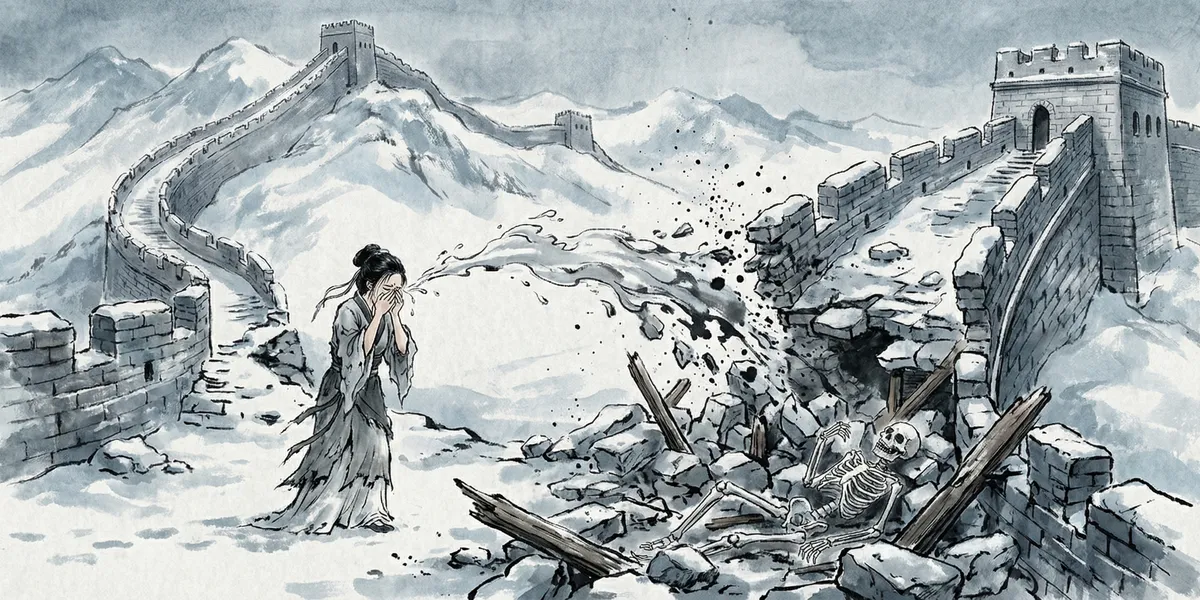
The story of Meng Jiangnv (Mèng Jiāng Nǚ) is one of the Four Great Chinese Folk Legends, and the most heartbreaking of them all. This is not a tale of gods battling or demons causing mischief — it is the story of an ordinary woman's desperate resistance against tyranny. Her tears brought down the Great Wall. Her story has been an indictment of injustice for over two thousand years.
Rewind to the Qin Dynasty (Qín Cháo). After Emperor Qin Shi Huang (Qín Shǐ Huáng) unified the six kingdoms, he decreed the construction of the Great Wall (Wàn Lǐ Cháng Chéng) to defend against the northern Xiongnu nomads. Behind this monumental engineering project lay the blood and tears of countless families: able-bodied young men from across the nation were conscripted by force and sent to the bitter northern frontier as laborers. No wages, no days off, no worker protections. When they died, they were buried on the spot, right inside the wall — this wasn't wall-building, it was wall-filling with human lives.
Meng Jiangnv's husband, Fan Xiliang (Fàn Xǐliáng), was one of the untold millions of young men dragged away. They had just been married — their honeymoon wasn't even over — when officials burst through the door and hauled Fan Xiliang away like cattle. It was perhaps the shortest period of marital happiness in all of Chinese literary history — some versions say three days, some say just one night.
Meng Jiangnv waited day and night for her husband's return, but no word ever came. Autumn arrived and left; winter came, the north winds howled. Thinking of her husband shivering in the bitter northern cold without winter clothing, she decided to sew padded garments herself and carry them a thousand miles to the construction site.
This "thousand-mile winter clothing delivery" was no figure of speech in ancient times. From the Jiangnan region to the northern Great Wall construction sites was genuinely a journey of thousands of li. No carriage to ride (she was a commoner, she couldn't afford one), no post stations to rest at (those were government facilities), and certainly no GPS navigation. Meng Jiangnv walked on her own two feet, a bundle of winter clothes on her back, step by step northward. She crossed the Qinling Mountains, forded the Yellow River, traversed the wilderness, and endured hunger and cold. When she encountered bandits she hid, when she encountered wild animals she ran, and when she met kind strangers she asked for directions.
They say she walked through an entire autumn and winter before finally reaching the foot of the Great Wall. Filled with hope, she asked the workers on the site: "Where is Fan Xiliang?" The answer struck her like a bolt from the blue — her husband had long since worked himself to death, and his bones had been packed into the wall itself. Not buried beside the wall, not interred near it — literally mortared INTO it. In that era, laborers died on the construction site in such numbers that nobody could be bothered with proper burials. The dead were simply used as "building materials," their bones sealed together with the bricks and stones to form the so-called Great Wall.
Meng Jiangnv collapsed in tears at the foot of the wall. This was no ordinary weeping — it was the explosion of more than a year's worth of longing, the exhaustion of a thousand-mile journey, and the absolute devastation of learning the truth, all pouring forth in soul-rending sobs. She cried for three days and three nights, her wailing shaking heaven and earth. Then the miracle happened — a massive section of the Great Wall came crashing down.
The earliest version of this story appears in *Zuo Zhuan* (Zuo's Commentary on the Spring and Autumn Annals), in the account of the wife of Qi Liang from the Spring and Autumn period, who wept at the city wall after her husband died in battle, and "the wall collapsed from her grief." Over the centuries, the story was reworked and merged with the historical backdrop of Qin Shi Huang's wall construction, eventually crystallizing into the version we know today — "Meng Jiangnv Cries Down the Great Wall."
When the wall collapsed, countless white bones were exposed in the rubble. Meng Jiangnv had to find her husband among thousands of skeletons — different versions offer different methods. The most widely told says she bit her finger and dripped her blood onto the bones; whichever skeleton absorbed her blood was Fan Xiliang. This detail is profoundly moving — even reduced to bare bones, a husband's body still recognizes his wife's blood.
News reached Qin Shi Huang. The First Emperor, far from feeling guilt, was instead taken by Meng Jiangnv's beauty and wanted to make her his concubine. Grief-stricken and furious, Meng Jiangnv set three conditions: first, hold a grand state funeral for Fan Xiliang; second, the Emperor himself must wear mourning garments for Fan Xiliang; third, build a platform overlooking the sea so she could have one last look at the ocean. Qin Shi Huang agreed to all three.
After the funeral was complete, Meng Jiangnv climbed the seaside platform, faced the ocean, and threw herself into the waves. Some versions say she cursed Qin Shi Huang's tyranny before she jumped; others say she simply walked quietly into the sea. Regardless of the version, the ending is the same: she chose death, chose to reunite with her husband on her own terms, rather than become the woman of the tyrant who killed him.
Meng Jiangnv's story has been sung for two thousand years because it strikes an eternal nerve: behind every grand narrative are individuals being crushed. The Great Wall is magnificent, but the people who built it suffered horribly. Between the glory of a nation and the agony of an individual, there is a chasm that can never be bridged. Meng Jiangnv's tears didn't just bring down a wall — they gave voice to the silent defiance of every ordinary person.
East vs West
East · Meng Jiangnv
Western counterpart: Penelope (devotion)
Meng Jiangnv's most resonant Western counterpart is not a specific mythological figure but an entire narrative tradition — the "counter-monument narrative." Western literature has a similar tradition, exemplified by the story of Antigone from Greek drama: a woman who defies a king's decree in order to bury her brother's body, ultimately paying with her own life. Meng Jiangnv and Antigone are strikingly similar — both are women, both face tyranny, both sacrifice their lives for the dignity of the dead.
But the difference lies in how that power is expressed. Antigone's resistance is rational and legalistic — she invokes divine law against human law, framing a philosophical debate about principles of justice. Meng Jiangnv's resistance is emotional and supernatural — her grief is so genuine and so intense that the physical world itself is moved to respond. In Chinese culture, the most authentic and pure emotion ("cheng") is believed to possess the power to move heaven and earth. This is the Confucian concept of "sympathetic resonance between heaven and humanity": extreme human emotion can trigger a corresponding response in the natural world. The West uses reason to challenge power; the East uses true feeling to shake the cosmos — two radically different yet equally moving aesthetics of resistance.
Modern Influence
The story of Meng Jiangnv Crying Down the Great Wall remains a core component of Chinese education, featured in various textbooks and cultural readers at the primary and secondary school level. Near Shanhaiguan, the Meng Jiangnv Temple (Mèng Jiāng Nǚ Miào) still stands, drawing large numbers of visitors each year and serving as a unique humanistic attraction along the Great Wall tourist route. In Chinese opera, Meng Jiangnv is a classic repertoire piece across multiple genres including Beijing opera, Yue opera, and Ping opera, with the "Crying at the Wall" act serving as a signature showcase for female lead performers. In recent years, her story has also been given new social relevance: in discussions about laborers' rights in large-scale infrastructure projects, her tale is frequently invoked as a reminder to pay attention to the sacrifices of ordinary workers behind "great national projects." Through a feminist lens, Meng Jiangnv is seen as a symbol of the weak standing against the strong — possessing no weapons, no magic, no political power, only tears, yet capable of shaking the most formidable ramparts of empire.
Related Characters
 Jiang ZiyaBack to CompendiumBai Suzhen
