
Bai Suzhen
Bai Su Zhen, The White Snake Immortal
A Thousand Years of Cultivation, All for One Umbrella at Broken Bridge
Domain
Medicine and love
Role
The White Snake Immortal
Weapon
None
Appearance
A breathtakingly beautiful woman in flowing white robes
Legend
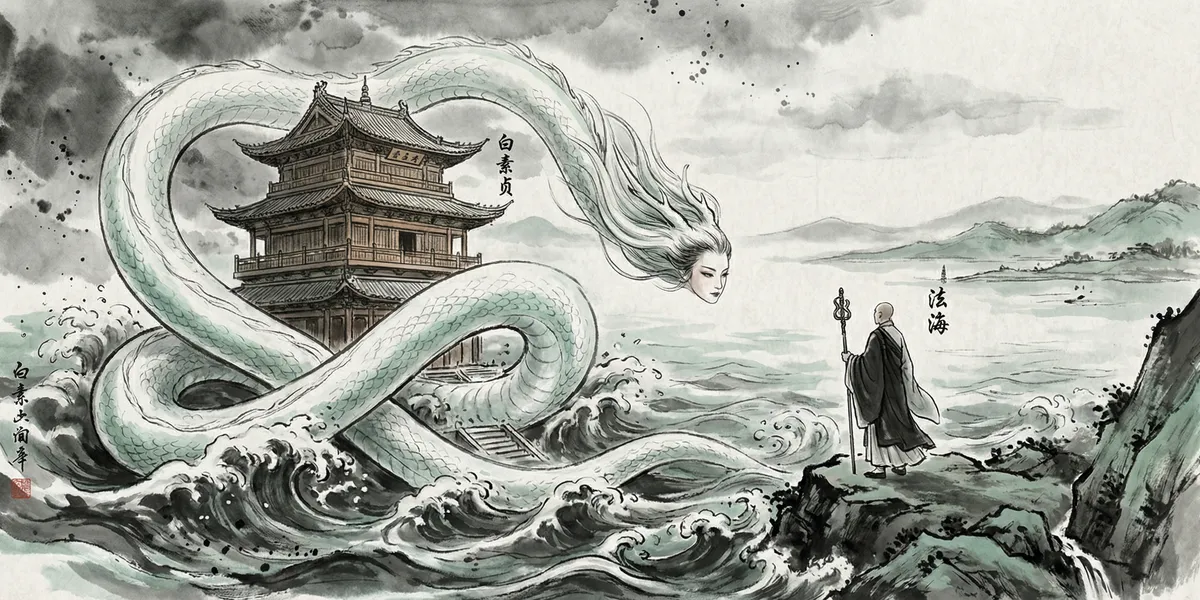
The story of Bai Suzhen (Bái Sù Zhēn) is the most romantic and most gut-wrenching love story in Chinese legend — bar none. A white snake who cultivated for a thousand years transforms into a woman of unearthly beauty, all to repay a single drop of life-saving water from a past life. Then she falls in love with the reincarnation of her savior, gets married, opens a pharmacy, and just when life seems perfect, a meddlesome monk ruins everything. This story is called *Legend of the White Snake* (Bái Shé Zhuàn), one of China's Four Great Folk Legends.
From the beginning. Long, long ago, on Mount Emei, there was a small white snake. One day, she was nearly beaten to death, but a passing boy saved her life. That boy was the previous incarnation of Xu Xian (Xǔ Xiān). In Chinese culture, repaying a debt of gratitude (bào ēn) is an extraordinarily serious matter — receive a drop of kindness, repay it with a gushing spring. The little white snake remembered this kindness, and then began a cultivation journey lasting a thousand years.
A thousand years — to put that in human perspective: the entire span from the Tang Dynasty to the present is less than fifteen hundred years. This snake started out as a little reptile, absorbing the essence of heaven and earth, gathering the spiritual energy of sun and moon, mastering Daoist arts, contemplating Buddhist teachings, surviving countless tribulations, until she finally achieved human form. She chose the name Bai Suzhen — "su" meaning pure and simple, "zhen" meaning faithful and constant. The name itself was her declaration of love.
In human form, Bai Suzhen brought along her best friend and handmaiden Xiao Qing (Xiǎo Qīng) — a green snake spirit who'd been cultivating for five hundred years — and traveled to Hangzhou's West Lake (Xī Hú). She was there to find the reincarnation of Xu Xian and repay her ancient debt.
Then comes what may be the most beautiful encounter scene in all of Chinese literature: the Broken Bridge over West Lake, a soft veil of rain. Bai Suzhen and Xu Xian meet by chance on the bridge. Rain begins to fall, and Xu Xian lends his umbrella to Bai Suzhen. One umbrella, one rainstorm, one bond of fate spanning a thousand years. This scene became the definitive image of "lending an umbrella" — in Chinese culture, it is practically synonymous with the beginning of love itself.
The two quickly fell in love and married. Bai Suzhen secretly used her powers to help Xu Xian, and together they opened a pharmacy in Zhenjiang called "Baohe Hall." Bai Suzhen was skilled in medicine (after all, a thousand years of cultivation gives you time to learn a few things), and Xu Xian managed the business. Trade was brisk, the couple was devoted, the neighbors were envious. If the story ended here, it would be a perfect "snake wins at life" fairy tale.
But then Fa Hai (Fǎ Hǎi) showed up.
Fa Hai was the abbot of Jinshan Temple (Jīn Shān Sì), a Buddhist monk of profound spiritual attainment. He possessed a pair of enlightened eyes that could see through demonic disguises. When he discovered Bai Suzhen's true form was a white snake, he declared her a "demon bewitching mortals" who had to be eliminated. Fa Hai's logic was simple: a demon is a demon, no matter how many centuries she's cultivated, how many good deeds she's done, or how much she loves her husband — between demons and humans there is an uncrossable boundary ordained by heaven.
Fa Hai found Xu Xian and instructed him to give Bai Suzhen realgar wine (xióng huáng jiǔ) on the Dragon Boat Festival (Duān Wǔ Jié). Realgar wine is kryptonite for snake spirits — drink it and your true form is revealed. Not wanting to dampen her husband's festive mood, Bai Suzhen reluctantly drank — and instantly reverted to a massive white snake coiled on the bed. Xu Xian saw a giant white snake where his wife should have been and was literally frightened to death. Yes, actually died of fright.
When Bai Suzhen came to and found her husband dead, she was devastated but made a desperate decision: pregnant as she was, she single-handedly broke into Mount Kunlun to steal the immortal lingzhi herb (líng zhī) to resurrect Xu Xian. She fought her way up the mountain, battling immortal attendants and celestial soldiers — while pregnant. This is probably the most hardcore expectant mother in all of Chinese mythology. She ultimately succeeded in stealing the herb and brought Xu Xian back to life.
But Fa Hai was relentless. He directly "invited" Xu Xian to Jinshan Temple and held him under a kind of religious house arrest, calling it "salvation" — which was really just kidnapping the woman's husband. Bai Suzhen went to get him back; Fa Hai refused. Pushed past her limit, Bai Suzhen unleashed her most powerful technique — Flooding Jinshan Temple (shuǐ màn jīn shān). She summoned the waters of rivers and lakes, sending a deluge crashing over Jinshan Temple, intent on washing away the temple and the monk together.
This battle is the most spectacular scene in *Legend of the White Snake*: behind Bai Suzhen, towering waves; in Fa Hai's hands, the golden light of Buddhist dharma. Water dragons versus Buddha-light, demon magic versus righteous dharma — the entire lower Yangtze trembled. But Bai Suzhen was months into her pregnancy, and her power was severely diminished. Fa Hai ultimately used a golden alms bowl to capture and imprison her beneath Leifeng Pagoda (Léi Fēng Tǎ) beside West Lake.
"When West Lake's waters run dry and Leifeng Pagoda falls, only then shall the White Snake be freed." That was Fa Hai's sentence. And so Bai Suzhen remained trapped beneath the pagoda, year after year. Xu Xian, heartbroken, eventually became a monk. Their son, Xu Shilin, grew up to become the top scholar in the imperial examinations, returned to Leifeng Pagoda, and knelt before his mother. His filial piety finally moved the heavens, and Bai Suzhen was released.
In a remarkable twist of history, the real Leifeng Pagoda actually collapsed in 1924. Lu Xun wrote his famous essay "On the Fall of Leifeng Pagoda," using the event to skewer the feudal morality that had oppressed women for centuries.
The eternal power of the White Snake legend lies in the question it poses — one that still has no standard answer: which matters more, rules or true love? Was Fa Hai wrong? From the perspective of Buddhist precepts, he was enforcing celestial law. Was Bai Suzhen wrong? She just wanted to love someone. Was Xu Xian wrong? He was just an ordinary man caught in a war between gods and demons. Nobody is purely evil, yet everybody suffers — and it is precisely this complexity that keeps the story eternally fresh.
East vs West
East · Bai Suzhen
Western counterpart: Medusa (serpent woman)
Bai Suzhen's most fitting Western counterpart is Melusine, the serpent-woman of medieval European legend. Both are serpentine females who marry human husbands, both face a crisis of "true form exposure," and both meet tragic ends. But the inner cores of the two stories are fundamentally different. Melusine's story is about "taboo" — the husband promises not to look at her on a certain day, breaks the promise, and the marriage shatters. The focus is on the violation of trust. Bai Suzhen's tragedy, on the other hand, is not caused by Xu Xian betraying her — it's caused by the forceful intervention of a third party. Xu Xian loves Bai Suzhen from start to finish, and Bai Suzhen is loyal to Xu Xian throughout. The force that destroys their marriage is an external authority claiming to "act on behalf of heaven."
This distinction is deeply meaningful. The Western "taboo-violation-punishment" narrative pattern (Pandora, Orpheus, Bluebeard, etc.) locates tragedy in human curiosity or weakness. The Chinese White Snake legend points its finger at institutions and authority — the real tragedy is not a flaw in the human heart, but rigid rules and "moral guardians" wielding power. This critical awareness gives *Legend of the White Snake* a social value that transcends any single era: in every age, there are people who tear apart those truly in love under the banner of "it's for your own good."
Modern Influence
The cultural influence of the White Snake legend ranks among the highest of all Chinese folk tales. The Broken Bridge, Leifeng Pagoda, and the former site of Baohe Hall on Hangzhou's West Lake have all become White Snake-themed tourist attractions, drawing millions of visitors annually. On the opera stage, *Legend of the White Snake* is a repertoire staple in virtually every major Chinese opera genre — Beijing opera, Yue opera, Sichuan opera — with the three acts "Meeting at Broken Bridge," "Stealing the Immortal Herb," and "Flooding Jinshan Temple" standing as classics among classics. In film and television, from the 1992 TV series *New Legend of Madame White Snake* starring Ye Tong and Angie Chiu to the 2019 animated film *White Snake: The Origin*, the story has been remade again and again, each version infused with the aesthetics and values of its time. In gaming, Bai Suzhen is a highly popular character in various xianxia games and *Honor of Kings*. The Dragon Boat Festival custom of drinking realgar wine persists in some regions, and whenever people mention the tradition, the White Snake story naturally comes to mind. On a deeper level, the White Snake legend has become the ultimate symbol in Chinese culture of "love that transcends prejudice" — whether it's race, class, or social convention, none of it should stand in the way of true love.
Related Characters
 Meng JiangnvBack to CompendiumNiulang and Zhinv
