
Guanyin
Guanyin, Goddess of Mercy
The Compassionate One Who Hears All Cries of Suffering
Domain
Mount Putuo's Purple Bamboo Grove on the South Sea, guiding all suffering beings to salvation
Role
Endlessly compassionate, hearing all cries of suffering, seeking all voices of distress
Weapon
Pure Water Vase and Willow Branch -- sweet dew sprinkled across three thousand worlds, the willow branch sweeps away the afflictions of all beings
Appearance
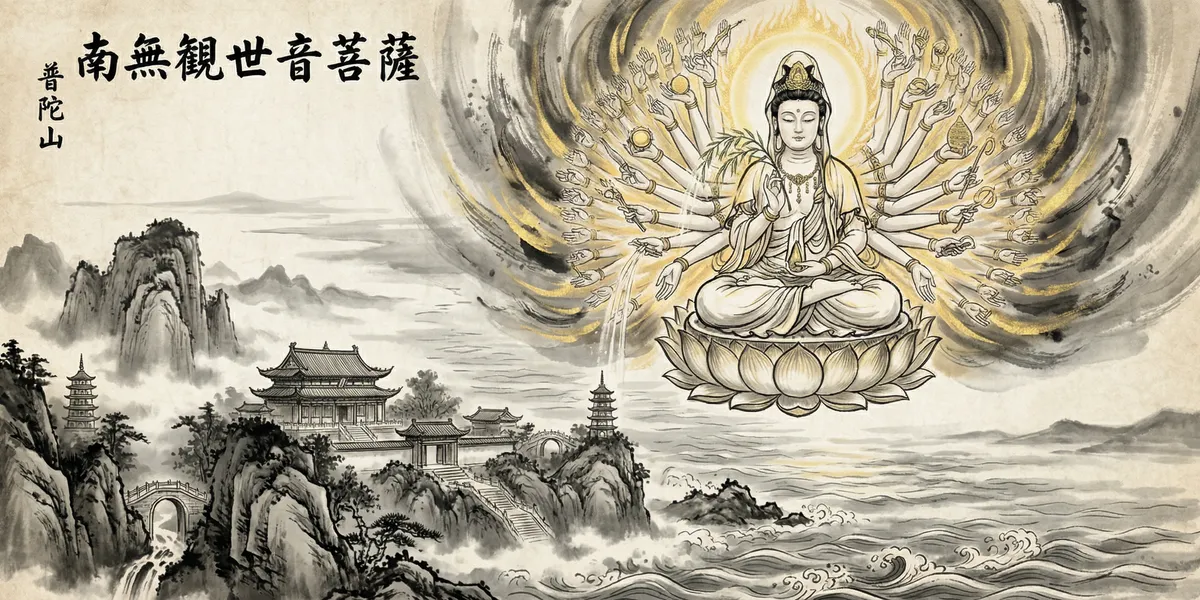
Draped in white robes, face like a full moon, gentle brows and compassionate eyes, holding a pure water vase and willow branch, or manifesting the thousand-armed thousand-eyed form, radiating boundless mercy within solemn grace
Legend
In China, there is one deity whose name is the first word that countless people utter in their most desperate moments -- Namo Guanshiyin Pusa (Nanmo Guanshiyin Pusa). She's not the most powerful god, not the highest-ranking buddha, but she is the most needed. From palaces to thatched huts, from deep-sea fishing boats to hospital delivery rooms, for over a thousand years, when Chinese people hit a wall they cannot get past, the first name they call is hers.
Guanshiyin, from the Sanskrit Avalokitesvara, means "the sovereign one who observes the sounds of the world." The name itself is a promise -- she listens to every cry of suffering, regardless of who you are or where you are; as long as you call out sincerely, she will come. The Tang Dynasty monk Xuanzang retranslated the name as "Guanzizai Pusa" (Bodhisattva Who Perceives Freely), the very figure who opens the Heart Sutra: "When Bodhisattva Guanzizai was practicing the profound Prajnaparamita..." But ordinary Chinese people prefer to call her simply "Guanyin" or "Guanyin Niangniang" -- in folk parlance, she's not a lofty bodhisattva but a loving mother.
Here lies one of the most fascinating transformations in cultural history. In the original Indian Buddhist scriptures, Avalokitesvara was male -- a handsome prince wearing a jeweled crown. The canonical Lotus Sutra's "Universal Gateway" chapter describes a male bodhisattva. But after Buddhism traveled the Silk Road into China, roughly from the Northern and Southern Dynasties through the Tang and Song periods, Avalokitesvara's image gradually shifted from male to female. Why? Because Chinese culture equated the four characters "great compassion and great mercy" with maternal love. In the emotional logic of the Chinese people, the force that unconditionally accepts everything and loves you without asking why finds its most natural vessel in a mother. And so Guanshiyin became the White-Robed Guanyin -- a female bodhisattva with a face like a full moon, holding a pure water vase and willow branch, with a gaze so tender it could make you weep. This is one of the most successful cases of Buddhism's sinicization (fojiao zhongguohua).
Guanyin's most awe-inspiring form is the Thousand-Armed, Thousand-Eyed Guanyin (Qianshou Qianyan Guanyin). Legend says Guanyin vowed to save all suffering beings, working ceaselessly day and night. But the suffering in the world was simply too vast -- two hands weren't enough, two eyes couldn't see it all. Her heart of compassion grew so heavy that her skull shattered from the strain. Amitabha Buddha (Amituo Fo) saw this and reassembled her shattered head into eleven faces, granting her a thousand arms, each with an eye in its palm. A thousand hands to rescue, a thousand eyes to watch -- she transformed herself into a never-stopping machine of mercy. This isn't a narrative about power; it's a narrative about what compassion looks like when pushed to its absolute limit.
In Journey to the West, Guanyin plays a pivotal role. It was she who suggested the scripture-seeking mission to the Buddha, she who selected the monk Tripitaka as the pilgrim, and she who intervened at critical moments throughout the eighty-one trials. The golden headband spell (jingu zhou) binding Sun Wukong's head was her gift; the taming of Red Boy and the subduing of the Black Bear Spirit were her handiwork. She's essentially the behind-the-scenes director of this grand spiritual journey -- but whenever she acts, it's always with a compassionate countenance, measured and understated, never flaunting her power. Wukong never respects the bureaucratic hierarchy of Heaven, but he maintains genuine reverence for Guanyin -- because she never wields authority over people; she wins them over with compassion.
Folk legends about Guanyin are beyond counting. Fishermen caught in storms at sea chant Guanyin's name, and the waves subside -- which is why nearly every fishing village along China's coastline has a Guanyin temple. Women in difficult labor pray to Guanyin for the safety of mother and child. Those wrongfully accused and at their wit's end will find Guanyin appearing disguised as an ordinary passerby to offer guidance -- hence the folk saying: "Amitabha in every home, Guanyin in every household," attesting to how deeply Guanyin worship has permeated every corner of society.
The Lotus Sutra's Universal Gateway chapter describes Guanyin's thirty-three manifestations (sanshisan zhong huashen): she can appear as a buddha, a heavenly king, a Brahma king, a layperson, a woman, a child -- changing form according to what each being needs for salvation. This principle of "appearing in whatever form will bring liberation" makes Guanyin a truly universal deity, transcending class, gender, and identity. You don't need wealth, you don't need education, you don't need to understand the sutras -- you just need to sincerely call out "Guanshiyin Pusa" in your heart. This zero-threshold compassion is the fundamental reason Guanyin worship has endured for millennia.
Mount Putuo (Putuo Shan) in Zhejiang Province is Guanyin's sacred abode -- one of China's Four Great Buddhist Mountains. On this sea-surrounded island, a bronze statue of the South Sea Guanyin stands thirty-three meters tall, facing the ocean as if watching over every passing vessel. Millions of devotees flock to this small island each year, burning incense and praying for peace. This scene is the perfect distillation of Guanyin worship: she stands at the water's edge, gazing upon the sea of suffering and all its beings, forever ready to reach out her hand.
East vs West
East · Guanyin
Western counterpart: Virgin Mary
Guanyin's most direct Western counterpart is the Virgin Mary of Catholicism. The parallels are striking: both are compassionate female figures, both serve as the last refuge of the suffering, both derive their core spiritual power from maternal love, and both command a scale of folk devotion that far exceeds what official doctrine might prescribe. Catholics pray to Mary; Buddhists pray to Guanyin -- and the content of their prayers is often remarkably similar: protection, healing, deliverance through hardship.
But there is one fundamental distinction: Mary is human, a mortal mother chosen by divine grace, whose sanctity derives from her relationship with Jesus -- she is an "intercessor" who helps the faithful by relaying their prayers to God. Guanyin is a bodhisattva, an enlightened being who already qualifies for Buddhahood but deliberately chose to remain in the world of suffering -- her sanctity comes from her own vows and spiritual cultivation. She doesn't need to "relay" anything; she rescues directly. Mary intercedes; Guanyin saves. This difference reflects divergent paths in how Christianity and Buddhism conceive of "compassion" -- Christian compassion is routed through God, Buddhist compassion is dispensed directly by the bodhisattva -- but the destination is the same: in the darkest hour, people need a compassionate mother.
Modern Influence
Guanyin is the most widely worshipped Buddhist figure in contemporary China, bar none. Mount Putuo receives over eight million visitors annually, making it one of the busiest religious tourism destinations in the country. The phrase "Guanshiyin Pusa of Great Compassion and Great Mercy" is something virtually every Chinese person can recite from memory, regardless of whether they practice Buddhism. In film and television, every adaptation of Journey to the West features Guanyin -- Zuo Dafen's portrayal in the 1986 CCTV series remains the iconic benchmark. Jade Guanyin pendants are among the best-selling categories in the Chinese jewelry market, and folk tradition holds that "men wear Guanyin, women wear Buddha." In gaming, Guanyin's thousand-armed form frequently appears in xianxia and mythology-themed titles. And in overseas Chinese communities, Guanyin temples are practically standard fixtures in every Chinatown, serving as a central symbol of spiritual sustenance for Chinese diaspora worldwide.
Related Characters
 GonggongBack to CompendiumRulai (The Buddha)
