
Dizang Wang (Ksitigarbha)
Dizang Wang, King Ksitigarbha
The Bodhisattva Who Vowed Not to Become Buddha Until Hell Is Empty
Domain
The dark netherworld, the darkest corners of the Six Realms of Rebirth
Role
Bodhisattva of Great Vows, redeeming the beings of Hell, delivering souls from suffering
Weapon
Tin Staff and Luminous Pearl -- the staff strikes the ground and Hell's gates fly open, the pearl illuminates boundless darkness
Appearance
Shaven-headed or wearing the Five Buddha Crown, draped in kasaya robes, luminous pearl in left hand, tin staff in right, expression of solemn compassion, often seated upon the divine beast Di Ting
Legend
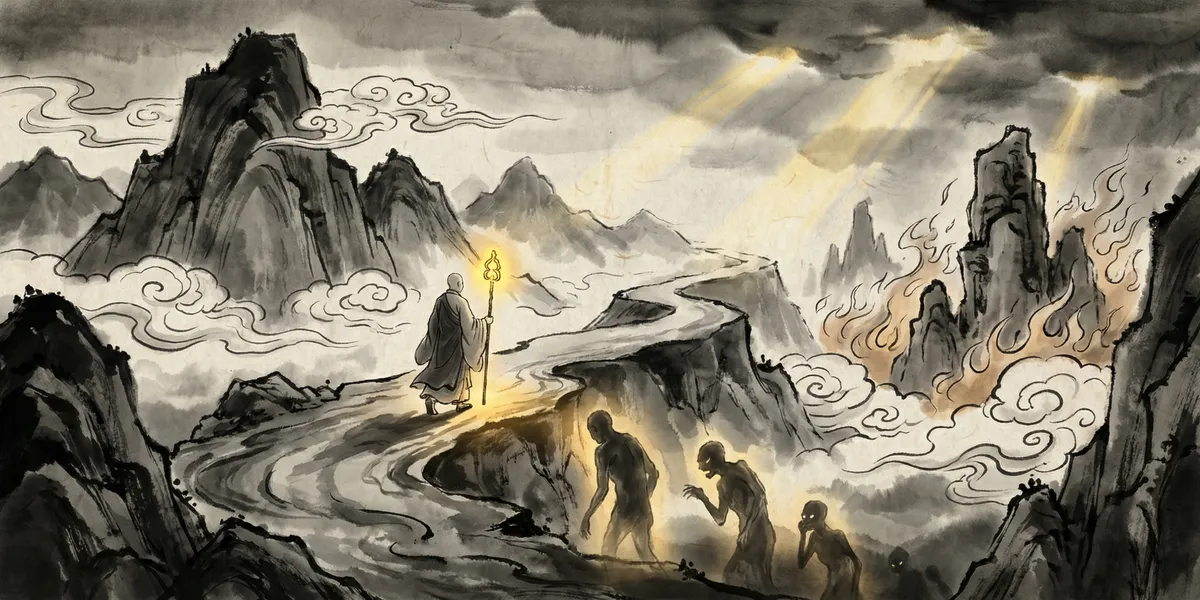
Among the Four Great Bodhisattvas of Chinese Buddhism, Dizang Wang Pusa (Dizangwang Pusa) is the most extraordinary. Guanyin is known for compassion, Wenshu for wisdom, Puxian for vows in action -- but Dizang Wang chose the darkest, most hopeless place that no other deity would willingly go as his permanent station: Hell.
His core vow is just eight characters, yet it stands as the most heroic declaration in all of Chinese religious history: "Hell not empty, vow not to become Buddha" (diyu bu kong, shi bu cheng fo). It means: as long as there remains a single suffering soul in Hell, I will not attain Buddhahood. As long as one being remains unsaved, I will stay in Hell forever.
Consider what this means. Buddhahood is the ultimate goal of every practitioner -- nirvana's serenity, eternal freedom from the cycle of rebirth, the supreme state of enlightenment. Dizang Wang's spiritual cultivation had long since reached that level; he was entirely qualified to become a Buddha. But he voluntarily renounced it -- because if he left, what would happen to those souls in Hell?
And there's a cruel logic embedded in this vow: the greed, anger, and ignorance of sentient beings (tan chen chi -- craving, aversion, and delusion) will never completely disappear, and Hell can never truly be emptied. So Dizang Wang's vow is, in essence, a promise that can never be fulfilled. He chose a road with no end -- and that is precisely what makes him great.
Dizang Wang's Sanskrit name is Ksitigarbha, meaning "Treasury of the Earth." The Sutra of the Past Vows of Earth Store Bodhisattva (Dizang Pusa Benyuan Jing) recounts his past-life stories in detail. The most moving is the tale of the Bright-Eyed Girl (Guangmu Nu) saving her mother. In one of his past lives, Dizang Bodhisattva was a filial daughter named Bright-Eyes whose mother had killed countless creatures during her lifetime and accumulated heavy karma. After death, the mother plunged into Hell to suffer agonizing torment. Overwhelmed with grief, Bright-Eyes spent everything she had making offerings to Buddhist images and made the grandest of all vows: I will save every being trapped in suffering and empty Hell completely -- only then will I become a Buddha. This vow moved all the Buddhas of the ten directions, and her mother was freed from the sea of Hell's suffering. Bright-Eyes herself, lifetime after lifetime, continued to fulfill this vow, eventually becoming Dizang Wang Bodhisattva.
This story reveals the emotional core of Dizang worship: filial piety (xiao). The most fundamental reason Chinese people venerate Dizang Wang isn't some abstract Buddhist doctrine but a profoundly simple human sentiment: My deceased parents, my grandparents -- are they doing all right on the other side? Are they suffering? Dizang Bodhisattva is the one who watches over them. He patrols the netherworld of the dark underworld, staff in hand (xizhang), its rings chiming as he walks, and wherever he goes, the gates of Hell swing open. The darkest corners of the Six Realms of Rebirth are his jurisdiction. But he isn't there to punish the dead -- he's there to save them.
In folk belief, the relationship between Dizang Wang and the Ten Courts of King Yama (Shi Dian Yanluo) deserves special mention. King Yama is responsible for judging the merits and sins of deceased souls, but Dizang Wang exists at a higher level -- he has the authority to intervene in judgments, to advocate for souls who sincerely repent, and to open the gates of Hell to release those who have been redeemed. If King Yama is the judge of the underworld, Dizang Wang is its supreme mercy -- his presence ensures that the Chinese imagination of the afterlife isn't entirely dark. Even if you fall into the deepest pit of Hell, there is still a bodhisattva waiting for you there, who will never give up on you.
Every year on the thirtieth day of the seventh lunar month -- the birthday of Dizang Wang Bodhisattva, which happens to fall on the last day of "Ghost Month" (Guiyue) -- temples across the nation hold grand Dizang Dharma Assemblies (Dizang Fahui). Devotees chant sutras for deceased relatives, burn paper offerings, and set floating river lanterns adrift -- each lamp gliding downstream carrying the living's longing and blessings for the departed.
Mount Jiuhua (Jiuhua Shan) in Anhui Province is Dizang Wang Bodhisattva's sacred abode in China. During the Tang Dynasty, a prince from the Korean kingdom of Silla named Jin Qiaojue (Jin Qiaojue) crossed the sea to China and practiced asceticism on Mount Jiuhua for seventy-five years before passing away. Later generations recognized him as an incarnation of Dizang Bodhisattva. His physical body, undecayed after a thousand years, is still enshrined in the Moon Body Precious Hall on Mount Jiuhua -- one of the most famous "flesh-body bodhisattvas" in Chinese Buddhist history.
The faith in Dizang Wang Bodhisattva carries one of the most profound convictions in Chinese culture: in the most hopeless of places, there is still hope. At the very bottom of the darkest abyss, there is still light. This isn't cheap motivational comfort but a solemn promise purchased through a bodhisattva's eternal self-sacrifice.
East vs West
East · Dizang Wang (Ksitigarbha)
Western counterpart: Hades (benevolent)
Dizang Wang is most commonly compared to the Greek god Hades, since both preside over the underworld. But this comparison actually exposes radically different cultural imaginations of the "ruler of the dead." Hades rules the underworld because he drew the short straw when the three brothers divided up the cosmos -- it was fate's assignment, not personal choice. He manages the dead as a cold, detached administrator: neither punishing nor saving, merely maintaining order.
Dizang Wang is the exact opposite -- he walked into Hell entirely of his own free will. Nobody forced him, nobody drew lots. He could have become a Buddha and enjoyed supreme bliss, but he chose to remain in the darkest, most agonizing place. Another comparable figure is Jesus descending into Hell in Christianity -- after being crucified, Jesus descended to rescue dead souls, but that was a one-time action (he rose three days later and ascended to heaven). Dizang Wang's residence is permanent -- no deadline, no exit clause.
Hades is an assigned administrator. Jesus is a temporary rescuer. Dizang Wang is an eternal watchman. This difference profoundly reflects the unique nature of Buddhist compassion: true great mercy sets no conditions and no time limit.
Modern Influence
Mount Jiuhua, as Dizang Bodhisattva's sacred abode, is one of China's Four Great Buddhist Mountains, receiving millions of pilgrims and tourists annually. The Dizang Dharma Assemblies held during the Ghost Festival period around the seventh lunar month are among the most important memorial ceremonies in Chinese Buddhism, combining with folk customs like floating river lanterns and burning paper offerings to create a distinctive Chinese funerary cultural landscape. The eight characters "Hell not empty, vow not to become Buddha" have transcended their religious context to become a classic Chinese expression for unwavering determination and selfless devotion. In gaming and anime, Dizang Wang is frequently reimagined as a mysterious guardian of the netherworld -- numerous popular mobile games feature characters based on Dizang Wang, with skills like "Underworld Judgment" and "Hell's Cycle of Rebirth" drawn directly from Dizang lore. In literary works, Dizang Wang's story is often adapted into modern narratives exploring the ethics of life and death and the redemption of human nature.
Related Characters
 Rulai (The Buddha)Back to CompendiumMilefo (Maitreya)
