
Milefo (Maitreya)
Milefo, The Laughing Buddha (Maitreya)
The Big Belly That Holds Everything, The Smile That Never Stops
Domain
The Inner Court of Tushita Heaven, the realm of the Future Buddha awaiting his descent
Role
The Future Buddha, Shakyamuni's designated successor, who will save all beings at the Three Dragon Flower Assemblies
Weapon
The Cloth Sack -- a cosmic bag that holds all things and produces whatever is needed
Appearance
Bare-chested with an enormously round belly, mouth perpetually open in laughter, carrying a cloth sack, sitting cross-legged, face radiating such infectious joy that all who see it forget their worries
Legend
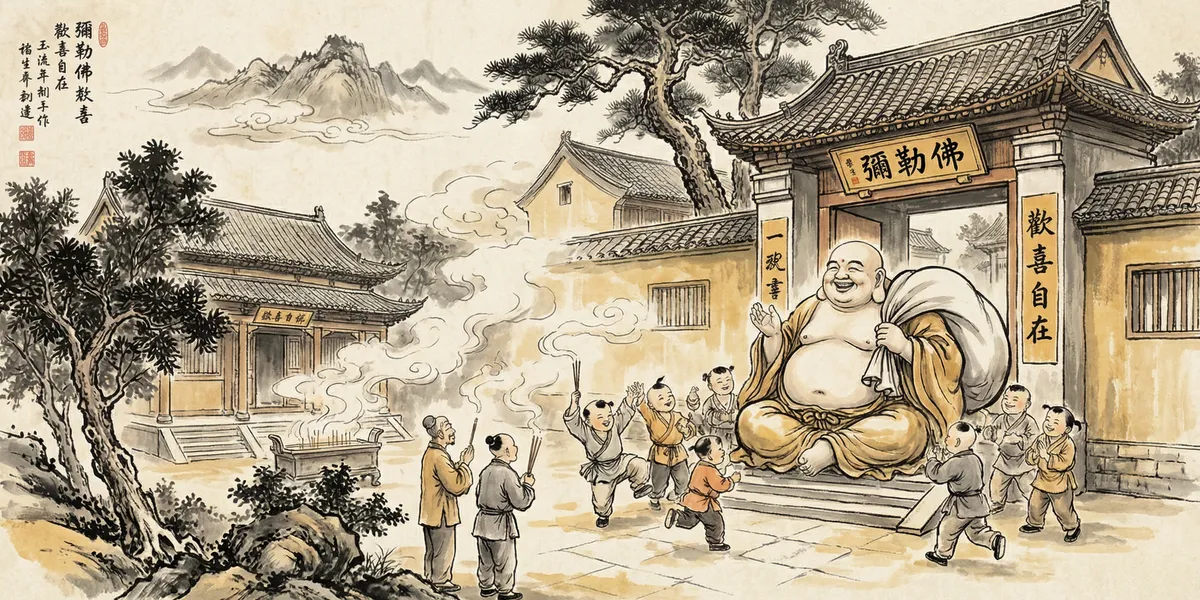
Walk into any Buddhist temple in China, and the first statue you see after passing through the main gate often isn't Shakyamuni or Amitabha -- it's a pot-bellied, grinning, bare-chested chubby monk. He sits cross-legged right in the center of the Hall of Heavenly Kings, mouth stretched wide, showing off a gloriously round belly, looking like a man who just finished the most satisfying meal of his life. He's probably the least "Buddha-like" Buddha in the entire world.
This jolly rotund monk is Milefo (Mile Fo), and his official title is terrifyingly impressive -- he's the "Future Buddha," the legally designated successor to Shakyamuni Buddha. In Buddhist doctrine, the universe operates on immensely long time cycles, and in each "kalpa" (jie), one Buddha appears to guide sentient beings. In our current "Worthy Kalpa," Shakyamuni is the fourth Buddha, and Maitreya will be the fifth. After Shakyamuni's teachings have completely vanished from the human world -- a period Buddhism calls the Age of Dharma Decline (mofa shidai) -- Maitreya will descend from the Tushita Heaven (Doushuai Tiangong), attain Buddhahood under the Dragon Flower Tree, and hold three magnificent Dharma assemblies -- the Three Dragon Flower Assemblies (Longhua San Hui) -- to save hundreds of billions of beings. He is humanity's ultimate hope: no matter how bad the world gets, Maitreya will eventually come.
But here -- and this is one of the most brilliant cultural switcheroos in Chinese history -- the Maitreya that lives in the Chinese imagination looks almost nothing like the one described in Indian Buddhist scriptures. In Indian and Southeast Asian Buddhist art, Maitreya is a slender, dignified figure, either a crowned bodhisattva or a serene Buddha. In China, Maitreya became a fat monk. And for that, we can thank one extraordinary real historical figure from the Five Dynasties period: Budai Heshang (Budai Heshang), the Cloth Sack Monk.
Budai, dharma name Qici (Qici), was from Fenghua in Zhejiang and was active around the tenth century. He was short, enormously fat, and spent his days wandering the streets lugging an oversized cloth sack. He smiled at everyone, begged for food from anyone, behaved like a madman, and spoke in cryptic riddles. Yet he'd occasionally display inexplicable supernatural powers: sleeping in the snow without a single flake sticking to his body, or predicting tomorrow's weather with uncanny accuracy. People thought he was a lunatic, but they had the nagging feeling that this man was something far more.
On his deathbed, Qici left behind a verse (ji yu) that forever transformed the image of Maitreya in China: "Maitreya, the true Maitreya, manifests in billions of forms, appearing constantly before the people of this age, yet the people of this age do not recognize him." In plain language: I AM Maitreya! I've been showing up in front of you in a thousand different guises, and you see me every day but never realize who I am. From that moment on, this disheveled wandering monk was accepted as an incarnation of Maitreya Buddha, and his big belly, laughing face, and cloth sack became the "official portrait" of the Chinese Maitreya.
This cultural transformation is distinctively Chinese. Ordinary Chinese people didn't need a remote, golden, glowing savior of the future -- they felt much closer to a chubby monk right next door with a goofy grin who looked a bit dim. The sinicization (zhongguohua) of Maitreya is one of the most successful and vivid examples in the entire history of Buddhism's localization.
That big belly isn't there for nothing -- it carries profound philosophical meaning. The most classic couplet flanking Maitreya statues, found in virtually every temple, reads: "A big belly that can contain what is hard to contain in the world; a mouth that opens in laughter, laughing at the laughable people of the world." In Chinese cultural context, Maitreya represents the highest wisdom for navigating life -- when facing the world's absurdity, injustice, and turmoil, the most masterful response is not anger, not escape, but laughter. Not mockery, not bitter laughter, but the serene release that comes from having seen through everything.
Maitreya worship also produced a profoundly far-reaching political impact in Chinese history. The prophecy of Maitreya's descent -- "Maitreya descends to earth, the Bright King appears" -- was invoked as a rallying cry in countless peasant uprisings. From the Mahayana Teaching rebellions of the Northern and Southern Dynasties to the White Lotus Movement (Bailian Jiao) of the late Yuan Dynasty, from the Manichean-influenced Ming Cult (yes, the very same one that Zhang Wuji leads in Jin Yong's novel The Heaven Sword and Dragon Saber) to various folk secret sects of the Qing Dynasty, the slogan "Maitreya descends" appeared again and again on the banners of common people rising against tyranny. These rebels may not have understood Maitreya's Buddhist significance, but the core promise Maitreya symbolized -- "the future will be better; a savior will come" -- gave them enough courage to fight against their present suffering.
Maitreya is the most approachable figure in Chinese Buddhism. He doesn't require you to sit up straight and bow formally, doesn't require you to chant obscure sutras. You just have to see that round belly and that irrepressible smile, and your mood lifts involuntarily. Perhaps that's the ultimate wisdom of Maitreya worship: before all the serious cultivation, first learn to laugh.
East vs West
East · Milefo (Maitreya)
Western counterpart: Santa Claus (joyful)
Maitreya's most fascinating Western counterpart isn't a religious figure at all -- it's Santa Claus. The visual parallels are striking: the round, ample belly, the beaming ruddy face, the atmosphere of joy and generosity. Both represent "good things to come" -- Santa brings gifts at Christmas, Maitreya brings salvation after the Age of Dharma Decline. Both have undergone dramatic image makeovers through secularization (Santa from Saint Nicholas to Coca-Cola's red-suited icon; Maitreya from an Indian crowned bodhisattva to a Chinese chubby monk).
But the fundamental difference is this: Santa Claus today is a thoroughly secularized commercial figure -- you wouldn't kneel and pray to Santa in a church. Maitreya, however, retains deep religious significance, with incense still burning before his temple statues. Maitreya's smile is backed by prajna wisdom (bore zhihui) -- the insight of having seen through all illusion; Santa's smile is backed by the commercial logic of holiday consumption. This may be the best footnote on how Eastern and Western "deities of joy" diverged in their fates.
Another comparison on the religious plane is between Christian eschatology and Maitreya's "Future Buddha" concept: both promise a better world to come, but the Christian End Times is premised on Final Judgment and the destruction of the present world, while Maitreya's Dragon Flower Assemblies save beings through peace -- destruction versus salvation, two civilizations' vastly different imaginations of the "ultimate future."
Modern Influence
The golden laughing statue of Milefo (in the Budai image) appears in virtually every Chinese restaurant worldwide, making him the most recognized "Chinese Buddha" among Westerners -- though they usually call him the Laughing Buddha without knowing his true identity. Mount Xuedou in Fenghua, Zhejiang -- Budai's hometown and Maitreya's sacred site -- has in recent years been formally added to the ranks of China's great Buddhist mountains. The Maitreya philosophy of "a big belly that can contain everything" is quoted with high frequency on Chinese social media, especially during online arguments and emotional debates, where netizens often invoke Maitreya's smile as self-deprecating wisdom. In the creative merchandise space, various chibi Maitreya figurines, emoji stickers, and fridge magnets have become some of the most popular Buddhist-themed cultural products -- people may not have deep understanding of Buddhist philosophy, but the Maitreya spirit of "smile -- it's no big deal" has thoroughly permeated the everyday mindset of contemporary Chinese people.
Related Characters
 Dizang Wang (Ksitigarbha)Back to CompendiumTaishang Laojun
