
Taishang Laojun
Taishang Laojun, The Grand Supreme Elder
The Supreme Patriarch of Daoism and Alchemy
Domain
The Tushita Palace beyond the Departure-from-Regret Heaven; the Grand Pure Realm of the Daoist Three Pure Ones
Role
One of the Three Pure Ones, supreme deities of Daoism; Founding Patriarch of Alchemy; embodiment of the Dao
Weapon
The Eight Trigrams Furnace and the Diamond Ring — the furnace refines all things into elixirs, the ring confiscates every weapon under heaven
Appearance
Youthful face with crane-white hair, flowing white beard, Ruyi Crown, Eight Trigrams robe, horsetail whisk in hand, riding a green ox — an air of transcendent grace, with profound wisdom gleaming behind a kindly gaze
Legend
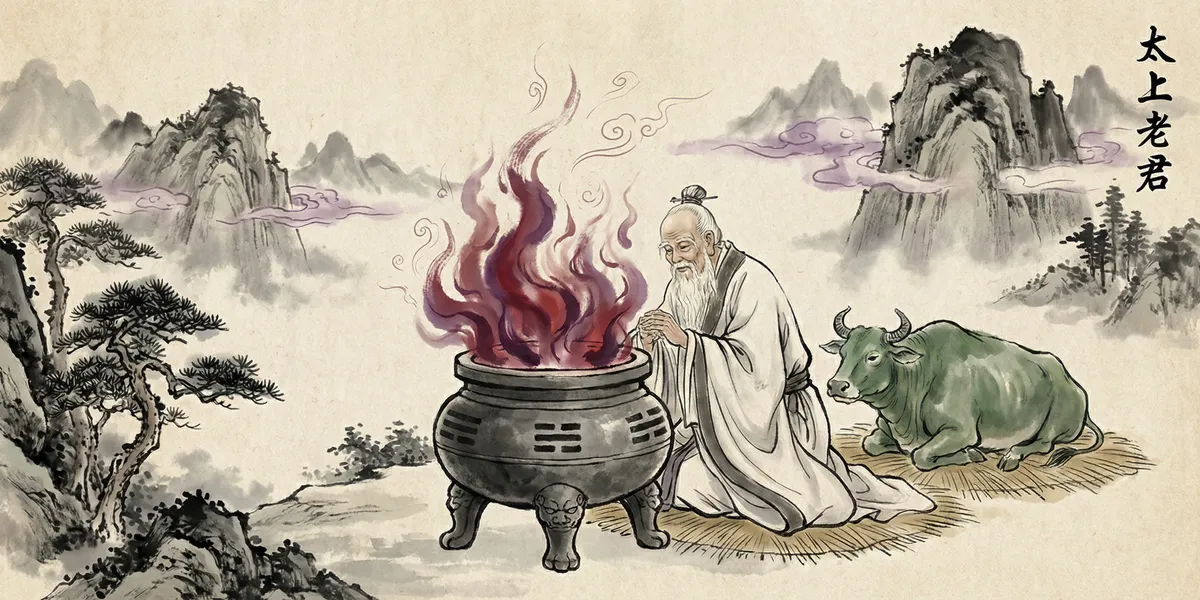
If the Jade Emperor is the CEO of the Heavenly Court, and the Buddha is the supreme enlightened being of the Buddhist cosmos, then Taishang Laojun (Tàishàng Lǎojūn) is the ultimate Big Boss of China's homegrown religion — Daoism. He is one of the Three Pure Ones (Sānqīng), the highest deities in Daoism, specifically the Grand Pure One of Moral Virtue. He is also the deified form of Laozi (Lǎozǐ) — the Spring and Autumn period philosopher who wrote the five-thousand-character *Dao De Jing* (Dàodé Jīng). A single figure who is both a real historical person and a cosmic supreme deity — this kind of "unity of man and god" dual identity is extraordinarily rare in the entire history of world religions.
Let's start with the historical Laozi. His surname was Li, given name Er, courtesy name Dan (Dān), born around 571 BCE in Ku County of the State of Chu. He served as the Keeper of the Archives for the Zhou Dynasty — translated into modern terms, something like "Director of the National Library." Later, he rode a green ox westward through Hangu Pass (Hánɡǔ Guān), where the pass guardian Yin Xi (Yǐn Xǐ) stopped him, saying: "Sir, you're leaving and never coming back, aren't you? Could you leave something behind for future generations?" Laozi then wrote the five-thousand-word *Dao De Jing*, and drifted away into the unknown. A librarian who wrote one book and then vanished from the face of the earth — even that ending alone is steeped in mystery.
In the Daoist theological system, Laozi is far more than just a philosopher who wrote a book. He is revered as the one among the Three Pure Ones closest to the mortal world — the Grand Pure One of Moral Virtue. The Three Pure Ones are: the Primordial Heavenly Worthy (Yuánshǐ Tiānzūn, the highest but most abstract, representing the origin of the universe), the Numinous Treasure Heavenly Worthy (Língbǎo Tiānzūn, overseeing scriptures and salvation), and the Moral Virtue Heavenly Worthy, a.k.a. Taishang Laojun (the closest to the mortal world, directly involved in worldly affairs). In Daoist cosmology, Taishang Laojun is the embodiment of the "Dao" — and the Dao is the origin and ultimate law of all things in the universe. He is not a god who was created; he IS the Dao that created everything. Chapter 25 of the *Dao De Jing* puts it plainly: "There was something formless yet complete, that existed before heaven and earth. Silent and void, standing alone and unchanging, pervading everywhere without exhaustion — it may be regarded as the mother of all under heaven. I do not know its name, so I call it Dao."
However, Taishang Laojun's most vivid image in the Chinese imagination comes not from Daoist scriptures but from *Journey to the West* (Xīyóu Jì). Under Wu Cheng'en's pen, Taishang Laojun is the most senior immortal in the Heavenly Court — even older than the Jade Emperor himself. He resides in the Tushita Palace (Dōushuài Gōng) beyond the sky of Departure from Regret, and his daily job boils down to one thing: alchemy. His Eight Trigrams Furnace (Bāguà Lú) is one of the most famous pieces of "equipment" in all of Chinese literature — configured with eight types of celestial fire arranged according to the Eight Trigrams, theoretically capable of refining any substance into elixirs of immortality or reducing it to ashes.
Then Sun Wukong showed up. During his rampage through Heaven, the Monkey King barged into the Tushita Palace and swallowed — in one go — five gourds of Golden Elixirs that Taishang Laojun had painstakingly refined over who-knows-how-many years, originally meant as premium immortality pills for the Peach Banquet. Taishang Laojun was so furious his white beard was practically spinning in circles. But his reaction was telling: he didn't fly into a rage demanding the monkey's death. Instead, he proposed a "technical" solution — throw Wukong into the Eight Trigrams Furnace and refine him.
By design, the furnace's eight celestial fires should have been able to refine anything into nothing. But Taishang Laojun never anticipated that Wukong would hide in the "Xun" position (xùn wèi, the trigram representing wind) — where there was wind but no fire. The result? Not only did Wukong survive, but after forty-nine days of smoke and heat, he emerged with the "Fiery Golden Eyes" (Huǒyǎn Jīnjīng) — a pair of golden eyes that could see through any demon's disguise. The ultimate weapon carefully crafted by Daoism's supreme deity ended up giving a free upgrade to Buddhism's monkey — arguably one of the most darkly humorous episodes in all of Chinese literature.
But Taishang Laojun is far more than just the unlucky old man who got his pills stolen in *Journey to the West*. In Daoist tradition, he is the founding patriarch of alchemy (liàndān shù, the precursor to Chinese chemistry). From Emperor Qin Shihuang sending Xu Fu across the sea to find the elixir of immortality, to Emperor Wu of Han's obsession with occult arts, to two millennia of Daoist priests firing up their furnaces in remote mountains — the entire history of Chinese alchemy traces back to Taishang Laojun. Ironically, while the elixir of immortality was never successfully produced, one "byproduct" of the alchemical process — gunpowder (huǒyào) — accidentally changed the course of world history.
There's one more divine artifact that deserves mention — the Diamond Ring (Jīngāng Zhuó), also known as the Golden Steel Hoop. In *Journey to the West*, Taishang Laojun's mount, the Green Bull Demon, stole the Diamond Ring and went down to earth to wreak havoc. This unassuming little ring could confiscate any weapon — Wukong's Golden Cudgel, Erlang Shen's three-pointed double-edged lance, Nezha's entire arsenal — all sucked away by it. In the end, when Sun Wukong was completely out of options, he flew up to the Tushita Palace to find Taishang Laojun. The old man leisurely rode his green ox down to earth, and without changing expression, retrieved his "pet" and his "accessory." That air of calm composure seemed to say: small matter, not worth mentioning.
Taishang Laojun's iconic appearance is the quintessential distillation of Daoist aesthetics: a youthful face framed by snowy hair, a three-foot white beard flowing in the breeze, wearing a Ruyi Crown and Eight Trigrams robe, riding a slow-plodding green ox, holding a palm-leaf fan or horsetail whisk. He looks like the most benevolent grandfather imaginable — but those seemingly half-closed eyes gleam with the wisdom to perceive everything across the Three Realms. He is the kind of presence that commands respect without anger: you wouldn't fear him, but you would absolutely never underestimate him.
East vs West
East · Taishang Laojun
Western counterpart: Merlin
Taishang Laojun is most often compared to Merlin from Western literature. The similarities are indeed striking: both are elderly sages with silver hair and long beards; both are masters of alchemy or magic; both have close relationships with the supreme ruler (Merlin advises King Arthur, Taishang Laojun is a founding elder of the Heavenly Court); both represent the "mysterious old man" archetype in their respective cultures. But the fundamental difference lies in their level of existence. Merlin is mortal — he was born, he can die, he has weaknesses, and he was ultimately sealed in a crystal cave by the Lady of the Lake, a rather tragic ending. Taishang Laojun, on the other hand, is the embodiment of the Dao — as long as the Dao is indestructible, so is he. Merlin's wisdom comes from magical training; Taishang Laojun's wisdom comes from the fact that he IS the universal law itself. More importantly, Merlin is a fictional literary character, while Taishang Laojun's mortal prototype — Laozi — was a real historical figure, a great thinker who left behind a philosophical work that has influenced all of human intellectual history. The *Dao De Jing* has been translated into dozens of languages and is a shared heritage of human civilization. This makes Taishang Laojun an exceptionally rare case in world religion: a real philosopher who was gradually deified after death into a cosmic supreme being.
Modern Influence
Taishang Laojun (Laozi) is one of the most successfully exported cultural figures in Chinese history. The *Dao De Jing* is one of the most widely translated Chinese texts in the world, second only to the Bible. Concepts like "Dao," "Wu Wei" (non-action), "The highest goodness is like water," and "The Dao follows Nature" have transcended language and borders to become shared vocabulary among intellectuals worldwide — Silicon Valley entrepreneurs quote Laozi when discussing management philosophy, and European philosophers reference the *Dao De Jing* when debating ontology. In Chinese film and television, Taishang Laojun is a classic character in every adaptation of *Journey to the West*, and the scene of Wukong being refined in the Eight Trigrams Furnace is a must-film episode. In mythology-themed games, Taishang Laojun typically appears as an alchemy system NPC or master blacksmith — perpetuating his classic persona as the "Founding Patriarch of Alchemy." The Hall of the Three Pure Ones in Daoist temples (such as Beijing's White Cloud Temple and Chengdu's Green Ram Temple) always enshrines a statue of the Grand Pure One of Moral Virtue, as this is a fundamental architectural requirement of Daoism. The image of Laozi riding his green ox is a familiar presence on Chinese stamps, in paintings, and in cultural tourism merchandise.
Related Characters
 Milefo (Maitreya)Back to CompendiumLu Dongbin
