
Sun Wukong
Sun Wukong (The Monkey King)
The Immortal Legend — From Stone Monkey to Victorious Fighting Buddha
Domain
Battle and freedom
Role
Great Sage Equal to Heaven, Victorious Fighting Buddha, chief disciple of Tang Sanzang
Weapon
Ruyi Jingu Bang — the Compliant Golden-Hooped Rod (weighing 13,500 jin, expandable and shrinkable at will)
Appearance
A golden-furred monkey king wearing the Phoenix-Wing Purple-Gold Crown, clad in Chain Mail Golden Armor, shod in Cloud-Walking Boots, with Fiery Golden Eyes, wielding the Golden Cudgel
Legend
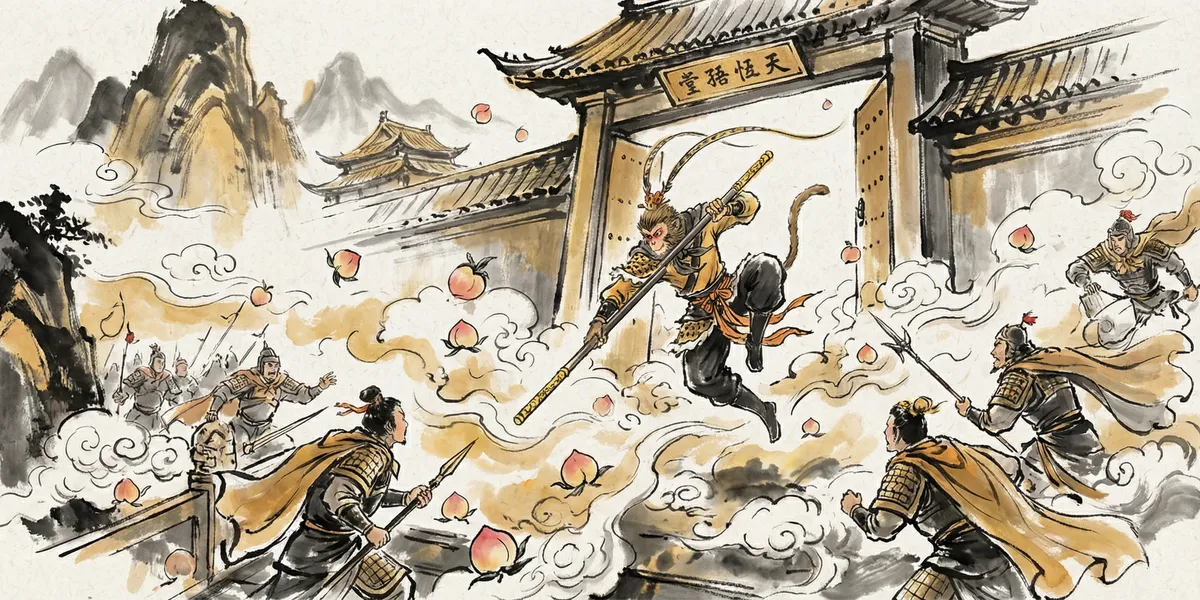
In the vast galaxy of Chinese literature, no character is more deeply beloved than Sun Wukong (Sūn Wùkōng). He is the Handsome Monkey King, the Great Sage Equal to Heaven, the Victorious Fighting Buddha — a monkey who burst out of a rock, stormed the gates of heaven, turned the Three Realms upside down, and then walked a long, long road westward toward enlightenment. His story comes from the Ming dynasty novel "Journey to the West" (Xī Yóu Jì) by Wu Cheng'en — the single greatest adventure novel in the history of Chinese literature, bar none.
The story begins with a stone. On the Mountain of Flowers and Fruit (Huāguǒ Shān), there sat a magical rock that had been absorbing the essence of heaven and earth for thousands of years. One day it suddenly cracked open, and out popped a stone monkey. He was clever and fearless, quickly becoming the leader of the monkeys. He discovered the Water Curtain Cave (Shuǐlián Dòng) hidden behind a waterfall and was proclaimed the Handsome Monkey King (Měi Hóuwáng) by his joyful subjects.
But the good life started to feel hollow. Wukong witnessed old monkeys dying and, for the first time, felt the terror of mortality. He could not accept the fate of aging and death. So he sailed across the ocean, seeking a master. After countless hardships, he found the Patriarch Subhuti (Pútí Zǔshī), who taught him the 72 Transformations (qīshí'èr biàn) — the power to become anything in existence — and the Cloud Somersault (Jīndǒu Yún) — a single flip that carries you 108,000 li. As Wukong departed, his master warned him: never reveal where you learned your skills, and your arrogance will be your undoing.
Wukong promptly forgot both warnings.
Back on the Mountain of Flowers and Fruit, unsatisfied without a proper weapon, he stormed the Dragon Palace of the Eastern Sea and seized the Ruyi Jingu Bang (Rúyì Jīngū Bàng) — the Compliant Golden-Hooped Rod — a 13,500-jin pillar that could grow or shrink at will, originally used by the Great Yu to measure the depth of the seas. Then he marched into the Underworld and crossed out the names of every monkey in the Book of Life and Death (Shēngsǐ Bù), permanently freeing himself and his kind from the cycle of reincarnation.
Heaven panicked. The Jade Emperor tried to co-opt him by offering an official title: Keeper of Horses (Bìmǎwēn). When Wukong later discovered this was nothing more than a stable-boy gig, he erupted in fury. He proclaimed himself the Great Sage Equal to Heaven (Qítiān Dàshèng) and declared war on the Heavenly Court.
What followed was the legendary Great Havoc in Heaven (Dà Nào Tiāngōng). First, Wukong crashed the Queen Mother's Peach Banquet (Pántáo Huì), devouring the finest immortal peaches. Then he guzzled celestial wine. Then he stumbled into Lord Laozi's (Tàishàng Lǎojūn) alchemy lab and popped every pill of immortality like candy. The Heavenly Court deployed a hundred thousand celestial soldiers. He fought the Four Heavenly Kings, the Twenty-Eight Constellations, Nezha, and Erlang Shen — three hundred rounds of battle.
Finally, Lord Laozi captured him with a magical snare and threw him into the Eight Trigrams Furnace (Bāguà Lú), roasting him for forty-nine days. The plan was to incinerate him. Instead, Wukong emerged not only alive but with a new power: Fiery Golden Eyes (Huǒyǎn Jīnjīng) — eyes that could see through any disguise or demonic aura. He leaped from the furnace, more powerful than ever.
The entire Heavenly Court was helpless. The final authority to step in was the Buddha himself (Rúlái Fózǔ). The Buddha made Wukong a wager: if you can leap out of my palm, all of heaven is yours. Wukong somersaulted to what he thought was the edge of the universe, found five pillars, and smugly graffitied "The Great Sage Equal to Heaven Was Here" on one of them. When he somersaulted back — those five pillars turned out to be the Buddha's five fingers. He had never left the Buddha's palm. The Buddha flipped his hand and pinned Wukong beneath Five Elements Mountain (Wǔxíng Shān), where he remained for five hundred years.
Five hundred years later, the monk Tang Sanzang (Táng Sēng) passed by on his pilgrimage to retrieve Buddhist scriptures from the West. He removed the seal from the mountain and freed Wukong. From that point on, Wukong became Tang Sanzang's chief disciple and bodyguard, escorting him on a journey of 108,000 li to the West. But freedom came with a price: a golden headband (Jǐngū Zhòu) was placed on Wukong's head. Whenever Tang Sanzang chanted the spell, the band tightened, sending excruciating pain through Wukong's skull. It was a leash placed on the untameable.
The westward journey lasted fourteen years and eighty-one trials. Wukong, along with Zhu Bajie (Zhū Bājiè) and Sha Wujing (Shā Wùjìng), battled demons and risked their lives at every turn, rescuing Tang Sanzang from the jaws of monsters time after time. But the real journey was internal. The monkey who once wanted to burn heaven to the ground slowly learned patience, compassion, and humility over the course of that long walk.
When the pilgrimage was complete, Wukong was bestowed the title of Victorious Fighting Buddha (Dòuzhàn Shèng Fó) by the Buddha. The golden headband dissolved on its own — not because someone removed it, but because he no longer needed it. The most untameable monkey in existence had finally found inner peace on that long road west. Not through submission, but through understanding.
Sun Wukong's story is, at its heart, a journey every person must walk: from extraordinary talent paired with reckless arrogance, through suffering and tempering, toward wisdom and transcendence. He is the mirror of everyone who was too clever, too proud, and had to learn life's lessons the hard way. Five hundred years on, he remains the most beloved character in Chinese culture — because his story is our story.
East vs West
East · Sun Wukong
Western counterpart: loki
Sun Wukong is often compared to Loki from Norse mythology — both are shape-shifters, tricksters, and agents of chaos who challenge the established order. But their endings could not be more different: Loki's story concludes with Ragnarok, bound to a rock, seething with resentment, awaiting the destruction of the world; Wukong's story concludes with Buddhahood, finding true freedom through enlightenment. The Chinese trickster achieves redemption; the Norse trickster does not — two civilizations handling "chaos" in fundamentally different ways. Wukong also resembles Prometheus — both defied the supreme authority (Zeus/the Jade Emperor) and both endured prolonged imprisonment (chained to a rock/pinned beneath a mountain). But Prometheus suffered for humanity's sake; Wukong suffered for his own hubris. His redemption came not through martyrdom but through service and self-cultivation, slowly wearing down his rough edges over time. Embedded in this is a deeply Buddhist and Confucian idea: even the most rebellious soul can find its place through spiritual practice. Chaos need not be destroyed; it can be transformed.
Modern Influence
In 2024, the video game "Black Myth: Wukong" took the world by storm, selling over twenty million copies globally and introducing Sun Wukong to a new generation of players worldwide. Looking further back, the protagonist Son Goku of the Japanese anime "Dragon Ball" was directly adapted from Sun Wukong, becoming one of the most influential anime characters of all time. From the Peking Opera stage to the Hollywood big screen, from streetwear collaborations to tattoo parlors around the globe, the Monkey King is arguably the single most successful Chinese cultural export ever. Phrases like "Great Havoc in Heaven," "Fiery Golden Eyes," and "Golden Cudgel" have long transcended their literary origins to become everyday cultural shorthand in the Chinese language — "give him a Golden Cudgel and he thinks he's the Great Sage" describes someone who gets carried away, and "Fiery Golden Eyes" means sharp insight — Sun Wukong has woven himself completely into the DNA of the Chinese language.
Related Characters
 NezhaBack to CompendiumCaishen