
Caishen
Caishen, God of Wealth
The God of Fortune and Prosperity
Domain
The Celestial Treasury
Role
Oversees the distribution of all earthly wealth
Weapon
Golden Whip and the Treasure Basin
Appearance
Red robes and a golden crown, holding a gold ingot, with a kind and beaming face
Legend
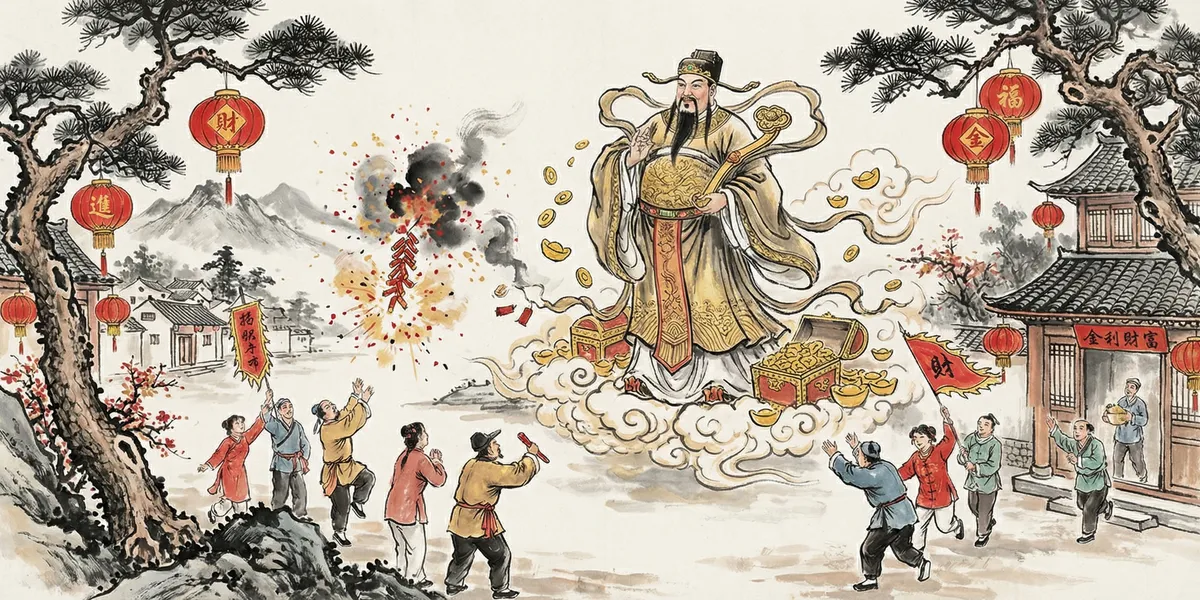
If you had to pick the most popular deity in the entire Chinese pantheon, Caishen (Cáishén) — the God of Wealth — would be a top contender. The reason is simple: in the world of faith, whoever controls the money gets the most visitors. Buddhists worship him, Daoists worship him, and atheists worship him too. When it comes to cold hard cash, all differences in belief can be temporarily set aside.
What makes it even more interesting is that Caishen isn't a single person — he's an entire department. The Chinese divide their wealth gods into two main branches: the Civil God of Wealth and the Martial God of Wealth, each with multiple candidates underneath, like a celestial Ministry of Finance with several deputy ministers.
The leading Martial God of Wealth is Zhao Gongming (Zhào Gōngmíng), whose full title — "Golden Dragon As-You-Wish Orthodox Unity Dragon-Tiger Mysterious Altar True Lord" — tells you right away this is somebody important. His story is recorded in the "Investiture of the Gods" (Fēngshén Yǎnyì). Zhao Gongming was originally a Daoist master who cultivated on Mount Emei. During the epic cosmic war between King Wu and the Shang dynasty, he fought on the Shang side. His gear was spectacular: he rode a black tiger, wielded a golden whip (Jīn Biān), and possessed a devastating superweapon — the Sea-Calming Pearls (Dìnghǎi Zhū), which could incapacitate an entire army. Yet he was ultimately killed in battle. But death turned out to be merely a career move — when Jiang Ziya (Jiāng Zǐyá) performed the grand investiture of the gods, he gave Zhao Gongming something better than a generalship: the directorship of Heaven's Treasury. Under him serve four capable deputies — the Heavenly Lord of Treasure-Inviting, the Heavenly Lord of Pearl-Collecting, the Envoy of Wealth-Attracting, and the Immortal Official of Profitable Markets — forming a complete "Celestial Financial Regulatory Authority."
On the Civil God of Wealth side, the two most famous figures are Bi Gan (Bǐ Gān) and Fan Li (Fàn Lǐ). Bi Gan's story is brutally tragic — he was a loyal minister of the Shang dynasty who was executed for daring to speak truth to the tyrant King Zhou (Zhòu Wáng). Egged on by the fox spirit Daji (Dájǐ), King Zhou had Bi Gan's chest cut open while he was still alive, wanting to see whether "a sage truly has a heart with seven apertures." Bi Gan died, but folk belief reasoned: a man with no heart is the fairest of all, because he cannot be partial. So Bi Gan became the most impartial Civil God of Wealth — when distributing wealth, he would never play favorites. The logic is simultaneously darkly humorous and profoundly philosophical.
Fan Li (Fàn Lǐ) walked a completely different path. He was the brilliant strategist who helped King Goujian (Gōujiàn) of Yue "sleep on brushwood and taste gall" through years of hardship to eventually destroy the state of Wu and restore his kingdom. But after achieving supreme success, he did something that stunned everyone — he resigned. He changed his name to Tao Zhugong (Táo Zhūgōng), went into business, and three times amassed enormous fortunes — and three times gave it all away. Earn, give, earn again, give again — he proved through action that he truly understood the laws of economics rather than just riding luck. Fan Li became the patron saint of Chinese merchants, embodying the spirit of the "righteous merchant": making money is fine, but never forget morality and giving back to society.
There's also a special Martial God of Wealth — Guan Gong (Guān Gōng), also known as Guan Yu. How did a military general famous for loyalty end up as a god of wealth? The answer lies in the character "xìn" — trustworthiness. In ancient China, business transactions relied not on contract law and courts but on personal reputation and moral obligation. Guan Yu's defining quality was keeping his word — Cao Cao tried to buy his loyalty with gold, silver, and beautiful women, but when Guan Yu said he was leaving, he left. This quality of being "unmoved by wealth or beauty" ironically became the scarcest commodity in the commercial world. Merchants who enshrine Guan Gong are sending a message to their business partners: like Guan Gong, my word is my bond. That's why in Hong Kong and Chinese business communities across Southeast Asia, a statue of Guan Gong is standard equipment in virtually every shop.
The standard visual image of Caishen is this: a plump old gentleman in red robes and a golden crown (plumpness signifies prosperity), his face beaming with smiles, one hand cradling a gold ingot (jīn yuánbǎo), the other holding a ruyi scepter (rúyì, meaning "may all go as you wish"), often with a Treasure Basin (Jùbǎo Pén) nearby — a magical bowl that doubles whatever you throw into it. This image is essentially a walking billboard for "Get Rich Quick" — one glance at it and you can't help but feel cheerful.
Caishen's grandest reception day falls during the Chinese New Year period on the fifth day of the first lunar month — the Festival of Breaking Five (Pòwǔ Jié). This day is regarded as "Wealth God Day," and the entire nation is busy "welcoming the God of Wealth" (yíng cáishén). At midnight, every household sets off firecrackers, burns incense, throws open their front doors, and shouts "The God of Wealth is here!" (Cáishén dào!), terrified that if their welcome isn't enthusiastic enough, Caishen might wander next door instead. In some regions, people eat dumplings — because their shape resembles gold ingots, symbolizing "attracting wealth and treasure." Shop owners go to extreme lengths to light the very first stick of incense, believing that whoever welcomes Caishen earliest will enjoy good fortune all year long.
The Chinese attitude toward Caishen reflects a deeply pragmatic philosophy of faith: wanting to get rich is nothing to be ashamed of. In the Western Christian tradition, "You cannot serve both God and Mammon" is an explicit tenet — money and faith are placed on opposing sides. But in Chinese culture, "Gōngxǐ fācái" (congratulations, may you prosper) is the universal New Year greeting for all 1.4 billion people — try saying "congratulations on getting rich" inside a Western church and see what expression the pastor makes. Chinese culture has never pitted the pursuit of wealth against spiritual cultivation. The very existence of Caishen proves this point: as long as wealth is earned honestly and shared generously, getting rich is the best thing in the world.
East vs West
East · Caishen
Western counterpart: plutus
Western culture has its own wealth-related deities, but the contrast with Caishen is fascinating. Plutus, the Greek god of wealth, is typically depicted as blind — distributing riches randomly, without method — and his name ultimately evolved into "plutocracy," a word laden with criticism. In the Christian tradition, Mammon represents wealth as idol worship, a symbol of spiritual corruption. "You cannot serve both God and Mammon" (Matthew 6:24) directly opposes wealth and sacred faith. In Norse mythology, gold is almost always cursed — Andvari's ring, Fafnir's hoard — treasure inevitably brings destruction. Caishen completely upends this narrative. In Chinese culture, wealth is not a mark of moral failing but a sign of heavenly blessing. "Gōngxǐ fācái" is spoken in unison as the first New Year greeting by over a billion people. The root of this difference isn't that Chinese culture is more "materialistic" — it's that Chinese culture never erected the wall between spiritual virtue and material prosperity that Western theology built.
Modern Influence
Caishen's influence on contemporary Chinese life is everywhere. Every Chinese New Year, "Gōngxǐ fācái" is spoken billions of times. The WeChat red envelope (Wēixìn hóngbāo) phenomenon — during the Spring Festival, digital red envelopes exchanged via WeChat total tens of billions of yuan — is essentially digitized Caishen worship. When businesses open or relocate, hiring a feng shui master to properly position the Caishen shrine is still standard practice. China's A-share stock market typically sees a "welcoming Caishen rally" on the first trading day after the fifth of the first month (Wealth God Day). On short-video platforms, "Caishen arrives" background music racks up billions of plays during Spring Festival. Even cryptocurrency communities break out Caishen memes when bull markets arrive — ancient faith and cutting-edge financial innovation blend together without the slightest friction.
Related Characters
 Sun WukongBack to CompendiumYue Lao
