
The Jade Emperor
The Jade Emperor
The Supreme Ruler of the Three Realms
Domain
Supreme ruler of the Heavenly Court, sovereign of the Three Realms
Role
Governs the Three Realms, maintains cosmic order, manages the divine hierarchy
Weapon
Imperial Jade Seal — the celestial seal symbolizing supreme authority
Appearance
Imperial crown with twelve bead-curtain tassels hanging before his face, clad in a golden dragon robe embroidered with nine dragons, holding a jade tablet, seated upon the Nine Dragon Throne
Legend
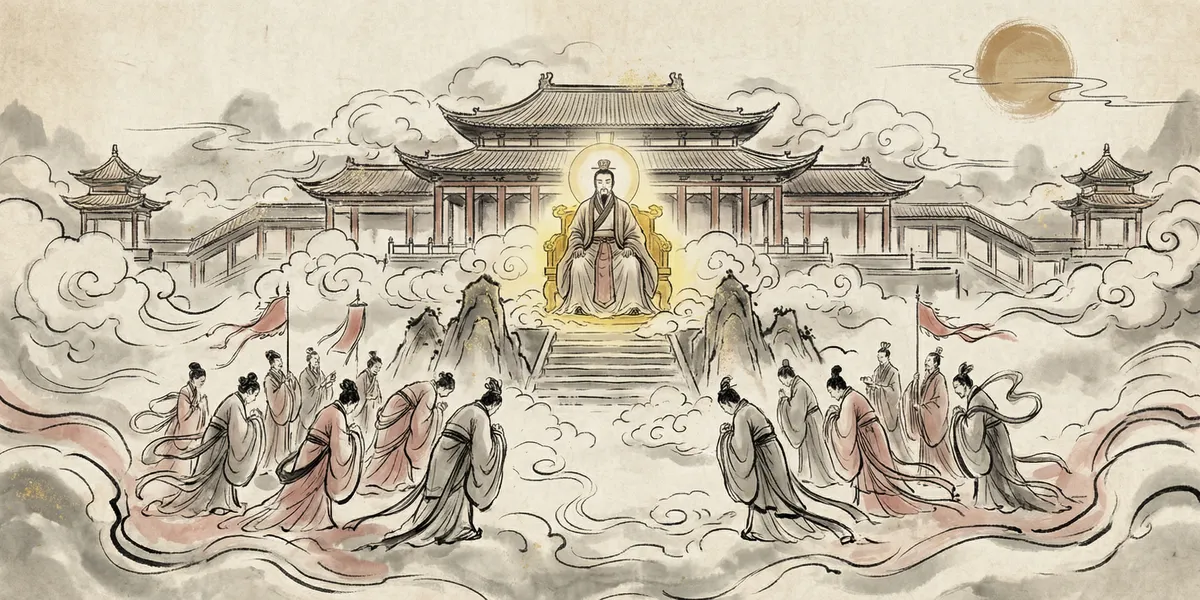
If you think of Chinese mythology as an enormous corporate conglomerate, then the Jade Emperor (Yù Huáng Dàdì) is the ultimate CEO sitting in the corner office on the top floor. He's not the company founder — that's Pangu. He's not the Chief Technology Officer — that would probably be Nüwa. But he's the one who keeps the whole system running: the supreme ruler sitting in the golden hall of the Heavenly Court (tiāntíng), managing a divine bureaucracy so vast it would make any human government weep with envy.
The administrative structure of the Heavenly Court is truly something to behold. The Thunder Department (Léi Bù) handles thunder, the Wind Department (Fēng Bù) manages wind, the Water Department (Shuǐ Bù) oversees rainfall — every natural phenomenon has a corresponding "department" behind it. There are celestial soldiers for military matters, literary and martial star gods overseeing the imperial examinations on earth, the planet Venus (Tàibái Jīnxīng) handling diplomatic missions, and Pagoda-Bearing Heavenly King Li Jing commanding the armed forces. The whole system features clear divisions of labor and strict hierarchical levels — it's a carbon copy of ancient China's imperial court.
The Jade Emperor's jurisdiction spans the Three Realms (sān jiè): the immortal world above, the mortal world in between, and the underworld below. He doesn't need to personally manage every raindrop or every soul — he has the Dragon Kings (Lóng Wáng) of the Four Seas handling ocean weather, King Yama (Yán Wáng) running the courts of the underworld, the Earth Gods (Tǔdì Gōng) managing local affairs, and the Kitchen God (Zào Shén) embedded in every household's kitchen as an intelligence operative, ascending to heaven on the twenty-third of the twelfth lunar month each year to file an annual performance report on every family. Yes, you read that correctly — the Jade Emperor operates a surveillance network that penetrates into every kitchen in China. This is arguably the earliest "big data governance" system in the history of human mythology.
Speaking of the Kitchen God's annual report, this gives rise to one of the most charming folk traditions in China: bribing the Kitchen God. Families smear his mouth with malt candy (tángguā) before he ascends to heaven — the logic is beautifully simple: if his mouth is stuck shut with candy, he can't say anything bad; if all he tastes is sweetness, he'll only have sweet things to report. It's a folk wisdom full of earthly charm: even when it comes to gift-giving for deities, the Chinese manage to do it with both elegance and practicality.
The most widely known story about the Jade Emperor is, of course, his conflict with Sun Wukong (Sūn Wùkōng) in "Journey to the West" (Xī Yóu Jì). Before Sun Wukong's legendary rampage through the Heavenly Court, he was actually co-opted with an official position. And what title did the Jade Emperor bestow? "Keeper of Horses" (Bì Mǎ Wēn) — literally, a stable boy. This was a precisely calculated bureaucratic insult: give someone a position within the system, but one so low-ranking it's an affront to their intelligence. When Sun Wukong discovered the truth and erupted in rebellion — storming the Heavenly Court — the Jade Emperor's response was equally telling: he never entered the fight himself. First, he sent a hundred thousand celestial soldiers, which didn't work. Then he called in Erlang Shen (Érlángshén), who fought to a draw. Finally, he brought in the Buddha (Fózǔ). From start to finish, the Jade Emperor was a manager, not a fighter.
But don't mistake his administrative style for weakness. The Jade Emperor's power lies in legitimacy. In Chinese political philosophy, the right to rule comes not from brute force, but from the Mandate of Heaven (tiānmìng) — a concept that profoundly shaped thousands of years of Chinese governance. The Jade Emperor is the embodiment of that mandate. Across the Three Realms, from the mightiest Dragon King to the humblest local earth god, everyone operates within his system.
According to Daoist legend, the Jade Emperor attained his throne through 1,750 kalpas (jié) of spiritual cultivation, each kalpa lasting 129,600 years. That works out to roughly 226 million years of practice. He didn't inherit the position, didn't seize it through a coup — he earned it purely through cultivation (xiūxíng), one step at a time. In a culture that places supreme value on self-cultivation and perseverance, this backstory perfectly answers a core question: why does he sit on that throne? Because he invested more time, exerted more effort, and endured more trials than anyone else.
The Jade Emperor's story is, at its core, an idealized Chinese vision of power: the supreme ruler should not be the strongest fighter, but the most patient, the best manager, the one who understands how to keep the entire system running smoothly. He is order personified, the guardian of institutions. In a culture that prizes harmony and stability, this kind of supreme god fits perfectly.
East vs West
East · The Jade Emperor
Western counterpart: zeus
The Jade Emperor's most direct Western counterpart is Zeus from Greek mythology. Both are the supreme rulers of their respective pantheons, but their leadership styles could not be more different. Zeus rules through thunder and force — his lightning bolt is the ultimate weapon; he is impulsive, passionate, notoriously unfaithful, and locked in perpetual tension with his wife Hera. The Jade Emperor rules through institutions and bureaucracy — he delegates, appoints, and maintains order through hierarchical management, and his relationship with the Queen Mother of the West is relatively harmonious and stable. Zeus is a warrior-king; the Jade Emperor is an administrator-emperor. Behind this lies a profound cultural difference: Greek mythology celebrates individual heroism and the worship of strength, while Chinese mythology values institutional order and collective harmony. In Western narrative tradition, the supreme god tends to be the strongest; in Chinese narrative tradition, the supreme god tends to be the steadiest. Zeus's heaven is rife with conflict and betrayal; the Jade Emperor's heaven runs like a finely calibrated administrative machine. There's no definitive answer as to which is "better," but these two visions genuinely reflect Eastern and Western civilizations' different understandings of what good governance looks like.
Modern Influence
The Jade Emperor remains deeply embedded in Chinese religious and cultural life today. The ninth day of the first lunar month is the Birthday of the Heavenly Lord (Tiāngōng Shēng), the Jade Emperor's birthday, and the worship ceremonies are particularly grand in Fujian province and among Chinese communities in Southeast Asia. In film and television, virtually every adaptation of "Journey to the West" features the Jade Emperor — he is typically portrayed as a somewhat bumbling but not ill-intentioned old bureaucrat, a characterization that audiences find both funny and endearing. The Heavenly Court's administrative system has become a rich source of internet humor in Chinese culture, with endless memes about "celestial workplace dynamics" and "immortal office workers" — comparing the divine bureaucracy to the modern workplace. This kind of humor is itself the best proof of the Jade Emperor's enduring cultural influence.
Related Characters
 NuwaBack to CompendiumQueen Mother of the West
