
Erlang Shen
Erlang Shen
The Rogue War God with the All-Seeing Third Eye
Domain
Guanjiang Pass — half-mortal, half-divine, operating outside the celestial system
Role
The Heavenly Court's supreme warrior, vanquisher of demons, answers the call but refuses the summons
Weapon
Three-Pointed, Double-Edged Lance — a divine weapon with three prongs and two blades
Appearance
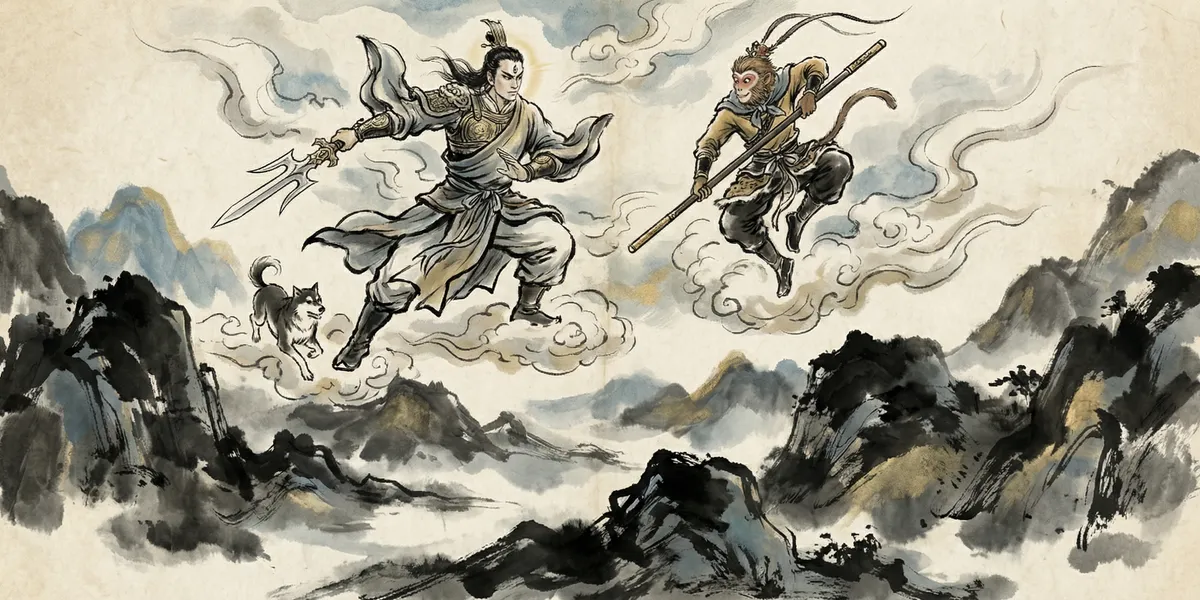
A celestial eye blazing in his forehead, strikingly handsome, clad in golden armor and a war cape, always accompanied by the Howling Celestial Hound
Legend
In a divine system full of bureaucrats, administrators, and cosmic managers, Erlang Shen (Érlángshén) is the one who actually gets his hands dirty. He's a warrior, a rebel, a lone wolf — with a third eye in the middle of his forehead, maintaining a subtle and complicated relationship with the establishment. If the Jade Emperor is the CEO and the Queen Mother the Chairwoman, then Erlang Shen is the special forces commander who is technically on the payroll but operates entirely by his own rules.
His full title is Erlang Xiansheng Zhenjun (Èrláng Xiǎnshèng Zhēnjūn — "Erlang, the Illustrious Sage and True Lord"), and his most distinctive feature is the celestial eye (tiānyǎn) in the center of his forehead — a third eye capable of seeing through every disguise, every illusion, every transformation. In a mythological system where shape-shifting is practically standard-issue for gods and demons alike, possessing an eye that penetrates all transformations makes Erlang Shen the ultimate lie detector.
His origin story is one of the most heartrending chapters in Chinese mythology. His mother, Yaoji (Yáojī), in most versions the Jade Emperor's own sister, fell in love with a mortal man and violated celestial law. As punishment, she was imprisoned beneath Peach Mountain (Táo Shān). The young Erlang Shen, driven by filial piety (xiào) — the most sacred virtue in Chinese culture — took up his divine weapon and cleaved an entire mountain in two to rescue her. This is the legendary "splitting the mountain to save his mother" (pī shān jiù mǔ), and it established the core of Erlang Shen's character: for those he loves, he will defy any authority, break any rule, and move any mountain.
But what truly cemented Erlang Shen's legend was his epic showdown with Sun Wukong (Sūn Wùkōng) in "Journey to the West." During the Great Havoc in Heaven, Sun Wukong had turned the Heavenly Court upside down, and the rank-and-file celestial soldiers couldn't even slow him down. One heavenly general after another retreated in defeat. In desperation, the Heavenly Court called upon Erlang Shen.
What followed is one of the most dazzling combat sequences in all of Chinese literature: the Battle of Transformations (biànhuà zhī zhàn). Sun Wukong commands the 72 Transformations (qīshí'èr biàn), able to turn into anything — a bird, a fish, a tree, a temple. But Erlang Shen commands 73 Transformations (qīshísān biàn), always one trick ahead. Wukong becomes a sparrow; Erlang becomes a hawk. Wukong becomes a fish; Erlang becomes a cormorant. Wukong transforms into a roadside temple (with his tail becoming the flagpole — a detail that still makes Chinese readers laugh to this day), and Erlang's celestial eye sees through it immediately. It was a breathtaking duel, blow for blow, trick for trick.
The significance of this fight is that Erlang Shen is one of the very few beings in all of Chinese mythology who can match Sun Wukong blow for blow. He wins not through brute-force dominance but through technique, intelligence, and that all-seeing celestial eye. He is the tactical master; Wukong is the force of chaos.
What makes Erlang Shen truly unique within the celestial system is his political stance, distilled in one famous phrase: "He answers the call to battle but refuses the summons to court" (tīng diào bù tīng xuān). Meaning: if the Jade Emperor needs him to fight, he'll show up. But if you want him to attend court, kneel in salute, and play politics — forget about it. He lives at Guanjiang Pass (Guànjiāngkǒu) with his own band of brothers and his loyal divine dog, the Howling Celestial Hound (Xiàotiān Quǎn), deliberately keeping his distance from the celestial bureaucracy.
This semi-independent status is what makes him so fascinating. He is half-god, half-mortal — literally, by blood, with an immortal mother and a mortal father — existing in the gap between the heavenly and the human, not fully belonging to either. He serves the system when the system needs him, but he never surrenders his autonomy. In a culture that intensely values both loyalty and personal integrity, Erlang Shen perfectly embodies the tension between these two ideals.
Erlang Shen is never without his Howling Celestial Hound — a beast the size of a tiger, capable of tracking any demon or evil spirit. In battle, the Hound often strikes at the critical moment, clamping down on the enemy in perfect coordination with Erlang Shen's attack. This bond of loyalty between master and dog adds a touch of warmth to this otherwise austere war god.
East vs West
East · Erlang Shen
Western counterpart: ares
Erlang Shen occupies a position somewhere between Ares and Athena in Greek mythology. Like Ares, he is a fearsome war god; like Athena, he wins through wisdom and tactics rather than brute force alone. But neither comparison is entirely accurate. Ares represents pure violence and aggression, and is frequently depicted negatively in Greek mythology; Athena is fully integrated into the Olympian power structure. Erlang Shen is neither — he is an independent warrior, the supreme combat force of the Heavenly Court, yet he refuses to be anyone's loyal soldier. Perhaps his closest Western counterpart is actually Achilles: a supreme warrior with a complicated relationship to the authority he serves, driven by a personal code of honor rather than institutional loyalty. But the key difference is that Erlang Shen's rebellion is quiet and principled, not a dramatic outburst of rage. He doesn't throw down his armor or storm off the battlefield — he simply doesn't show up for court.
Modern Influence
Erlang Shen is one of the most popular characters in Chinese entertainment. The 1999 animated film "Lotus Lantern" retold the "splitting the mountain to save his mother" legend from his nephew's perspective, portraying Erlang Shen as a complex, conflicted figure — a milestone in Chinese animation history. He is a top-tier character in the mobile game "Honor of Kings" and a regular presence in xianxia (immortal hero) media. His celestial eye and loyal Howling Celestial Hound have become iconic visual elements in Chinese character design. In the 2024 global hit game "Black Myth: Wukong," the showdown with Erlang Shen was one of the most anticipated boss fights, reaffirming his timeless status as Sun Wukong's most formidable rival. The idiom "opening the celestial eye" is commonly used in everyday Chinese to mean gaining insight or seeing through to the truth of things.
Related Characters
 Queen Mother of the WestBack to CompendiumNezha
