
Nezha
Nezha
The Lotus-Reborn Rebel Who Returned His Bones to His Father
Domain
War and divine protection
Role
Great God of the Three Altars and the Sea Assembly, vanguard general of the Heavenly Court
Weapon
Fire-Tipped Spear, Universal Ring, Red Armillary Sash, Wind Fire Wheels, Gold Brick, Nine Dragons Divine Fire Shield, Yin-Yang Swords
Appearance
A lotus-reborn youth, three heads and six arms (battle form), riding Wind Fire Wheels, draped in the Red Armillary Sash, wielding the Fire-Tipped Spear, the Universal Ring on his arm
Legend
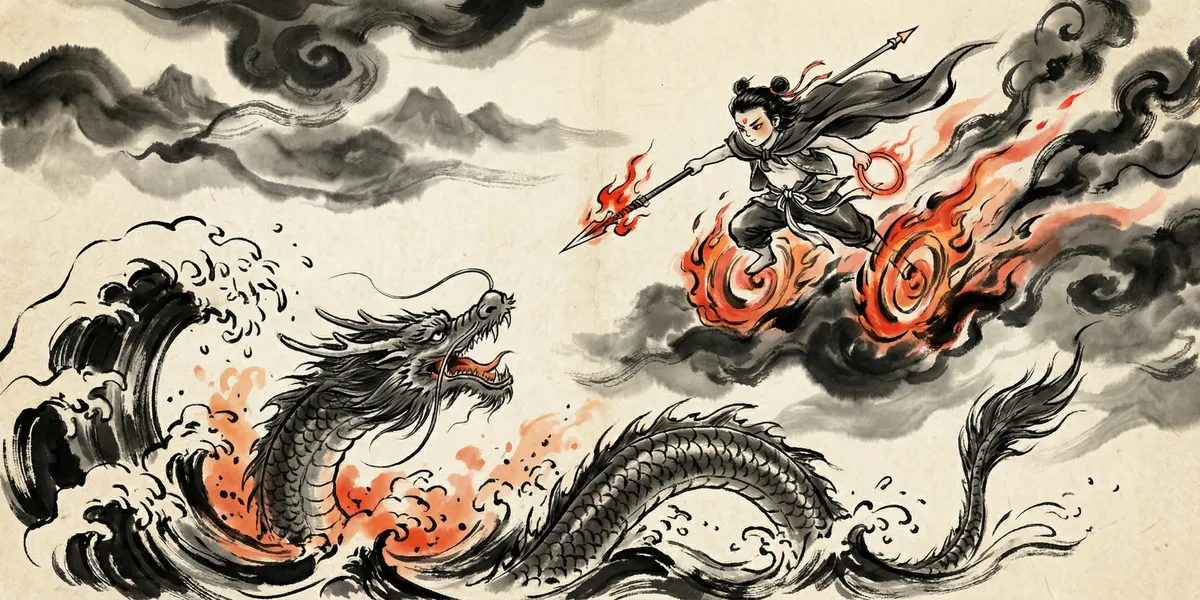
If Chinese mythology had an award for "Most Explosive Entrance," Nezha (Nézhā) would win it hands down. This is a child who carved his own flesh from his bones, returned them to his parents, and then came back from the dead reborn in a body of lotus flowers — his story is the most extreme collision between filial piety and rebellion in all of Chinese culture.
Let's start with his birth. Nezha's father, Li Jing (Lǐ Jìng), was the military commander of Chentang Pass. His mother carried him for a full three and a half years. On the day of delivery, what came out was not a baby but a glowing ball of flesh. Li Jing, convinced it was a demonic abomination, drew his sword and slashed — the ball split open, and out leaped a boy wearing a red dudou (belly wrap) and golden bracelets. The Universal Ring (Qiánkūn Quān) on his wrist and the Red Armillary Sash (Hùntiān Líng) draped across his body were no baby toys — they were bona fide divine weapons.
Nezha was fearless from the start. At the age of seven, he was washing his Red Armillary Sash in the sea when the silk's magical energy shook the entire Dragon Palace of the Eastern Sea (Dōnghǎi Lónggōng). The Dragon King's third prince, Ao Bing, came to confront him — and Nezha killed him. Not only that, Nezha stripped the dragon's tendons and flayed his scales, and brought them home to make a belt for his father. At seven years old, he had already made enemies of all four Dragon Kings of the seas.
The Dragon King of the Eastern Sea (Dōnghǎi Lóngwáng) was apoplectic. He threatened to flood all of Chentang Pass and file a formal complaint with the Heavenly Court. Li Jing was terrified — as a military commander guarding a border post, his greatest fear was divine retribution that would condemn his entire family. He turned on his own son and demanded Nezha take full responsibility.
This brings us to the most gut-wrenching moment in the entire story. Facing his father's fury and the peril of his entire family, Nezha made an unthinkable choice: he carved his flesh and returned it to his mother; he stripped his bones and returned them to his father (gē ròu huán mǔ, tī gǔ huán fù). Blade by blade, he cut the flesh from his body and gave it back to his mother; bone by bone, he pulled apart his skeleton and returned it to his father. In the most extreme way possible, he settled the debt — you gave me blood and bone, and now I return every last piece. From this moment on, I owe no one anything.
This scene is the most paradoxical and shattering passage in Chinese mythology. It is filial piety taken to its absolute extreme — sacrificing oneself to protect one's parents — and yet simultaneously rebellion taken to its absolute extreme — repaying everything to declare total independence. "I've given back everything you ever gave me. From now on, my life is my own."
But the story doesn't end there. Nezha's master, the Immortal Taiyi (Tàiyǐ Zhēnrén), rebuilt his body using lotus flowers and lotus roots. Nezha was reborn in a lotus incarnation (liánhuā huàshēn) — no longer a being of flesh and blood, no longer a son of the Li family (at least not in the biological sense). He returned with a battle form of three heads and six arms (sān tóu liù bì), riding the Wind Fire Wheels (Fēnghuǒ Lún), wielding the Fire-Tipped Spear (Huǒjiān Qiāng), armed to the teeth with divine weapons.
The reborn Nezha was a force of nature. He became one of the Heavenly Court's most formidable vanguard generals, following Jiang Ziya (Jiāng Zǐyá) in the "Investiture of the Gods" (Fēngshén Yǎnyì) to overthrow the tyrannical last king of the Shang dynasty, slaying demons and storming fortresses, earning the fearsome title of "Great God of the Three Altars and the Sea Assembly." He eventually reconciled with his father Li Jing — but the relationship always carried its scars. Whenever Nezha lost control of his rage, Li Jing would deploy the Exquisite Pagoda given to him by the Buddha to suppress him. Between father and son, trust and wariness always coexisted.
Nezha's story has resonated across centuries because of the tension at its core: the pull between obedience and rebellion. Chinese culture places supreme importance on filial piety (xiào), and yet here is a hero whose defining moment is rejecting his father's claim over his body. He is the eternal youth — hot-blooded, impulsive, bursting with a sense of justice, refusing to accept an unjust world. He has already died once; he fears nothing.
Nezha's arsenal is arguably the most impressive in all of Chinese mythology: the Fire-Tipped Spear, the Universal Ring, the Red Armillary Sash, the Wind Fire Wheels, the Gold Brick, the Nine Dragons Divine Fire Shield, and the Yin-Yang Swords — seven divine weapons wielded by three heads and six arms, virtually unstoppable. And those Wind Fire Wheels beneath his feet have become his most iconic image — a teenage war god blazing across the sky on wheels of flame. It's a picture that practically every Chinese person can describe from memory.
East vs West
East · Nezha
Western counterpart: heracles
Nezha's closest Western counterpart is Heracles (Hercules) — both are young heroes of superhuman strength who accomplished impossible feats in their youth. But a closer look reveals fundamental cultural differences. Heracles' tragedy comes from external forces — Hera's jealousy drove him to madness, causing him to kill his own family. Nezha's tragedy comes entirely from within the family; his greatest adversary is not a monster but his own father. Heracles' Twelve Labors are acts of atonement; Nezha's returning of flesh and bone is an act of liberation. The Greek hero struggles to earn a seat on Olympus; the Chinese youth destroys himself to prove he belongs to no one. In Western mythology, defying one's father (like Phaethon driving the sun chariot) typically ends in catastrophe; in Nezha's story, defiance is precisely the starting point of transcendence — through death he achieves rebirth, through giving up everything he attains true freedom. This reflects two cultures' divergent imaginative paths for handling the eternal conflict between the individual and parental authority: in the West, rebellion tends to lead to destruction; in China, rebellion can lead to nirvana.
Modern Influence
The 2019 animated film "Ne Zha" ("Nezha: Birth of the Demon Child") became the highest-grossing animated film in Chinese box office history, earning over 5 billion yuan. Its tagline — "My fate is mine to decide, not heaven's" (wǒ mìng yóu wǒ bù yóu tiān) — became a national catchphrase, perfectly capturing the contemporary expression of Nezha's spirit. Nezha is a top-tier character in the mobile game "Honor of Kings" and recurs throughout Chinese pop culture as the archetypal rebellious youth. For China's Generation Z, Nezha represents the ultimate anti-establishment hero — refusing to accept fate, refusing to back down, refusing to bow to injustice. The 2025 Chinese New Year sequel "Ne Zha 2" shattered records once again, confirming that this three-thousand-year-old teenage war god still commands astonishing cultural appeal in the modern era. The image of Nezha riding his Wind Fire Wheels has permeated contemporary design, from skateboard culture to streetwear collaborations — Nezha remains synonymous with "cool."
Related Characters
 Erlang ShenBack to CompendiumSun Wukong
