
Loong (Chinese Dragon)
Loong (Chinese Dragon)
Lord of All Scaly Creatures, Supreme Among Beasts
Shanhaijing Original Text
大荒东北隅中,有山名曰凶犁土丘。应龙处南极,杀蚩尤与夸父,不得复上,故下数旱。
In the far northeastern corner of the Great Wilderness, there is a mountain called Xiongli Tuqiu. The Winged Dragon (Yinglong) dwells in the extreme south. It slew Chiyou and Kuafu, but could not return to the heavens thereafter, and so droughts became frequent below.
In the far northeastern corner of the Great Wilderness, there is a mountain called Xiongli Tuqiu. The Winged Dragon (Yinglong) dwells in the extreme south. It slew Chiyou and Kuafu, but could not return to the heavens thereafter, and so droughts became frequent below.
Identity
Deer antlers, ox head, shrimp eyes, serpent body, fish scales, eagle talons — nine resemblances fused into one, clad in golden scales, with flowing whiskers and an aura of divine radiance
Summons wind and rain, rides clouds and mist, transforms endlessly, commands all rivers, lakes, and seas
Imperial power, strength, auspiciousness, the totem of the Chinese nation
Legend
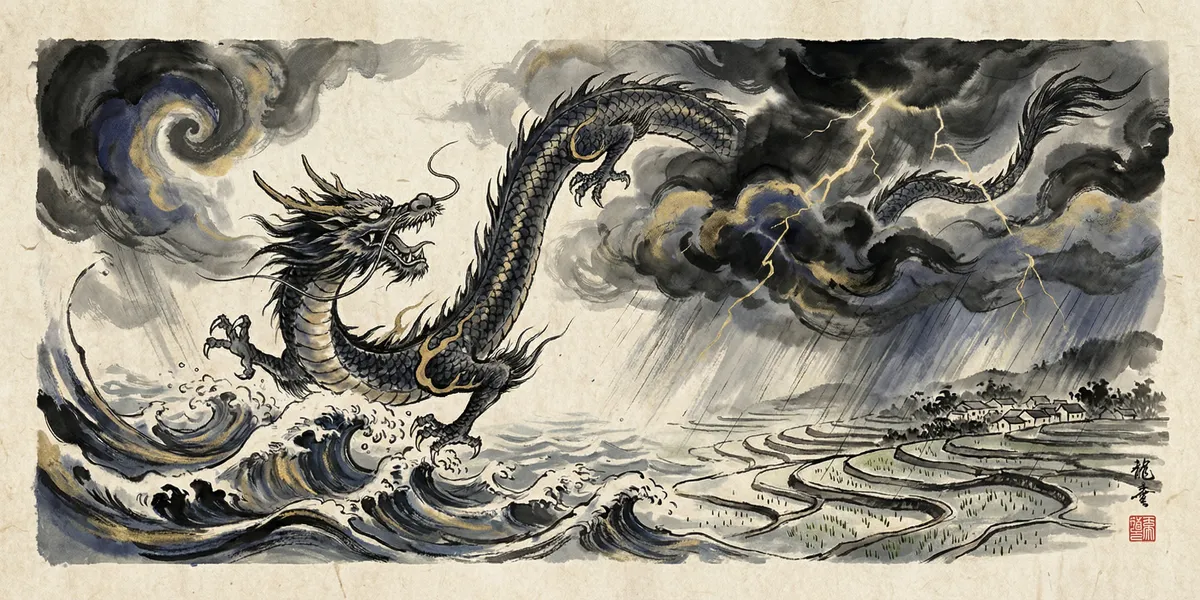
Let's get the most important thing straight first: the Chinese dragon (long) is absolutely nothing like the fire-breathing, princess-snatching, gold-hoarding overgrown lizard of the West. In China, the dragon is sacred — the most revered divine beast in the entire mythological pantheon. It symbolizes imperial power, the Way of Heaven, and the life-giving force of water. Translating it as "dragon" is itself a cultural mistranslation, which is why more and more people now advocate using the pinyin "Loong" instead.
The dragon's origins stretch back over six thousand years. Jade dragons unearthed from the Hongshan Culture (Hongshan Wenhua, c. 4500 BCE) are among the earliest dragon images ever found. But the sinuous, cloud-riding, wind-commanding dragon we know today is actually the product of thousands of years of tribal merging. The mainstream scholarly view holds that ancient tribes each had their own totems — snake, deer, fish, eagle, ox — and when tribes merged, so did their totems, combining into a single composite divine beast. This is the concept of "jiu si" (Nine Resemblances): deer antlers (lujiao), ox head (niutou), shrimp eyes (xiayan), serpent body (sheshen), fish scales (yulin), eagle talons (yingzhao), tiger paws (huzhang), ox ears (niu'er), plus the overall essence of a divine serpent. It is not any single animal but the unification of all animals — the dragon itself is a symbol of "oneness."
The dragon's power is intimately connected to water. The Four Dragon Kings (Sihai Longwang) — Ao Guang of the East Sea, Ao Qin of the South Sea, Ao Run of the West Sea, and Ao Shun of the North Sea — govern all the world's waters, controlling rainfall, rivers, floods, and tides. In an agricultural civilization dependent on the heavens for sustenance, the Dragon Kings held enormous importance. Dragon King temples dotted every river valley and coastline, and during droughts, people performed elaborate rain-prayer (qiyu) rituals — dragon dances, offerings, and even parading dragon statues through the parched fields.
But the dragon's significance goes far beyond favorable weather. It is the supreme symbol of imperial authority. The emperor was called the "True Dragon Son of Heaven" (zhen long tianzi), sat on a Dragon Throne (longyi), and wore Dragon Robes (longpao) embroidered with exactly nine five-clawed golden dragons, because nine and five are the numbers most fitting for the supreme position. The emperor's face was called the Dragon Countenance (longyan), and offending the emperor meant offending the Heavenly Dragon. This was not mere metaphor but state ideology: the dragon conferred upon the emperor the legitimacy to rule, proof that he held the Mandate of Heaven.
Chinese mythology also tells of the "Nine Sons of the Dragon" (long sheng jiu zi), each different from their father and from each other. Qiuniu loves music and is carved onto instrument heads; Yazi craves slaughter and decorates sword hilts; Chaofeng loves heights and crouches on roof ridges; Pulao loves bellowing and is cast onto bell tops; Suanni loves smoke and fire and guards incense burners; Bixi loves bearing weight and carries stone steles; Bi'an loves litigation and stands before prison gates; Fuxi loves literature and twines around stele inscriptions; Chiwen loves swallowing and perches at both ends of roof ridges to ward off fire. Each son in its proper place — which is itself a parable about everything finding where it belongs.
The varieties of dragons are equally rich. Yinglong is the oldest and most powerful winged dragon, said to have helped the Yellow Emperor defeat Chiyou at the Battle of Zhuolu. Jiaolong dwells in rivers and lakes, not yet fully ascended. Chilong is hornless and commonly seen in jade carvings. Zhulong is an ancient primordial beast whose open eyes bring day and closed eyes bring night, whose exhaled breath brings summer and inhaled breath brings winter. These are not subspecies but different stages of transformation and different aspects of cosmic power.
The "Classic of Mountains and Seas" (Shanhai Jing) records: "Yinglong dwells in the extreme south, having slain Chiyou and Kuafu." The "Shuowen Jiezi" calls the dragon "lord of all scaly creatures, able to be hidden or bright, fine or huge, short or long." The "Book of Rites" (Liji) further lists the dragon as one of the "Four Sacred Creatures," alongside the phoenix, tortoise, and qilin. The dragon's status in Chinese culture was not bestowed by any single book but is a collective belief accumulated by an entire civilization since antiquity.
The dragon is not a monster you need to slay — it is a being you need to revere. It does not guard gold in a cave — it brings sweet rain to your fields. It does not terrorize villages — it protects an entire nation. Understanding this distinction is understanding one of the deepest divides between Eastern and Western mythology.
East vs West
The contrast between the Chinese dragon and the Western dragon is one of the most striking cultural divergences in world mythology. In European tradition — from Beowulf to Saint George and the Dragon to Tolkien's Smaug — the dragon is the ultimate villain: greedy, destructive, fire-breathing, and a hero must slay it to prove his worth. Dragon-slaying is a rite of passage, and the dragon represents chaos, evil, and plundered wealth that must be liberated.
In China, the very idea of killing a dragon is not just absurd — it borders on sacrilege. The dragon is sacred, benevolent, and intimately connected to the natural order. It brings rain, not fire; it symbolizes the emperor, not the enemy. Western heroes gain glory by destroying dragons; Chinese emperors gain legitimacy by becoming dragons. This single distinction — monster vs. deity, enemy vs. ancestor — reveals fundamentally different worldviews about humanity's relationship with power and nature. The "Erya" classifies the dragon as the lord of "scaly creatures," and this classification itself reveals the Chinese attitude toward the dragon: it is the supreme ruler of the animal kingdom, not an alien being to be conquered. The Western dragon-slaying narrative stems from a dualistic view of humanity opposing nature, while Chinese dragon worship is rooted in the harmonious philosophy of the unity of heaven and humanity.
Modern Influence
The dragon is omnipresent in modern Chinese life. The Dragon Boat Race (longzhou sai) during the Dragon Boat Festival (Duanwu Jie) has been recognized by UNESCO as an Intangible Cultural Heritage and has developed into an international competitive sport. Birth rates always spike noticeably during Dragon Years (long nian) in the Chinese zodiac, as parents hope their children will inherit the dragon's power and fortune. In recent years, a cultural movement has been pushing to replace the English word "Dragon" with "Loong" when referring to the Chinese dragon, arguing that the Western connotations of "dragon" distort its original meaning — during the 2024 Year of the Dragon celebrations, the word "Loong" sparked widespread discussion on social media. Dragon motifs, from the coiled dragon pillars of the Forbidden City to dragon elements on contemporary fashion runways, have never lost their visual vitality. Dragon dances (wu long) remain the most spectacular finale of Chinese New Year celebrations worldwide. In gaming, the dragon-related boss battles in "Black Myth: Wukong" gave global players a visceral sense of the Chinese dragon's majesty.
Related Characters
 NianBack to CompendiumFenghuang (Chinese Phoenix)
