
Nian
Nianshou, The New Year Monster
The Village-Devouring Beast of New Year's Eve
Shanhaijing Original Text
民间传说:年兽居于深山海底,每至岁末除夕,出山入村,吞食人畜。后人发现其惧红色、火光、爆竹声,遂以此驱赶,沿袭成俗。
Folk legend says: The Nian beast dwells in deep mountains or the sea bottom. Every New Year's Eve, it emerges to enter villages and devour people and livestock. Later, people discovered it fears the color red, firelight, and firecracker sounds, so they used these to drive it away, and this custom has continued ever since.
Folk legend says: The Year Beast dwells in deep mountains or the sea bottom. Every New Year's Eve, it emerges to enter villages and devour people and livestock. Later, people discovered it fears the color red, firelight, and firecracker sounds, so they used these to drive it away, and this custom has continued ever since.
Identity
A hybrid of lion and dragon, with a cavernous blood-red mouth, a single horn upon its head, malevolent eyes, and a massive frame
Immense strength, devours people and livestock, fears the color red, bright light, and loud noise
The threat of the old year, sweeping away the old to welcome the new, family reunion, the continuation of tradition
Legend
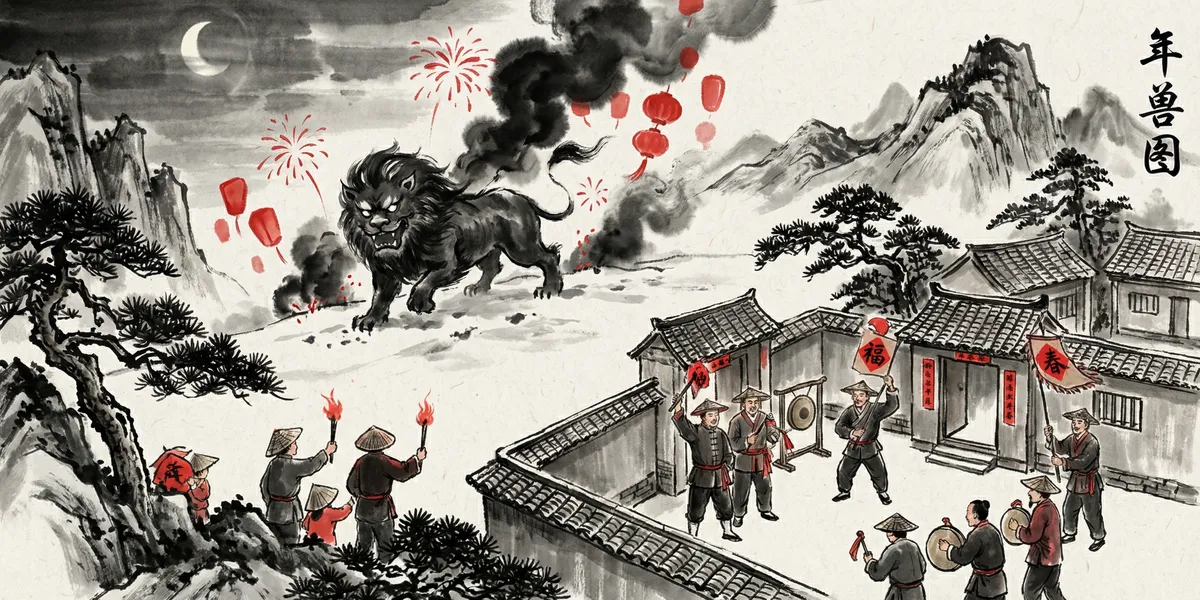
If there is one mythical beast that has had the greatest impact on daily Chinese life, it has to be the Nian (Nianshou). Because of this creature, the Chinese wear red during the New Year, paste red couplets on their doors, set off ear-splitting firecrackers, and stay up all night — virtually the entire visual and auditory aesthetic of Chinese New Year (Chunjie) was invented to deal with this one monster.
The Nian's appearance varies slightly across versions, but the core elements are highly consistent: a massive frame, looking part lion and part dragon, with horns on its head, a cavernous blood-red mouth, jaws full of fangs, and eyes glowing menacingly in the dark. It normally lives deep in the mountains or at the bottom of the sea (different regional legends disagree on its "registered address"), sleeping peacefully for three hundred sixty-four days of the year. But on New Year's Eve (chuxi) — the last night of the lunar year — it wakes up, absolutely ravenous.
How ravenous? Ravenous enough to come down from the mountains and eat people. Every New Year's Eve, the Nian burst from its lair, stormed into nearby villages, and ate everything in sight — people, cattle, whatever it could find. An entire village could be devastated in a single night. Year after year, as New Year's Eve approached, villagers would pack up their families and flee into the mountains, abandoning their homes and livestock to the Nian, hoping only to save their lives. Living on the edge of terror, year after year.
The turning point came on one particular New Year's Eve. A white-haired old man arrived at the village. Everyone was busy fleeing for their lives, but one kind-hearted old woman took him in and gave him food. The old man said: "You don't need to run. I have a way to deal with the Nian." The old woman left skeptically, and the old man stayed behind alone. He plastered the doors and windows with red paper, built a bonfire in the courtyard, and threw bamboo joints into the fire — the hollow bamboo exploded with deafening "crack-crack-crack" sounds as it heated.
That night, the Nian came to the village as usual, hunting for food. But as soon as it approached this particular house, it began to tremble all over — the sight of all that red (hongse) gave it a splitting headache, the bright firelight (huoguang) dazzled its eyes, and the thunderous cracking of exploding bamboo (juxiang) scared it out of its wits. The Nian let out a terrible shriek, turned tail, and fled, never daring to return.
The next day, the refugees returned to find the village intact, while the white-haired old man had vanished (most likely an immortal who had descended from heaven). They finally understood the Nian's three great weaknesses: it fears the color red, bright light, and loud noise. From then on, every New Year's Eve, every household used these three things to "guard against the Nian":
Paste red Spring Festival couplets (chunlian) and red "fu" characters — painting the doors crimson;
Hang red lanterns (denglóng), light candles — keeping everything brilliantly lit inside and out;
Set off firecrackers (bianpao) — filling the entire village with thunderous noise.
The whole family gathers together and stays awake all night — this is called "shou sui" (guarding the year), literally "holding on through this year," everyone huddling together and using their presence and noise to scare the Nian away. At the stroke of midnight, firecrackers erupt, the streets blaze with red light, and someone shouts "guonian le!" (we've survived the year!) — meaning "the Nian has passed! We've lived another year!"
Interestingly, the character "nian" (nian) itself derives from the legend of the Nian beast. Originally it referred to this monster, and only later evolved into the unit of time meaning "one year." So when we say "guonian" (celebrating New Year), the literal meaning is actually "surviving the Nian's threat." Saying "xinnian kuaile" (Happy New Year) is, at its root, a celebration of yet another successful repulsion of a man-eating monster — though this primal meaning has been softened over millennia into the warm atmosphere of family reunion.
In some regional versions, the Nian was eventually tamed by a Daoist immortal (Daojiao xianren) and became his mount. So the Nian never returned — but people didn't dare gamble on that, so they continued setting off firecrackers and posting couplets every New Year's Eve. In modern terms: what if one year we skip the firecrackers and the Nian comes back? Nobody can afford that risk. And so, fear became custom, custom became culture, and culture became one of the grandest celebrations on earth.
East vs West
The Nian shares certain parallels with European "holiday monsters" — most famously Krampus, the Alpine demon that punishes naughty children at Christmas. But their logic is entirely different: Krampus's arrival depends on individual behavior — be good and you get Santa Claus, misbehave and you get Krampus. The Nian does not care whether you've been good or bad; it launches indiscriminate attacks. The way to deal with Krampus is "be a good child"; the way to deal with the Nian is "the whole family sets off firecrackers together." The former emphasizes individual morality, the latter emphasizes collective action. This difference is profoundly revealing: Western holiday traditions tend toward a system of "individual responsibility," while the Chinese Spring Festival tradition is an "all-hands-on-deck" affair. The Nian's most extraordinary legacy is that it transformed a "survival terror" completely into a "collective celebration" — there is probably no other monster in the world that managed to turn its own threat into humanity's biggest party.
Modern Influence
The Nian is one of the most deeply ingrained legends in Chinese Spring Festival culture. Every year during Chinese New Year, from kindergartens to the CCTV Spring Festival Gala, the Nian's story is told and retold. In modern commercial contexts, the Nian has even been "cutified" — major brands release adorable Nian-themed merchandise, animated shorts, and limited-edition products. "The Nian is coming!" has transformed from a cry of terror into a promotional slogan. Every string of firecrackers, every couplet, every red lantern is, on a cultural-genetic level, "anti-Nian equipment." Mobile games and animated films frequently feature the Nian, some preserving its original ferocity, others reimagining it as a misunderstood "lonely monster." Whichever version prevails, the Nian remains the most powerful narrative engine of Chinese Spring Festival customs — because its story answers the question every child will ask: "Why do we wear red for New Year? Why do we set off firecrackers?"
Related Characters
 BifangBack to CompendiumLoong (Chinese Dragon)
