
Zao Shen
Zao Shen, The Kitchen God
Heaven's Secret Agent Stationed at Your Stove
Domain
Every household in the mortal world
Role
Monitors the good and evil of mortals and reports to the Heavenly Court
Weapon
The Ledger of Good and Evil
Appearance
Plain official's robes, a kindly face, always by the kitchen fire
Legend
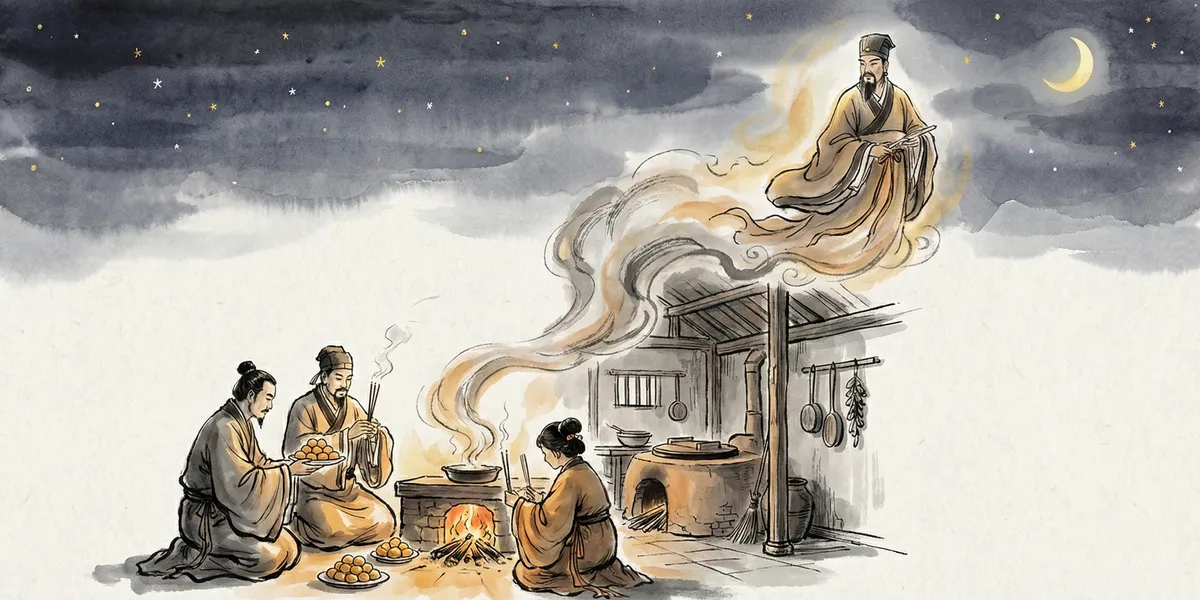
Every mythology has its cosmos-splitting primordial giants, its heaven-ruling supreme emperors, its fearsome war gods. But only Chinese mythology has a deity whose entire job is to squat in your kitchen, watch you cook, listen to you argue, and then fly up to heaven once a year to tattle on you to the boss. He is Zao Shen (Zào Shén), also known as Zao Wangye (Zào Wángyé) or Zao Jun (Zào Jūn) — the most down-to-earth, most smoke-and-steam-scented, and quite possibly the most influential deity in the daily lives of ordinary Chinese people.
His full title is impressively grand — "Eastern Kitchen Life-Commanding Fortune-Fixing Kitchen Lord" (Dōngchú Sīmìng Dìngfú Zào Jūn) — but his office couldn't be humbler. He doesn't reside in a celestial jade palace; he lives behind your kitchen stove. Specifically, his shrine is a small niche above the cooking surface, usually just a paper-printed portrait — and in some households, nothing more than a strip of red paper reading "Kitchen God's Seat." He is, without exaggeration, the most "grassroots" deity in the entire Chinese divine hierarchy.
The most widely circulated story about the Kitchen God's origin is a classic "prodigal son" tale. Once there was a prosperous farmer named Zhang Dan (Zhāng Dān) (some versions call him Zhang Wancang) who had a kind and capable wife named Dingxiang (Dīngxiāng, "Clove"). But Zhang Dan couldn't control himself; he became infatuated with another woman called Haitang (Hǎitáng, "Crabapple"), divorced his wife, and proceeded to live it up with Haitang, burning through his fortune in spectacular fashion. When the money ran out, Haitang left without looking back — after all, it was the money she loved, not the man. Zhang Dan was reduced to begging on the streets, utterly destitute.
One winter, half-frozen, Zhang Dan stumbled to a house to beg for food. The door opened — and there stood Dingxiang, his former wife. After being divorced, she had worked hard and rebuilt a good life for herself. She recognized her wretched ex-husband and didn't turn him away; instead, she made him a bowl of hot noodles. Zhang Dan held the bowl, looked up, saw that his ex-wife's life was ten thousand times better than his own, and was overwhelmed with shame. In the extremity of his humiliation and despair, he threw himself headfirst into the kitchen fire and burned to death.
The Jade Emperor (Yùdì) was watching from above. In this pathetic story, he saw an unexpected quality: a man who, in his final moment, felt genuine remorse. So instead of casting Zhang Dan into hell, the Jade Emperor gave him a second chance — with one condition. He appointed Zhang Dan as the Kitchen God, stationing him forever in the place that reminded him of his shame: the kitchen stove. His job would be to observe every household's daily conduct — good or evil, loyal or treacherous, industrious or lazy, harmonious or quarrelsome — and report back to heaven once a year.
The brilliance of this arrangement is that the Kitchen God is not some abstract, lofty presence — he is stationed in the most intimate space of your home: the kitchen. Every family argument, every sneaky little misdeed, every lie told over dinner — the Kitchen God sees it all, remembers it all. He is heaven's embedded agent in every household, a divine surveillance system deployed at the grassroots level. In a cultural tradition that places supreme value on family harmony, having a deity in your kitchen taking notes around the clock is a powerful incentive for good behavior.
The most important day in the Kitchen God's year is the twenty-third day of the twelfth lunar month (Làyuè Èrshísān) — also known as Little New Year (Xiǎonián; the twenty-third in northern China, the twenty-fourth in the south). On this day, the Kitchen God leaves his year-long post and ascends to heaven to deliver his annual performance report to the Jade Emperor. The report covers everything in exhaustive detail: Was this family harmonious? Did they waste food? Were their business dealings honest? Did they treat their elders with respect? The Jade Emperor uses this "annual performance review" to determine the family's fortunes for the coming year.
Every household wants the Kitchen God to say nice things. So the Chinese devised an eminently practical solution: bribery. The core ritual item for the "sending off the Kitchen God" ceremony (jì zào) is malt candy (tángguā), an extraordinarily sticky confection. People smear the candy directly onto the lips of the Kitchen God's portrait. The logic is delightfully straightforward: if his mouth is glued shut, he can't say anything bad; if all he tastes is sweetness, he can only say good things.
The classic prayer recited when sending the Kitchen God to heaven is one that virtually every Chinese person knows by heart: "Ascend to heaven and speak only good words; return to earth and bring peace and safety" (Shàngtiān yán hǎoshì, xiàjiè bǎo píng'ān). This line is half prayer, half negotiation — both reverent and pragmatic. Some regions also offer wine to the Kitchen God — reasoning that if he's drunk, his memory will be fuzzy, and fuzzy memory means he'll forget the bad stuff. Other regions simply burn the Kitchen God's paper portrait — because the smoke will "carry" him to heaven — and then paste up a new portrait on New Year's Eve to welcome him back from his "business trip."
The Kitchen God's return on New Year's Eve also has its own ceremony — a fresh portrait goes up, offerings are laid out, firecrackers boom. The whole family pays extra attention to their behavior for the first few days, figuring they should at least start the "new review period" on good terms.
What makes the Kitchen God special is precisely his ordinariness. He's not powerful, not handsome, not possessed of great magical abilities — just a man who once made terrible mistakes and, after death, was assigned to a kitchen on surveillance duty. He doesn't vanquish demons or save the world; he just watches you and takes notes. And yet this "minor god" has been one of the most consistently worshipped deities in China for over two thousand years — because every family has a kitchen, and every family has things they'd rather heaven didn't know about. The Kitchen God represents the deepest principle of Chinese folk belief: the Way of Heaven doesn't only concern itself with emperors and generals — it pays attention to the rice, oil, salt, and vinegar of every ordinary family. Heaven has stationed someone in your kitchen. He is taking notes.
East vs West
East · Zao Shen
Western counterpart: hestia
The closest Western figures to the Kitchen God are Hestia (Greek) and Vesta (Roman) — fellow guardian deities of the hearth and home. But a closer look reveals the similarity is only skin-deep. Hestia is a warm, loving, unconditionally protective presence — she doesn't judge, doesn't record, doesn't report. She simply is the comforting flame that makes the whole family feel safe. Vesta's sacred fire in Rome was tended by the Vestal Virgins and symbolized the eternal life of the state. Both are passive, gentle, unconditionally protective deities. The Kitchen God is nothing like this. He is an auditor, an inspector, a ground-level civil servant with a notebook in hand. Hestia radiates unconditional warmth; the Kitchen God radiates conditional approval. She protects you from external threats; he monitors your internal conduct. This reflects a fundamental difference in how East and West understand the relationship between the sacred and the domestic space: in the West, the hearth deity shields the family from outside harm; in China, the Kitchen God monitors the family's inner workings on heaven's behalf.
Modern Influence
Kitchen God worship remains one of the most widely practiced folk customs in China today. Every Little New Year, hundreds of millions of Chinese households still perform some form of the send-off ceremony — buying malt candy, reciting the prayer, deep-cleaning the house (taking advantage of the Kitchen God's absence to tidy up). "Ascend to heaven and speak only good words; return to earth and bring peace and safety" appears on Spring Festival couplets hung on doors across the nation. The Kitchen God has also unexpectedly become an internet meme — Chinese netizens jokingly refer to smart speakers and home security cameras as "electronic Kitchen Gods" (diànzǐ zào shén), a wry commentary on how modern technology surveils domestic privacy. Brands like Xiaomi and Tmall Genie regularly incorporate "Kitchen God ascending to heaven for his annual report" into their Little New Year marketing campaigns. A folk belief more than two thousand years old has found new life in the digital age in the most unexpected way imaginable.
Related Characters
 Yue LaoBack to CompendiumFuxi
