
Fuxi
Fuxi, God of Civilization
The Founding Father Who Drew Order from Chaos
Domain
Civilization, Knowledge, Marriage
Role
Founding father of human civilization
Weapon
The Eight Trigrams (Bagua)
Appearance
Human head with serpent body, holding the Eight Trigrams diagram
Legend
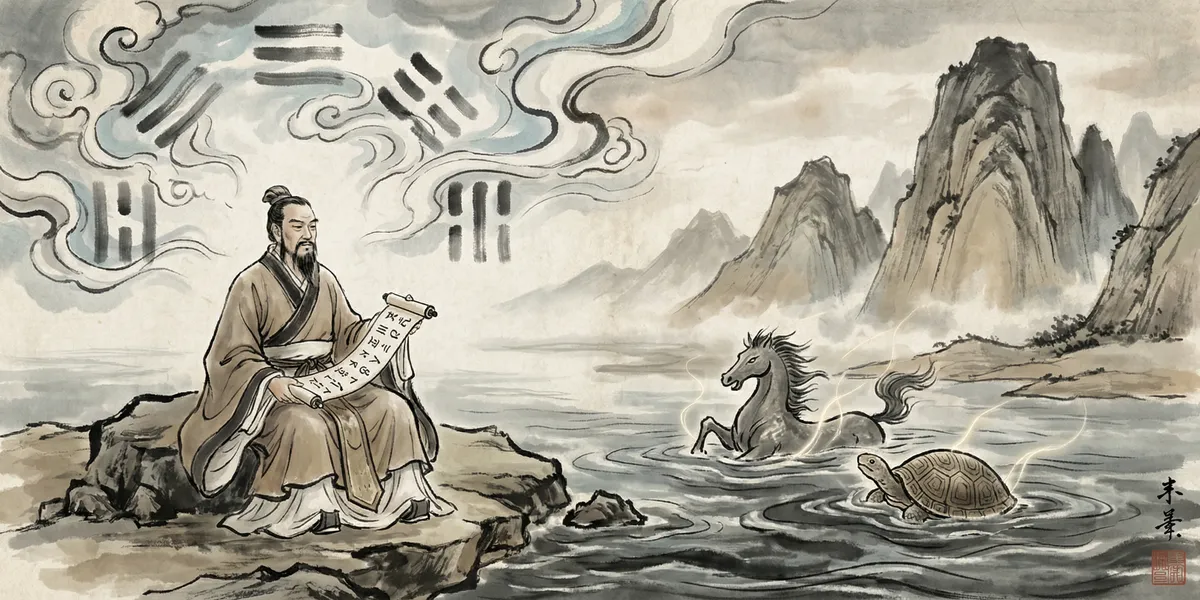
After Pangu split heaven and earth and Nuwa shaped humanity from clay, people finally existed -- but they were living pretty rough. No writing, no calendar, no social rules, not even a systematic way to hunt or fish. Everyone was basically in "survival by pure luck" mode -- catch a rabbit today and you eat, miss it and you starve. It was into this age of fumbling ignorance that Fuxi (Fuxi) made his entrance.
Like Nuwa, Fuxi had the head of a human and the body of a serpent (ren shou she shen). In many ancient paintings, Fuxi and Nuwa's snake tails are shown intertwined, symbolizing the union of yin and yang and the genesis of all things. They were both siblings and spouses -- in the context of creation mythology, this represents the universe's most primordial pair of complementary forces. Fuxi embodies yang, Nuwa embodies yin, and together they form the complete taiji.
Fuxi's greatest achievement was the creation of the Eight Trigrams (bagua).
The story goes like this: one day, a miraculous dragon-horse (longma) leaped from the Yellow River. On its back was an extraordinary pattern -- later generations called it the River Chart (Hetu). Fuxi studied these patterns intently, then looked up at the constellations above, down at the contours of mountains and rivers below, observed the tracks of birds and beasts and the cycling of the four seasons, and ultimately distilled all the phenomena of the universe into eight symbols. These became the Eight Trigrams: Qian (Heaven), Kun (Earth), Zhen (Thunder), Xun (Wind), Kan (Water), Li (Fire), Gen (Mountain), and Dui (Marsh). The Yizhuan records: "In ancient times, when Baoxi ruled the world, he looked up to observe the patterns in the heavens, looked down to examine the forms on the earth, observed the markings of birds and beasts and what suited the land, took models from his own body nearby and from things far away, and thus created the Eight Trigrams."
Eight simple symbols, combinations of three lines -- something that basic, yet they constitute the foundational code of Chinese philosophy. The Yijing (Book of Changes) was later developed on the basis of the Eight Trigrams, and the Yijing is called "the foremost of all classics," having influenced millennia of Chinese philosophy, medicine, astronomy, military strategy, architecture, and everyday life. Visit a traditional Chinese doctor and they'll use yin-yang and the Five Elements. Practice tai chi and your footwork follows the trigram positions. Consult a feng shui master and they'll reference the trigrams again. You could say that these eight symbols Fuxi drew were the earliest "operating system" of Chinese civilization.
But Fuxi's contributions went far beyond the trigrams. He also invented knot-tying record keeping (jie sheng ji shi), using knotted cords to record information -- the most important data storage method before the invention of writing, essentially humanity's earliest "hard drive." He taught people to weave nets for fishing (jie wang bu yu), replacing the old method of blindly groping around in the water. He domesticated wild animals and taught humanity animal husbandry. He even invented the se, a stringed instrument, elevating the human spiritual world from "being able to eat" to "being able to enjoy music."
Most significant socially, Fuxi established the institution of marriage (hunyin zhidu). Before him, human mating was chaotic and random -- no fixed partners, no family structure. Fuxi codified wedding rituals and established the tradition of offering a pair of deerskins as a betrothal gift. From that point on, human society had the "family" as its basic unit. The Tongjian Waiji records that he "instituted marriage and used a pair of deerskins as the ceremonial gift." This was a monumental step -- with families came clans, with clans came social order, and humanity evolved from biologically "gregarious animals" into culturally "civilized society."
In Tianshui, Gansu Province, stands the Fuxi Temple (Fuxi Miao), first built during the Ming Dynasty and now the best-preserved complex of buildings dedicated to Fuxi worship in China. Every year on the sixteenth day of the first lunar month, the Fuxi Cultural Festival features a grand public ceremony. Fuxi is revered as the "Ancestor of Human Civilization" (renwen shizu), ranked alongside the Flame Emperor and the Yellow Emperor as the three great progenitors of the Chinese nation.
Fuxi's story is fundamentally a narrative about the transition from chaos to order. He didn't use brute force like Pangu to split heaven and earth, nor did he use tender devotion like Nuwa to create life -- he used observation, contemplation, and synthesis. He perceived the patterns governing the universe, translated them into a language humanity could understand, and taught them to everyone. If Pangu was the universe's construction worker and Nuwa was humanity's mother, then Fuxi was civilization's teacher.
East vs West
East · Fuxi
Western counterpart: Prometheus
Finding Fuxi's Western counterpart is complicated, because he simultaneously embodies the functions of several Western deities. The closest match might be the Norse god Odin -- both are the central "bringers of knowledge and writing" in their respective civilizations. Odin sacrificed one eye in exchange for comprehension of the Runes; Fuxi observed the dragon-horse and the River Chart to create the trigram symbols. Both gave humanity an encoding system for understanding the universe.
But the crucial difference lies in the cost. Odin's wisdom was obtained through pain and sacrifice -- he hung himself from the World Tree for nine days and nine nights, and lost an eye. This fits the Norse worldview that "knowledge must be purchased with suffering." Fuxi's process of discovering the trigrams was natural and harmonious: he observed celestial patterns and earthly geography, grasped the laws of nature, without any confrontation or sacrifice. This reflects the Chinese philosophical belief in "the Dao follows nature" (dao fa ziran) -- true wisdom doesn't need to be stolen from the heavens or bought with pain; it already exists within the operating patterns of nature, waiting for an attentive mind to discover it.
Another fascinating comparison is Prometheus. Prometheus "stole" knowledge (fire) for humanity and suffered Zeus's terrible punishment for it. In the Greek narrative, human progress is an offense against divine authority. But Fuxi's transmission of civilization was never seen as overstepping -- in the Chinese mythological framework, a sage teaching the people is part of the Heavenly Way, not a challenge to it. This reveals the most fundamental divergence between two civilizations: Western mythology tends to place gods and humans in opposition, while Chinese mythology tends to view Heaven, Earth, and Humanity as a harmoniously coexisting whole.
Modern Influence
Fuxi's influence in contemporary China is everywhere, though people have grown so accustomed to it they barely notice. The trigram diagram is the iconic symbol of Daoist temples and the core theoretical foundation of Chinese martial arts schools, especially Baguazhang (Eight Trigram Palm). The Yijing remains one of China's best-selling classical philosophical texts, with modern applications in business management, decision consulting, and psychological analysis. Notably, the taiji and four trigram symbols on the South Korean national flag originate directly from Fuxi's Eight Trigrams system. The annual Fuxi Cultural Tourism Festival held in Tianshui, Gansu has become a national-level intangible cultural heritage event, attracting Chinese people from around the world to honor their ancestor. In games and film, Fuxi typically appears as the "Ancestor of Civilization" or "Primordial Deity," serving as the defining figure of the "ancient era" in Chinese fantasy worldbuilding.
Related Characters
 Zao ShenBack to CompendiumShennong
