
Yue Lao
Yue Lao, The Old Man Under the Moon
The Matchmaker Who Ties the Red Thread of Destiny
Domain
The Bureau of Matrimonial Destiny in the Heavenly Court
Role
Oversees all marriages and romantic bonds under heaven
Weapon
Red thread and the Book of Matrimonial Destiny
Appearance
A white-haired, white-bearded elder, reading the Book of Destiny by moonlight
Legend
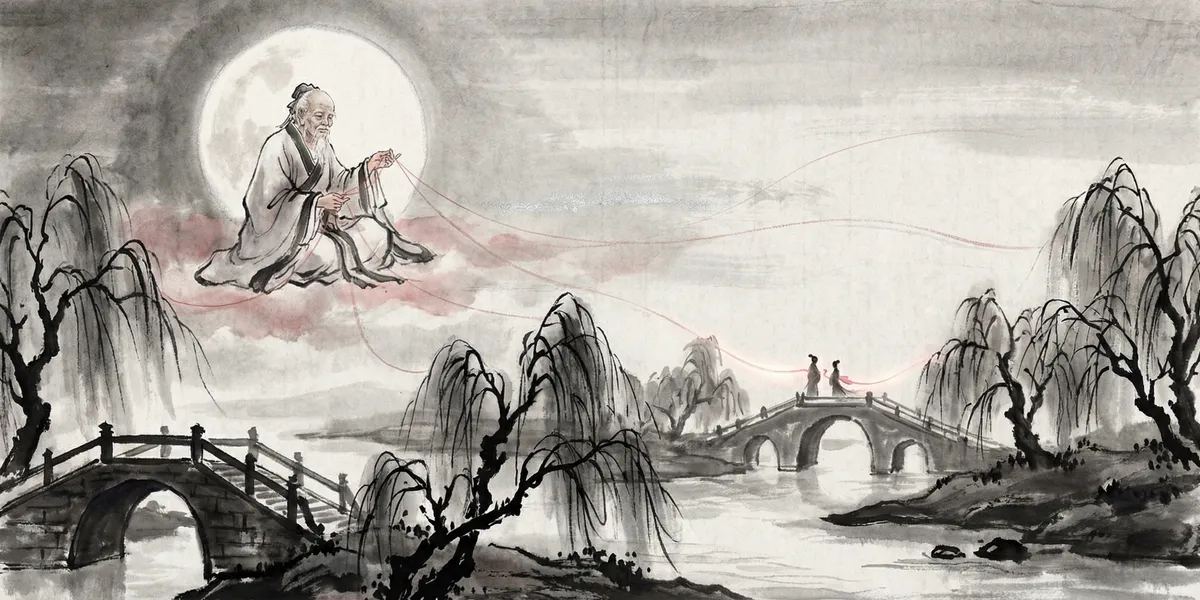
Within the vast bureaucratic apparatus of the Chinese Heavenly Court, there is one department that every mortal cares about but few dare to bother — the Bureau of Matrimonial Destiny (Yīnyuán Sī), essentially heaven's "Marriage Management Authority." Sitting in this office is a white-haired old gentleman, reading by moonlight from a tome ten times thicker than a dictionary, with a cloth sack beside him. He is the Old Man Under the Moon (Yuèxià Lǎorén), known colloquially as Yue Lao (Yuè Lǎo). He can't slay demons or summon storms, but what he does may be more important than everything all the other gods do combined — he decides who marries whom.
Yue Lao's "debut" story comes from a tale called "The Marriage Predestination Inn" in the Tang dynasty collection "Sequel to Records of Dark Mysteries" (Xù Yōuguài Lù), written around the ninth century. The protagonist is a young man named Wei Gu (Wéi Gù), who traveled to the city of Songcheng on business and, while he was at it, figured he'd look for a wife. One evening, outside his inn, he encountered an old man sitting against a cloth sack in the moonlight, poring over an enormous book by the light of the moon.
Wei Gu, curious, asked the old man what he was reading. The old man replied: "This is the Book of Matrimonial Destiny (yīnyuán bù). Every marriage in the world is recorded in this book. Which man marries which woman — it was all decided long ago." Wei Gu's eyes lit up, and he eagerly asked who his future wife would be. The old man chuckled and said: "Your future wife is currently three years old. She's the daughter of old Chen, the vegetable seller at the north market."
Wei Gu was dumbfounded. He was a man of status and standing — marry a vegetable vendor's three-year-old daughter? How humiliating. He pressed: "Can it be changed?" The old man reached into his cloth sack and pulled out a length of red thread (hóngxiàn). "This is the red thread. Once I tie this thread to two people's ankles, their fates are bound together. No matter if they're separated by a thousand mountains and ten thousand rivers, no matter how vast the gap in family status, no matter how deep their enmity — this thread will pull them together. Nothing in heaven or earth can break it."
Wei Gu was furious. He didn't believe in destiny. He sent a servant to find the three-year-old girl and kill her, breaking so-called "fate" once and for all. The servant found the baby girl in her nursemaid's arms and slashed with a knife — but only managed to cut a gash across her forehead before being swept away by the crowd. Wei Gu assumed the girl was dead and went on with his life, satisfied.
Fourteen years later, Wei Gu had become a minor official. His superior, Wang Tai (Wáng Tài), offered him his daughter's hand in marriage. The bride was beautiful, talented, virtuous — seemingly perfect. But she always wore a decorative flower on her forehead and never removed it. On their wedding night, Wei Gu asked her why. She lowered her head and said: "When I was three, my nursemaid was carrying me through the market when a madman slashed my forehead with a knife, leaving a scar. I've always covered it with a flower." The truth hit him like a bolt of lightning — she was Old Chen the vegetable seller's daughter. After her father died, she had been adopted by Wang Tai and raised as a noblewoman. The red thread had been tied all along. Fourteen years of twists and turns, and the two of them ended up together anyway.
This story established the most enduring image in Chinese romantic culture — the red thread (hóngxiàn), the "red thread of fate" or "red string of destiny." The concept is elegant and absolute: somewhere in this world, there is one person destined for you. An invisible red thread connects your ankles (in some versions, your pinky fingers). The thread may stretch, tangle, and wind through a million detours, but it will never break. You will meet.
Yue Lao himself is one of the gentlest figures in the Chinese celestial pantheon. He is old — very, very old — with a flowing white beard, eyes that are both kind and knowing. He sits in the moonlight (hence "the Old Man Under the Moon"), his Book of Destiny spread across his knees, a sack of red thread at his side. He doesn't judge, doesn't punish — he simply reads his book and ties his threads. In some folk paintings, he wears a faint, knowing smile — probably because he already knows how everything ends, which makes all the emotional turmoil of mortals rather amusing to watch.
At the heart of Yue Lao worship is one of the most universal and urgent of all human needs: finding love. Across mainland China and Taiwan, Yue Lao temples (Yuè Lǎo Miào) are packed with young singles praying for romantic destiny. The most famous is the Yue Lao shrine at Longshan Temple (Lóngshān Sì) in Taipei — there's a whole protocol for praying: first, you cast divination blocks (zhì jiǎo) to ask Yue Lao's permission to help; if granted, you receive a blessed red thread to wear on your wrist. The success rate is said to be remarkably high, and the walls of the shrine are plastered with thank-you letters and wedding invitations from successfully matched couples.
There's a crucial detail to praying to Yue Lao: you have to clearly state your name, birthday, address, and exactly what kind of partner you're looking for — because Yue Lao is a bureaucrat, and bureaucrats need specific information. You can't just say "I want someone nice"; you need to specify tall or short, introverted or extroverted, what profession. Some temples even provide forms for you to fill out — essentially a sacred version of a dating app profile. If you find someone but the relationship hits rocky waters, you can go back and "file a complaint" with Yue Lao — ask him to double-check the file. It's the celestial equivalent of customer service.
The philosophy of love that Yue Lao and the red thread represent is powerful because it seamlessly weaves together fatalism and romanticism. It tells every lonely person: love is not random. It's not about whether you're attractive or rich. It's written. It's destined. No matter how lost or alone you feel right now, that red thread was tied long ago, and it's quietly, steadily pulling you toward the right person.
East vs West
East · Yue Lao
Western counterpart: cupid
Yue Lao's most direct Western counterpart is Cupid (Greek name: Eros) — both are deities who govern love. But their "working methods" represent completely different philosophies of romance. Cupid is random — he draws his bow, shoots his arrow, and whoever is struck falls into sudden, overwhelming passion. Love under the Cupid model is chaotic, unpredictable, and frequently disastrous — recall how many Greek tragedies were sparked by Eros's arrows. Love equals lightning: beautiful but uncontrollable. Yue Lao takes the diametrically opposite approach. He doesn't improvise; he checks his ledger. Every match is pre-registered, pre-approved, filed in triplicate in the celestial database. Love under the Yue Lao model is not a random spark but an appointment you haven't kept yet — it's already on your calendar; you just haven't arrived. Cupid is a jazz improvisation solo; Yue Lao is a symphony written before the musicians were even born. This difference reflects a deeper cultural divide: Western romanticism celebrates the "beauty of the unexpected" and the thrill of unpredictable passion; Chinese romanticism draws comfort from the certainty that "the universe has a plan."
Modern Influence
Yue Lao's influence runs deep in contemporary Chinese romantic culture. Red string bracelets are one of the most popular accessories among young Chinese people (especially singles) — wearing a red string to "attract romantic luck" has become a hybrid of fashion and faith. Chinese dating apps heavily incorporate red thread imagery in their branding and marketing. Around the Qixi Festival (Qīxì Jié, Chinese Valentine's Day) each year, Yue Lao temples across the country see their biggest visitor surges. "Yue Lao tying the thread" has become the standard Chinese idiom for "setting someone up on a date," and matchmakers are commonly referred to as "Yue Lao." Even in the age of algorithmic recommendations and big data matching, the belief in "destined love" remains deeply rooted in the Chinese emotional DNA — after all, "we were matched by Yue Lao" sounds about a hundred times more romantic than "we were paired by an algorithm."
Related Characters
 CaishenBack to CompendiumZao Shen
