
Bifang
Bifang, The One-Legged Flame
The One-Footed Fire Bird of Antiquity
Shanhaijing Original Text
有鸟焉,其状如鹤,一足,赤文青质而白喙,名曰毕方,其鸣自叫,见则其邑有讹火。
There is a bird shaped like a crane with one foot, red patterns on a blue body and a white beak, named Bifang. Its cry sounds like its own name, and wherever it appears, strange fires will occur in that place.
There is a bird shaped like a crane with one foot, red patterns on a blue body and a white beak, named Bifang. Its cry sounds like its own name, and wherever it appears, strange fires will occur in that place.
Identity
Crane-shaped with a single leg, blue-green plumage with red markings, white beak and crimson claws, with a human face and bird body
Summons flames, foretells fire, hops on its single foot, walks through infernos unharmed
Spirit of fire, harbinger of disaster, yin-yang imbalance, the double-edged sword of civilization
Legend
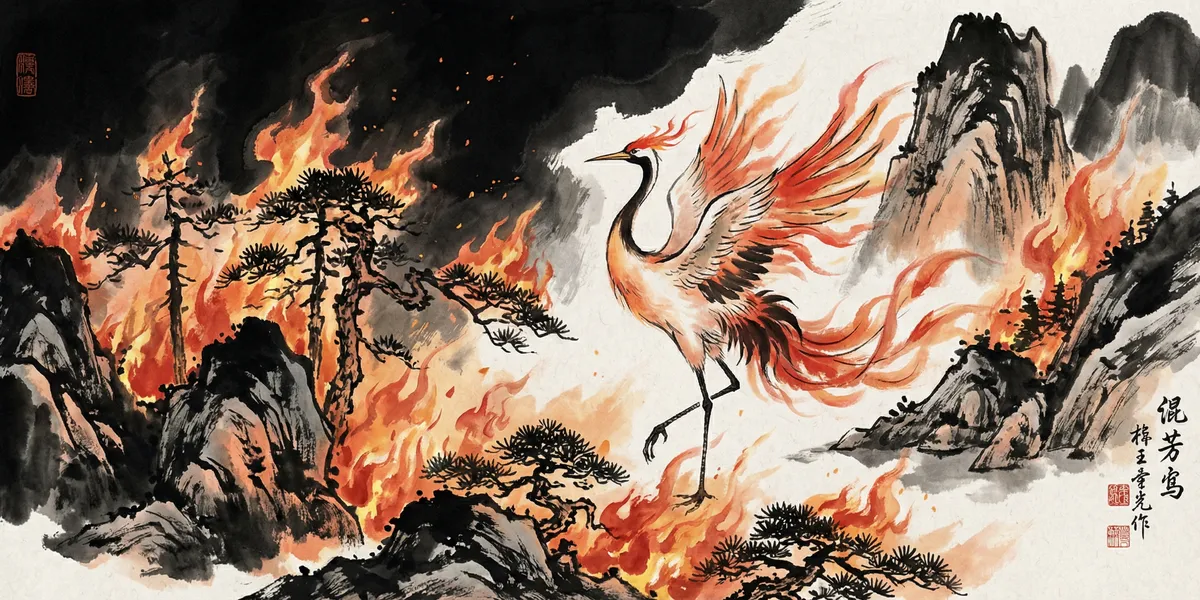
In the great family of mythological birds, Bifang (Bifang) is the most "dangerous" — not because of its ferocity, but because wherever it goes, fire follows. A crane-shaped bird standing on a single leg, with blue-green plumage dotted with red markings and a white beak, its cry is literally its own name: "Bi — fang —." When you hear that call, you had better start filling buckets, because mysterious fire is about to break out.
The "Classic of Mountains and Seas" (Shanhai Jing) describes the Bifang with crisp precision: "There is a bird shaped like a crane with one foot, red patterns on a blue body and a white beak, named Bifang. Its cry sounds like its own name, and wherever it appears, strange fires will occur in that place." Note the phrase "strange fires" — not ordinary fires, but eerie conflagrations of unknown origin that are nearly impossible to extinguish.
The Bifang's most distinctive physical feature is its single leg (dujiao). How can a bird have only one leg? To the ancients, this was deeply mysterious. Some scholars suggest that ancient people may have observed cranes standing on one leg while resting and assumed the bird was born with only one, spawning the entire mythology of a one-legged fire bird. But there is also a deeper reading: in yin-yang (yin yang) philosophy, a single leg signifies "yin-yang imbalance" — two legs create balance, one leg represents an extreme state. The Bifang has only one foot, representing an excess of yang energy (yang qi) with insufficient yin — and the ultimate expression of pure yang without yin is fire.
The Bifang also has a connection to the Yellow Emperor (Huangdi). The "Classic of Mountains and Seas" records that when the Yellow Emperor was smelting copper to cast ritual cauldrons at Mount Jing (Jing Shan), the Bifang bird appeared. In this context, the Bifang's appearance is not an omen of disaster but an auspicious sign of divine fire descending — because without fire there is no bronze smelting, without smelting there are no ritual cauldrons, and without cauldrons there is no foundation for Chinese civilization's ritual system. Here the Bifang is imbued with the positive meaning of "the fire of civilization": fire is dangerous, but it is also the fundamental force driving civilizational progress.
This "duality" is the Bifang's deepest cultural significance. Fire in Chinese philosophy has never been purely good or bad — it cooks food, provides warmth, smelts iron, and illuminates, but it also burns homes, destroys forests, injures people, and razes cities. The Bifang perfectly embodies this paradox (maodun): it is not an evil bird, but fire follows it; it does not intend to harm, but wherever it appears fire breaks out. This is the fundamental nature of elemental forces — they do not care about your feelings; they simply operate according to their own laws.
In actual folk belief, the ancients held an attitude of "reverence mixed with fear" toward the Bifang. On one hand, people performed rituals begging the Bifang to stay away — "please, honored elder, go be somewhere else." On the other hand, at occasions requiring fire (such as smelting and pottery-making), the Bifang was worshipped as a messenger of the fire god. This contradictory attitude precisely reflects the complex relationship between China's early peoples and the forces of nature — simultaneously dependent upon and in awe of them.
The Bifang's position in the ancient fire bird hierarchy is also worth noting. Chinese mythology has three famous fire birds: the Fenghuang (fenghuang) represents nobility and auspiciousness; the Vermilion Bird (zhuque) represents the south and summer; and the Bifang represents the raw, primal power of fire — without the Fenghuang's regal magnificence, without the Vermilion Bird's directional symbolism, just the purest, unadorned essence of fire itself. If the Fenghuang is fire's aesthetic sublimation, and the Vermilion Bird is fire ordered within cosmic structure, then the Bifang is fire in its original, unfiltered state: uncontrollable, unpredictable, awe-inspiring.
East vs West
The Bifang and the Western Phoenix both belong to the "fire bird" family, but their symbolic meanings diverge sharply. The Western Phoenix is a metaphor for "death and rebirth" — it self-immolates, then rises renewed from its own ashes, representing the eternal cycle of life. The Bifang has nothing to do with "rebirth"; it is simply the incarnation of fire — pure, direct, unadorned. The Western Phoenix is philosophical; the Bifang is physical. The Slavic Firebird is a treasure that adventurers pursue, capable of bringing both fortune and disaster; the Bifang is closer to the personification of a natural phenomenon — not a "treasure" you can hunt, but an uncontrollable force. What makes the Chinese Bifang most distinctive is its "moral neutrality" — it is neither good nor evil, makes no choices, and simply exists. This attitude of passing no moral judgment on natural forces is relatively uncommon in Western fire bird narratives.
Modern Influence
The Bifang is a popular fire-type creature in contemporary Chinese fantasy culture. In mobile and PC games, the Bifang is frequently designed as a summonable fire-attribute spirit beast or appears in its iconic "one-legged fire bird" form. In internet slang, "Bifang constitution" is occasionally used to playfully describe people who seem to bring problems wherever they go. Fire safety campaigns have also borrowed the Bifang's image, using "driving away the Bifang" as a metaphor for fire prevention. In traditional Chinese fire-pattern decorations and period-style illustration, the Bifang's one-legged crane form is a highly recognizable design element. In recent years, animated films like "Big Fish & Begonia" have brought renewed attention to Bifang and other "Classic of Mountains and Seas" creatures among younger audiences.
Related Characters
 XiezhiBack to CompendiumNian
