
Xiezhi
Xiezhi, The Judge of Heaven
The Divine Beast That Discerns the Loyal from the Treacherous
Shanhaijing Original Text
东北荒中有兽,名獬豸。一角,性忠,见人斗则触不直者,闻人论则咋不正者。
In the northeastern wilderness there is a beast named Xiezhi. With one horn and a loyal nature, when it sees people fighting it gores the one in the wrong, and when it hears people arguing it bites the dishonest one.
In the northeastern wilderness there is a beast named Xiezhi. With one horn and a loyal nature, when it sees people fighting it gores the one in the wrong, and when it hears people arguing it bites the dishonest one.
Identity
Somewhat goat-like yet not quite, somewhat deer-like yet not quite, with dense black fur and a single horn upon its head, eyes like piercing torches
Distinguishes the loyal from the treacherous, perceives good and evil, understands human speech, gores the wicked with its horn
Just law enforcement, keen-eyed discernment, incorruptible integrity, the authority of law
Legend
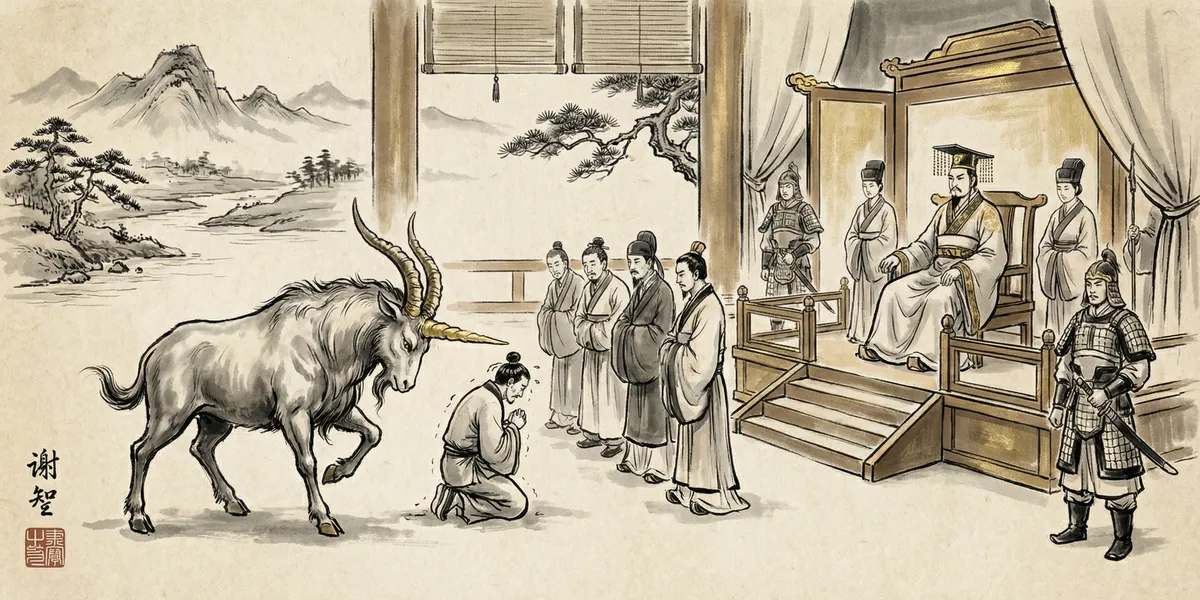
In the courtroom of Chinese mythology, there is one divine beast more trusted than any judge: the Xiezhi (Xiezhi). It looks somewhat like a goat yet not quite, somewhat like a deer yet not quite, its body covered in dense black fur, with a single horn on its head pointing straight at the sky. That horn is no decoration — it is a supernaturally accurate lie detector and executor rolled into one. Whoever is guilty, the horn strikes them — never wronging an innocent person, never letting a villain escape.
The earliest written record of the Xiezhi appears in the "Yiwu Zhi" (Record of Strange Things), describing it as "able to distinguish right from wrong; when it sees people fighting, it gores the one in the wrong; when it hears people arguing, it bites the dishonest one." This one-horned beast from the northeastern wilderness was regarded by later generations as the ultimate symbol of just law enforcement.
The most famous story about the Xiezhi involves the legendary judge Gao Yao (Gao Yao). Gao Yao was the judicial officer during the era of Emperors Yao and Shun, honored by posterity as "the founding father of Chinese law." Legend has it that when adjudicating difficult cases, he would bring out the Xiezhi. The method was simple: line up the suspects before the beast. If the Xiezhi stood still, the person was innocent. If it charged and struck with its horn, that was ironclad proof of guilt — no witnesses needed, no physical evidence required, one animal settled the entire judicial process. This "divine beast trial" system was certainly efficient, though from a modern legal perspective, it amounts to "presumption of guilt plus instant execution" — defense attorneys would collectively lose their minds.
But the Xiezhi's single horn also carries deep philosophical significance. The ancients believed that two horns signified indecision and wavering, while a single horn (dujiao) symbolized "one mind, unwavering" — an unshakable commitment to justice. The Xiezhi sees every issue in stark black and white, with no room for "maybe," "perhaps," or "close enough." In a society that favors "smoothing things over" through personal relationships, this kind of absolute justice becomes a rare and precious quality.
The Xiezhi's intelligence was also considerable. It was said to be able to distinguish not just good from evil but to comprehend all languages, including every dialect within the Chinese territories. No matter what language you lied in, to the Xiezhi's ears it was all the same — a lie is a lie. This "universal polygraph" ability made it the ideal judicial instrument in a vast, multilingual ancient empire.
For precisely these reasons, the Xiezhi's image was widely adopted in China's ancient legal and supervisory systems. Dynasty after dynasty, the censors (yushi) — officials specifically tasked with impeaching corrupt colleagues — wore caps embroidered with the Xiezhi motif, known as the "Xiezhi Crown" (xiezhi guan). A censor wearing the Xiezhi Crown entering the court hall meant "I represent justice, and I will investigate anyone with problems." This tradition persisted for over two thousand years, from the Han Dynasty through to the Ming and Qing.
What makes the Xiezhi unique in Chinese culture is that it transformed the abstract concept of "justice" into a concrete, tangible divine beast. Justice was no longer an invisible, intangible ideal but a real animal that would physically gore you with its horn. This power of embodiment was immensely potent: when you know there exists a beast that can smell lies, the psychological cost of lying rises dramatically. The Xiezhi is not just a myth — it is a "moral deterrence system" internalized within the cultural psyche.
East vs West
The Xiezhi and the Western Unicorn are both single-horned divine beasts associated with purity and virtue, but their functions point in completely different directions. The Western Unicorn symbolizes personal purity — it approaches virgins, embodies innocence, and is a passive, aesthetic being. The Xiezhi is an active law enforcer — it doesn't wait for good people to approach; it charges at wrongdoers and gores them. If the Unicorn is an angel, the Xiezhi is a bailiff. Western mythology also has the goddesses of justice, Themis and Justitia, but their signature image is the blindfold — ensuring fairness by "not seeing." The Xiezhi is the exact opposite: it sees everything, and its fairness comes from "seeing through all things" rather than "turning a blind eye." This reflects fundamentally different understandings of "justice" between East and West: the West emphasizes procedural justice — eliminating bias through institutional design; Chinese tradition leans more toward substantive justice — having a being with perfect moral judgment make direct rulings.
Modern Influence
The Xiezhi remains the most central cultural icon of the Chinese judicial system to this day. Xiezhi statues stand before courts and procuratorates throughout China, and its image frequently appears on police badges and legal publications. The "Xiezhi Crown" has become a cultural allusion for incorruptible law enforcers. In law school education, the Xiezhi is regularly cited in discussions of "legal faith" and "judicial justice." In period dramas and detective shows, the Xiezhi is often used as a visual symbol of the forces of justice. It is worth noting that comparing a judge or lawyer to a "Xiezhi" is the highest of compliments in China, signifying wisdom to see through to the truth and courage to defy the powerful.
Related Characters
 HundunBack to CompendiumBifang
