
Hundun
Hundun, The Faceless Chaos
The Faceless, Mindless Beast of Primordial Chaos
Shanhaijing Original Text
有神焉,其状如黄囊,赤如丹火,六足四翼,浑敦无面目,是识歌舞,实为帝江也。
There is a divine being shaped like a yellow sack, red as cinnabar fire, with six legs and four wings, chaotic and faceless, yet it knows song and dance — this is actually Dijiang (another name for Hundun).
There is a divine being shaped like a yellow sack, red as cinnabar fire, with six legs and four wings, chaotic and faceless, yet it knows song and dance – this is actually Dijiang (another name for Hundun).
Identity
A yellow mass of flesh, six legs and four wings, entirely faceless, lacking all seven openings, enormous in size
Cannot distinguish good from evil, creates chaos, cannot be defeated by conventional means, represents primordial chaos
Primordial chaos, ignorance, the state before order, the cost of civilization
Legend
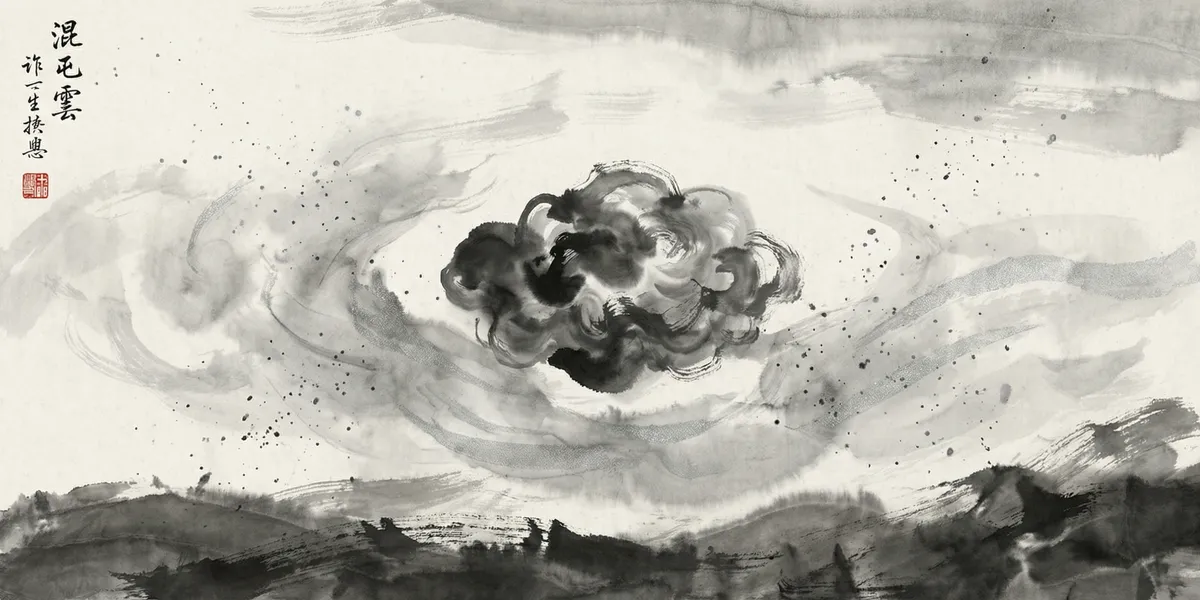
Among the Four Fiends, Hundun (Hundun) is the strangest — not because it is the most savage, but because it is the most bewildering. Imagine an enormous yellow blob of flesh with six legs and four wings, but no face — no eyes, no nose, no mouth, no ears, nothing where the head should be. And yet it can somehow see, hear, eat, and even sing and dance. Hundun is this kind of head-scratching existence: antiquity's original "glitch in the system."
The "Classic of Mountains and Seas" (Shanhai Jing) describes it thus: "There is a divine being, shaped like a yellow sack, red as cinnabar fire, with six legs and four wings, chaotic and faceless, yet it knows song and dance — this is actually Dijiang." Later commentators identified "Dijiang" as "Dihong," meaning a descendant of the Yellow Emperor (Huangdi), so in some narratives Hundun is classified as an offspring of the Yellow Emperor. But in the context of the Four Fiends, it more broadly represents a state — the primordial state before all things were differentiated, a formless mass of chaos.
Hundun's most famous story appears not in the "Classic of Mountains and Seas" but in the "Zhuangzi" (Zhuangzi), in the chapter "The Normal Course for Rulers" (Ying Diwang). Zhuangzi tells this parable: The Emperor of the Southern Sea was called Shu (meaning "swift"), and the Emperor of the Northern Sea was called Hu (meaning "sudden"). The Emperor of the Center was called Hundun. Shu and Hu often visited Hundun's territory, and Hundun treated them very kindly. The two emperors wanted to repay Hundun's hospitality, so they conferred: "All people have seven openings (qi qiao) — two eyes, two ears, two nostrils, one mouth — for seeing, hearing, eating, and breathing. But Hundun has none of these. How pitiful! Let us bore seven openings for it!" And so, each day they bored one opening: the first day the left eye, the second day the right eye, the third day the left ear... On the seventh day, when all seven openings were complete — Hundun died.
This story is one of Daoist philosophy's most brilliant parables. Its deeper meaning is this: Shu and Hu's "good intentions" were precisely the weapon that killed Hundun. They imposed their own standards on it — "you should have seven openings like us" — without considering that Hundun's existence had its own validity. Hundun had no face and no senses, but it was doing perfectly fine; once the seven openings were bored through, it died. This is the sharpest possible critique of "over-civilization": not all "progress" is progress, and not all "help" is help. Sometimes, well-meaning transformation is more lethal than malicious destruction.
But Hundun's image in other texts is not always this philosophical. In its role as one of the Four Fiends, it represents ignorance and moral blindness — the primordial state of not distinguishing good from evil. It barreled through villages not out of malice but because it simply could not tell what should be done from what shouldn't. Farmers' carefully cultivated crops (wugu) would be trampled into mush after Hundun passed through; carefully built houses would collapse at its touch. It was not deliberately destructive — it simply did not know what "order" was.
Dealing with Hundun was especially tricky. Traditional martial arts (wushu) rely on reading your opponent's eyes and footwork, but Hundun has no eyes to read, no expression to judge — you cannot predict what a faceless thing will do next. Its movements followed no discernible logic, and fighting it was like punching fog. In the end, Emperor Shun exiled Hundun to the western wilderness, leaving it to stumble about in its dazed confusion in the uninhabited wastes.
Hundun's story ultimately points to an eternal philosophical question: How should the balance between order and chaos be maintained? Total chaos makes civilization impossible, but totally eliminating chaos also exacts a price in life itself. Perhaps the healthiest state is a delicate tension between the two — just as Zhuangzi advocated "dao fa ziran" (the Way follows nature), letting all things exist according to their own rhythm.
East vs West
Hundun directly corresponds to the Greek concept of "Chaos" — both point to the primordial void before all things came into being. But Greek Chaos is closer to an abstract concept, a philosophical starting point for cosmic creation. Chinese Hundun is embodied as a tangible being you can interact with — you can even befriend it, invite it to dinner. The more crucial distinction is the unique tragedy that Zhuangzi's parable bestows upon Hundun: Hundun's death comes not from being conquered by a hero but from being "helped" to death by friends. In Western mythological tradition, order's victory over chaos is typically portrayed as a heroic feat — Zeus defeating the Titans, Marduk splitting Tiamat. The Chinese Hundun parable questions this very "conquest narrative": Is order's victory truly without cost? This is a deeply Daoist reflection, extremely rare in Western narratives that celebrate "conquest" and "progress."
Modern Influence
The word "hundun" is ubiquitous in modern Chinese: describing a confused state is called "hundun"; the physics concept of chaos theory is called "hundun lilun"; even the word for wonton soup (huntun) is believed to share an etymological connection with "hundun" — because the way wonton wrappers enclose filling looks like a unified, undifferentiated mass, resembling the undivided state of primordial chaos. Zhuangzi's parable of "seven openings bored and Hundun dies" frequently appears in discussions about modernization, urbanization, and cultural preservation: in our pursuit of development, are we also "boring to death" some precious primordial states? In fantasy games and media, Hundun often appears as an amorphous primordial entity representing the ultimate forces of entropy and disorder.
Related Characters
 TaowuBack to CompendiumXiezhi
