
Taowu
Taowu, The Stubborn Brute
The Unteachable Beast of Antiquity
Shanhaijing Original Text
有兽焉,其状如虎而犬毛,长二尺,人面,虎足,猪口牙,尾长一丈八尺,搅乱荒中,名梼杌。
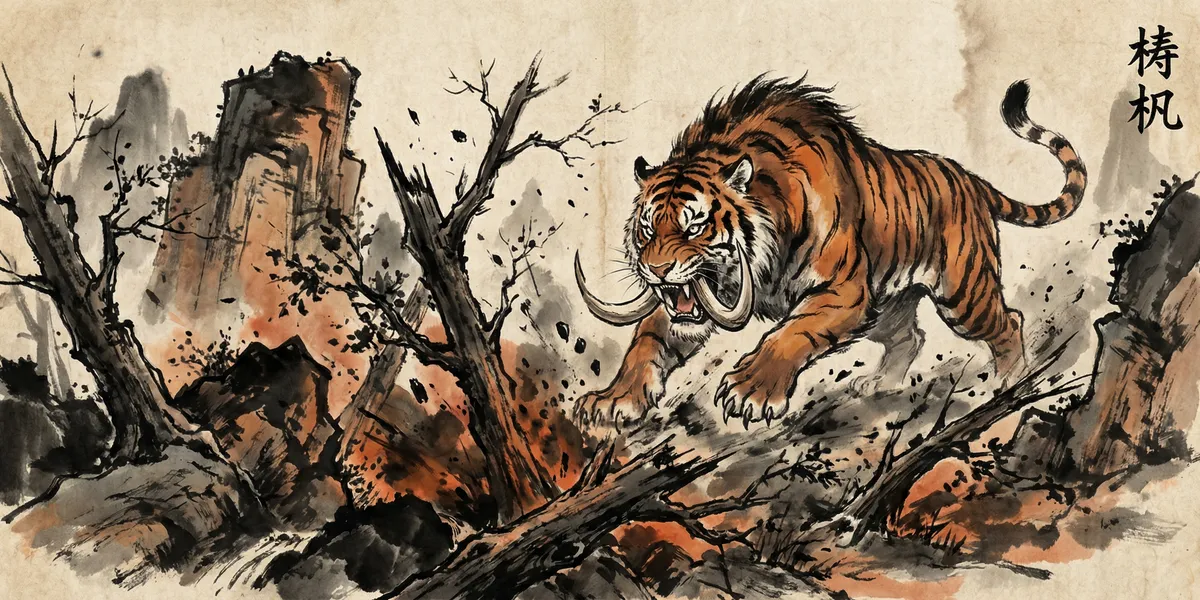
There is a beast shaped like a tiger with dog fur, two feet long, with a human face, tiger claws, pig mouth and tusks, and a tail eighteen feet long, causing chaos in the wilderness, named Taowu.
There is a beast shaped like a tiger with dog fur, two feet long, with a human face, tiger claws, pig mouth and tusks, and a tail eighteen feet long, causing chaos in the wilderness, named Taowu.
Identity
Tiger's body with a human face, fanged tusks, thick and powerful limbs, reddish fur, eyes gleaming with malice
Immense strength, impervious to blades and spears, destroys order, resists all education and reform
Incorrigible stubbornness, the refusal to learn, antisocial behavior, hopeless pig-headedness
Legend
If Qiongqi represents "deliberately doing evil," then Taowu (Taowu) is the poster child for "impossible to teach." Among the Four Fiends (Si Xiong), Taowu's brand of evil is not active aggression but passive resistance — resistance against all education, all reason, all attempts at reform. It is the Chinese imagination's most extreme vision of "stubbornness."
The "Zuo Zhuan" records: Taowu was a son of Zhuanxu (Zhuanxu), who "could not be instructed or taught, did not understand speech; when told, he was obstinate; when left alone, he was unruly." You try to teach him, and he sits there like a rock; you leave him alone, and he doubles down on his mischief. The people gave him the name "Taowu," meaning "wooden stump" — a rotten log that no amount of carving can turn into anything useful.
The "Shenyi Jing" (Classic of Divine Marvels) provides a more detailed physical description: "There is a beast, shaped like a tiger with dog fur, two feet long, with a human face, tiger claws, pig mouth and tusks, and a tail eighteen feet long, causing chaos in the wilderness." A tiger's body with dog fur, a human face but pig snout, dragging an eighteen-foot tail, wreaking havoc wherever it goes. The image is inherently contradictory: part tiger, part pig, human-faced yet devoid of humanity — as if the creator had randomly assembled mismatched parts into something that resembles nothing.
What makes Taowu truly maddening is not how fierce it is, but that it "clearly understands yet stubbornly refuses to listen." It is not stupid; it is willful. Ancient records state that Taowu could fully comprehend human language and reasoning, but it selectively ignored all well-meaning counsel, turning every attempt at education into a farce. Legend has it that wise men tried to tame it with the guqin (qin) — in Chinese tradition, the most refined instrument for cultivating one's character, capable of making stubborn stones nod and fierce beasts grow docile. Taowu's response? It smashed the instrument and chased the musician.
Another tale recounts how a group of Confucian scholars built an academy (shuyuan) specifically to take Taowu in for "educational reform." They hired the most erudite teachers, designed the most comprehensive curriculum, covering everything from filial piety (xiao ti) to loyalty, from ritual propriety to benevolence. Taowu came, sat patiently through the first lecture on "ren" (benevolence), and then — demolished the entire academy. When asked why, legend says it merely snorted and walked away. It couldn't even be bothered to explain — that is the true meaning of "unteachable."
Philosophically, Taowu touches on a profound question: Is education truly omnipotent? Confucianism has always maintained "you jiao wu lei" (in education, there are no class distinctions) — there is no one under heaven who cannot be taught. But Taowu's existence is the ultimate challenge to this belief. If there truly exists a form of willful ignorance that "cannot be taught no matter what," then where are the limits of education? Is it a problem with the "student" or the "method"? This mythological proposition from over two thousand years ago remains relevant today.
Some Daoist (Daojia) thinkers were inclined to sympathize with Taowu, seeing it not as unwilling to learn but as trapped by its own nature (benxing) — a cage of innate temperament from which it could not escape. This reading adds a touch of tragedy: Taowu is not a villain but a soul imprisoned in the wrong body. But regardless of interpretation, Taowu was ultimately exiled by Emperor Shun to Mount Chong (Chong Shan), left to carry on its stubborn ways far from civilization. The word "taowu" has since become a classic Chinese epithet for anyone who is "ming wan bu ling" — hopelessly, incorrigibly pig-headed.
East vs West
Taowu shares certain affinities with the Minotaur of Greek mythology — both are tragic beings with human elements yet trapped in bestial forms. But the Minotaur's tragedy stems from others' sins (Poseidon's curse, Daedalus's labyrinth); it is an innocent victim of circumstance. Taowu's deformity is entirely self-inflicted, the karmic result of personal obstinacy. Western mythology also has its share of stubborn figures — Sisyphus endlessly pushing his boulder uphill, Atlas forever shouldering the heavens — but their stubbornness is typically given a tragic or even heroic sheen. Taowu's stubbornness is purely negative: it does not persist for any noble purpose but is an instinctive rejection of everything good. In a culture that regards education as the highest value, "unteachable" is more terrifying than "unbeatable."
Modern Influence
In modern Chinese usage, "Taowu" is commonly used to describe people who are set in their ways and refuse to accept new knowledge — especially in online debates, when confronted with someone who "responds to your reason with their nonsense," netizens will say "this person is literally Taowu reincarnated." Notably, "Taowu" was also the name of the historical annals of the state of Chu — the "Taowu" was Chu's national history, the name meaning "recording evil deeds as a warning for future generations." In fantasy games and novels, Taowu is typically designed as a berserker-type boss whose defining trait is "the more you fight it, the angrier it gets; the more you reason with it, the fiercer it becomes" — perfectly recreating its core characteristic of being immune to education.
Related Characters
 QiongqiBack to CompendiumHundun
