
Qiongqi
Qiongqi, The Winged Tyrant
The Winged Fiend That Inverts Good and Evil
Shanhaijing Original Text
邽山,其上有兽焉,其状如牛,猬毛,名曰穷奇,音如嗥狗,是食人。
On Mount Gui, there is a beast shaped like an ox, covered in hedgehog quills, named Qiongqi. Its cry sounds like a howling dog, and it eats people.
On Mount Gui, there is a beast shaped like an ox, covered in hedgehog quills, named Qiongqi, whose cry sounds like a howling dog, and it eats people.
Identity
Tiger's body with eagle wings, covered in bristling spines, a ferocious visage, massive frame like an ox
Flies like the wind, discerns good from evil, punishes the righteous and rewards the wicked, its roar shakes mountains
The inversion of right and wrong, forces of evil, corrupt power, moral collapse
Legend
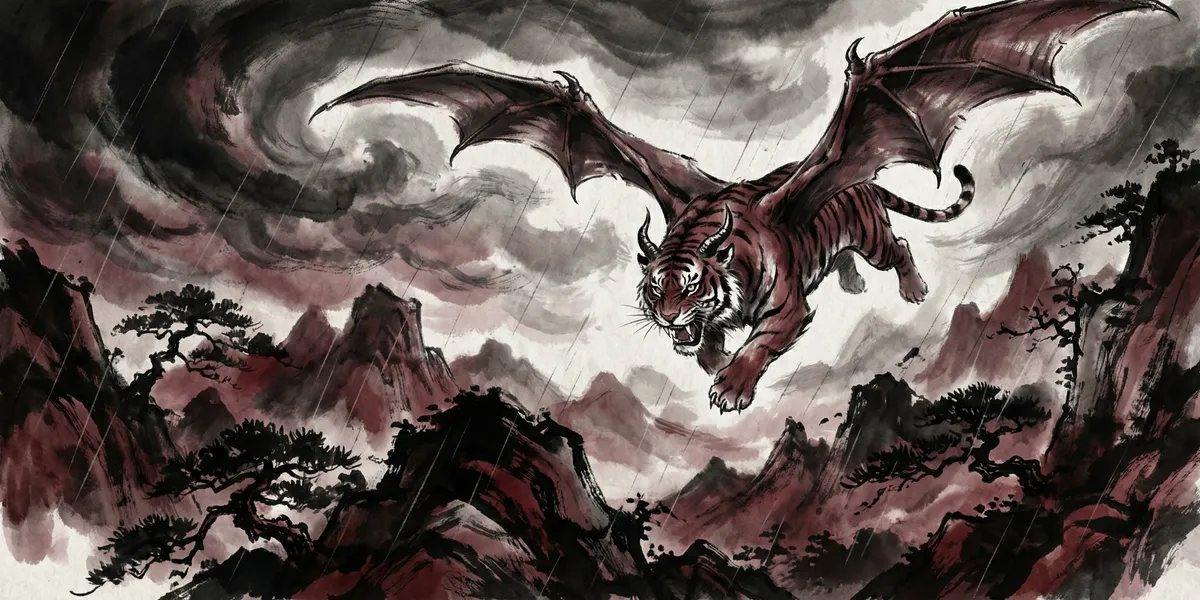
Among the Four Fiends of antiquity, Qiongqi (Qiongqi) is the one most likely to make you stomp your feet in outrage — because it isn't just evil in a straightforward way; it deliberately gets good and evil backwards. Other fiends at least wreak havoc at random. Qiongqi practices precision strikes: it specifically devours the righteous and specifically rewards the wicked. If the Taotie is the embodiment of greed and Taowu the symbol of willful ignorance, then Qiongqi is the ultimate form of "calling a deer a horse" — the systematic inversion of right and wrong.
The "Classic of Mountains and Seas" (Shanhai Jing) offers two descriptions. The "Western Mountains" chapter records: "On Mount Gui, there is a beast shaped like an ox, covered in hedgehog quills, named Qiongqi; its cry sounds like a howling dog, and it eats people." It looks like an ox, is covered in porcupine-like spines, howls like a dog, and eats humans. But the "Seas Within the North" chapter gives another version: "Qiongqi is shaped like a tiger, has wings, and eats people starting from the head." Combine the two descriptions and picture this: a spine-covered, winged tiger diving from the sky, going straight for your skull. Nightmare fuel.
But what truly makes Qiongqi infuriating is not its appearance but its behavioral logic. According to the "Shenyi Jing" (Classic of Divine Marvels): "When it hears of people quarreling, it immediately devours the one in the right; when it hears of someone loyal and trustworthy, it bites off their nose; when it hears of someone wicked and treacherous, it kills an animal and presents it as a gift." In plain terms: if two people are fighting, it eats the one who's right. If someone is known for loyalty and integrity, it goes and bites their nose off. If someone is notorious for evil deeds, it kills a deer and sends it over as a present. This is cosmic-level "punish the good, reward the wicked."
As for Qiongqi's origin, the "Zuo Zhuan" provides an account: it was originally a degenerate son of the Shaohao (Shaohao Shi) clan, who "destroyed trust and abandoned loyalty, embellished wicked words" — wrecking good faith, discarding loyalty, and specifically dressing up malicious speech. Because he was so thoroughly awful, the people of the world nicknamed him "Qiongqi." Eventually Emperor Yao could no longer stand it, and Emperor Shun exiled Qiongqi along with the Taotie, Taowu, and Hundun as the Four Fiends (Si Xiong), banishing them to the four wildernesses to ward off demons and monsters (chi mei wang liang).
The reason Qiongqi left such a deep imprint on Chinese culture is that it strikes at the most fundamental fear in traditional Chinese society: the inversion of right and wrong. In the Confucian (Rujia) value system, the foundation of social order is "reward the good and punish the evil" — good people receive good fortune, bad people face retribution. The moment this logic reverses — the good suffer and the evil prosper — the entire moral edifice of society collapses. The ancients called this state "li beng yue huai" (the collapse of ritual and the ruin of music), and Qiongqi is this apocalyptic scenario made flesh.
Throughout history, literati used Qiongqi as an allegory for the same type of person: treacherous officials who invert black and white and persecute the loyal. When a dynasty's court was overrun with "Qiongqis," it meant loyal ministers were being killed and sycophants were being favored — the end was not far off. In a sense, Qiongqi is not just an ancient fiend but a mirror that reveals evil. In any age, wherever someone "punishes the good and rewards the wicked," Qiongqi's shadow appears.
East vs West
Qiongqi bears a superficial resemblance to the Manticore of Persian mythology — both are winged, tiger-like, man-eating beasts. But the Manticore is a pure predator that eats people without discrimination between good and evil — a killing machine devoid of moral judgment. Qiongqi is fundamentally different: it possesses precise moral discernment but deliberately acts in reverse. The Manticore is "chaotic neutral"; Qiongqi is "chaotic evil with a mission statement." In Greek mythology, trickster figures like Loki cause chaos, but Loki's destruction is driven more by personal amusement and whimsy than by a systematic agenda to subvert moral order. What makes Qiongqi terrifying is that it doesn't engage in random evil — it wages organized, targeted warfare against justice. In a culture that venerates moral order, this is the most fearsome thing imaginable.
Modern Influence
In modern Chinese, "Qiongqi" is often used as a veiled metaphor for systems where rewards and punishments are inverted — such as workplace promotions based on connections rather than competence, or social situations where good people lose and bad people win. In internet slang, when encountering blatant injustice, netizens will say "this is literally Qiongqi possessing someone." In Chinese fantasy games and novels, Qiongqi is practically a standard boss-tier monster, usually designed with a special "reversal buff" ability — in its presence, your strengths become weaknesses, perfectly recreating its original "punish the good, reward the wicked" design. Popular mobile games like "Onmyoji" feature Qiongqi among their characters.
Related Characters
 DapengBack to CompendiumTaowu
