
Dapeng
Dapeng, The Great Roc
The Boundless Bird of Absolute Freedom
Shanhaijing Original Text
北冥有鱼,其名为鲲。鲲之大,不知其几千里也。化而为鸟,其名为鹏。鹏之背,不知其几千里也;怒而飞,其翼若垂天之云。
In the Northern Dark there is a fish, and its name is Kun. The Kun is so huge that no one knows how many thousand li it measures. It transforms into a bird, and its name is Peng. The Peng's back is so huge that no one knows how many thousand li it measures. When it rouses itself and flies, its wings are like clouds hanging from the sky.
In the Northern Dark there is a fish, and its name is Kun. The Kun is so huge that no one knows how many thousand li it measures. It transforms into a bird, and its name is Peng. The Peng's back is so huge that no one knows how many thousand li it measures. When it rouses itself and flies, its wings are like clouds hanging from the sky.
Identity
A body of immeasurable size, wings spread like clouds hanging from the sky, blotting out the sun, feathers of deep azure or gold, a back as broad and thick as a mountain range, a powerful beak, deep unfathomable eyes, its flight stirring wind and cloud
Commands the wind element, soars to ninety thousand li altitude, a single wingbeat raises titanic waves, the Kun-to-Peng transformation symbolizes metamorphosis and transcendence, represents the ultimate freedom and the grandest vision
Represents freedom, transcendence, magnificent ambition, transformation, the wind element, the loftiest perspective, carefree wandering, the formless Way, and a journey of ten thousand li
Legend
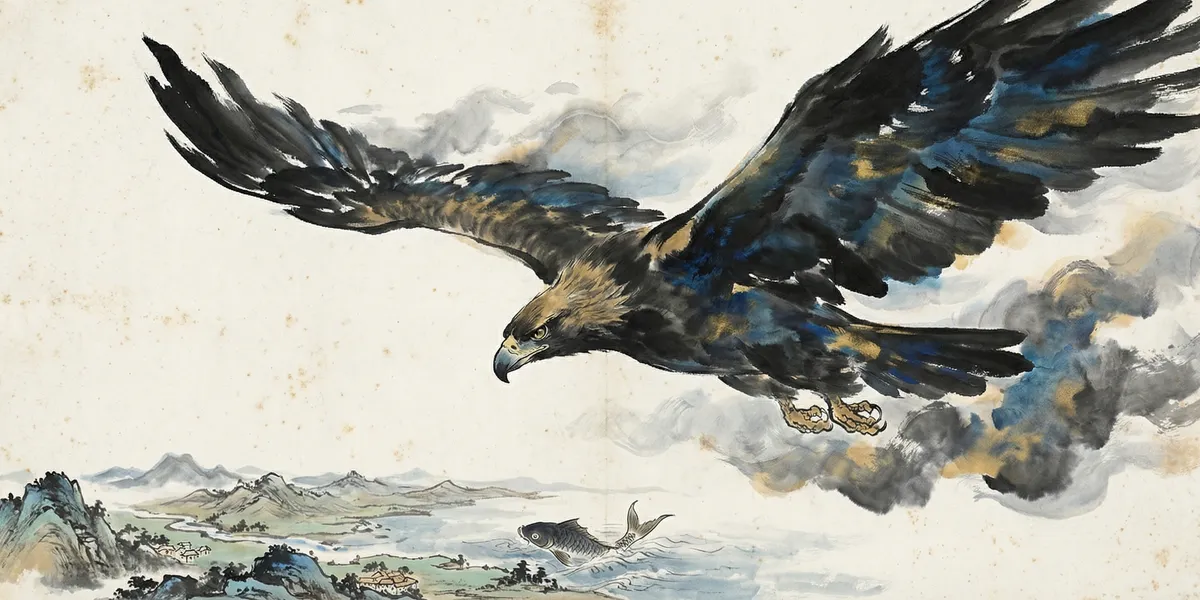
What is the largest creature in Chinese mythology? Not the dragon, not the Kun-Peng — wait, the Kun-Peng is the answer. Specifically, it is the Dapeng (Dapeng), a bird so vast that it is "thousands of li across, no one knows how many," whose wings in flight are "like clouds hanging from the sky," blotting out the sun. If the monsters of the "Classic of Mountains and Seas" are horror movie material, then the Dapeng is IMAX-scale science fiction.
The Dapeng's story comes from the opening masterpiece of the "Zhuangzi" (Zhuangzi), titled "Free and Easy Wandering" (Xiaoyao You). Zhuangzi writes: "In the Northern Dark there is a fish, and its name is Kun. The Kun is so huge that no one knows how many thousand li it measures. It transforms into a bird, and its name is Peng. The Peng's back is so huge that no one knows how many thousand li it measures. When it rouses itself and flies, its wings are like clouds hanging from the sky." A fish named Kun in the northern sea, so enormous that no one knows its size. It transforms into a bird called Peng, whose back is equally unfathomable. When it takes flight, its wings look like clouds draped across the heavens.
The grandeur of this passage is already staggering, but Zhuangzi is not done. How does the Dapeng fly from the Northern Sea to the Southern Sea? "It strikes the water for three thousand li, then spirals upward on a whirlwind to ninety thousand li." It creates a splash of three thousand li on the ocean surface, then rides a cyclone up to an altitude of ninety thousand li. Ninety thousand li — by ancient measurements, that is roughly 45,000 kilometers, nearly the distance from Earth to space. Zhuangzi was imagining sub-orbital flight over two thousand years ago.
Yet the most brilliant part of "Free and Easy Wandering" is not its description of how big the Dapeng is, but the philosophical proposition it introduces: "small knowledge cannot comprehend great knowledge." While the Dapeng soars at ninety thousand li, the cicada (tiao) and the fledgling dove (xue jiu) perched in the trees laugh at it: "We fly up from a tree and land on another tree, and sometimes when we can't even make it that far we just drop to the ground — why bother flying so high and so far?" The little insects believe their world is all there is, completely unable to understand why the Dapeng needs to fly so far. This is not the Dapeng showing off — its "vision" dictates that it can only be free at that altitude. The cicada's freedom lies between two trees; the Dapeng's freedom lies between two oceans. Both forms of freedom are real, but they are on entirely different levels.
The deeper philosophy lies in the transformation of Kun into Peng itself. The Kun is a fish in the water; the Peng is a bird in the sky — from water to sky, from swimming to flying, this is a complete metamorphosis of existential form. In Daoist (Daojia) philosophy, this transformation symbolizes the possibility of breaking through one's own limitations to achieve ultimate freedom. You don't have to be a fish forever; you can become a bird. Your starting point does not determine your destination. This idea has had an immensely profound influence on later generations.
The great Tang Dynasty poet Li Bai (Li Bai) was the Dapeng's number one fan. He wrote: "The great Dapeng will one day rise with the wind, soaring straight up ninety thousand li" — the Dapeng will someday ride the wind and shoot straight to ninety thousand li. Li Bai used the Dapeng as a self-comparison, expressing his own conviction that despite his current frustrations, he would ultimately soar. From that point on, "Dapeng zhan chi" (the Dapeng spreads its wings) became the most iconic image in Chinese culture for expressing grand ambition.
After Buddhism was introduced to China, the Dapeng was given an additional identity: the Golden-Winged Great Peng (Dapeng Jinchi Niao), corresponding to the Garuda of Indian mythology — the natural enemy of the dragon race and a protector of the Buddhist dharma. This cross-cultural fusion made the Dapeng's image even richer — it is simultaneously the Daoist symbol of freedom and the Buddhist guardian deity, straddling two religious systems while remaining awe-inspiring in both.
East vs West
The closest Western counterpart to the Dapeng is the Roc of Arabian mythology, which appears in the voyages of Sinbad — a bird so large it can carry elephants. Both represent inconceivable size and power, but their cultural functions are entirely different. The Arabian Roc is an "obstacle" in an adventure story, a danger that Sinbad must outsmart or escape. The Chinese Dapeng has never been defined as an enemy to be "defeated" — it is a philosophical image to be "comprehended." The Western Roc is an external challenge; the Eastern Dapeng is an internal ideal. Furthermore, the Kun-to-Peng transformation narrative has no equivalent in Western mythology. The Arabian Roc is simply a large bird with no previous life; the Chinese Dapeng was formerly a fish, and this "fundamental metamorphosis" endows it with a unique philosophical depth — existential form can be completely rewritten while the essential continuity of being remains unbroken.
Modern Influence
The Dapeng is synonymous with "ambition" and "vision" in contemporary Chinese culture. "Pengcheng wanli" (a Peng's journey of ten thousand li) is one of the most common blessing phrases, used at graduation ceremonies, job-hunting well-wishes, and business openings. Shenzhen has a district called "Dapeng New District," named for precisely this reason. Countless companies include the character "peng" in their names — because who wouldn't want their business to "soar straight up ninety thousand li"? In martial arts, "Dapeng zhan chi" (the great Peng spreads its wings) is a classic movement name, symbolizing power and expansiveness. In fantasy novels and games, the Dapeng is frequently designed as a top-tier wind-attribute mount or boss. Environmentalists have also borrowed the Dapeng's imagery, calling for humanity to view ecological issues with a grander perspective — like the Dapeng surveying the earth from ninety thousand li above.
Related Characters
 Chongming BirdBack to CompendiumQiongqi
