
Chongming Bird
Chongmingniao, The Double-Brightness Bird
The Four-Eyed Auspicious Bird That Banishes Evil
Shanhaijing Original Text
昔帝舜时,有鸟名重明,一目两瞳,状如鸡,鸣如凤,解落毛羽,肉翮而飞。能逐猛兽虎狼,使妖灾群恶不能为害。
In the time of Emperor Shun, there was a bird named Chongming, with two pupils in each eye, shaped like a rooster but crying like a phoenix, shedding its feathers and flying with flesh wings. It could drive away fierce beasts like tigers and wolves, preventing demons, disasters, and all manner of evil from causing harm.
In the time of Emperor Shun, there was a bird named Chongming, with two pupils in each eye, shaped like a rooster but crying like a phoenix, shedding its feathers and flying with flesh wings. It could drive away fierce beasts like tigers and wolves, preventing demons, disasters, and all manner of evil from causing harm.
Identity
Shaped like a large rooster, impressive in size, plumage of five brilliant colors; its most distinctive feature is double pupils in each eye — four eyes in total — bright and piercing, able to survey all directions; tall comb and long tail feathers, with a resonant call
Banishes evil and drives away ghosts, perceives deception, breaks through illusions, announces dawn to dispel yin energy, guards doorways, brings fortune and light, sees through every disguise of evil
Represents vigilance, keen perception, integrity, guardianship, revealing evil and manifesting righteousness, the Five Virtues, yang energy, New Year blessings, light conquering darkness
Legend
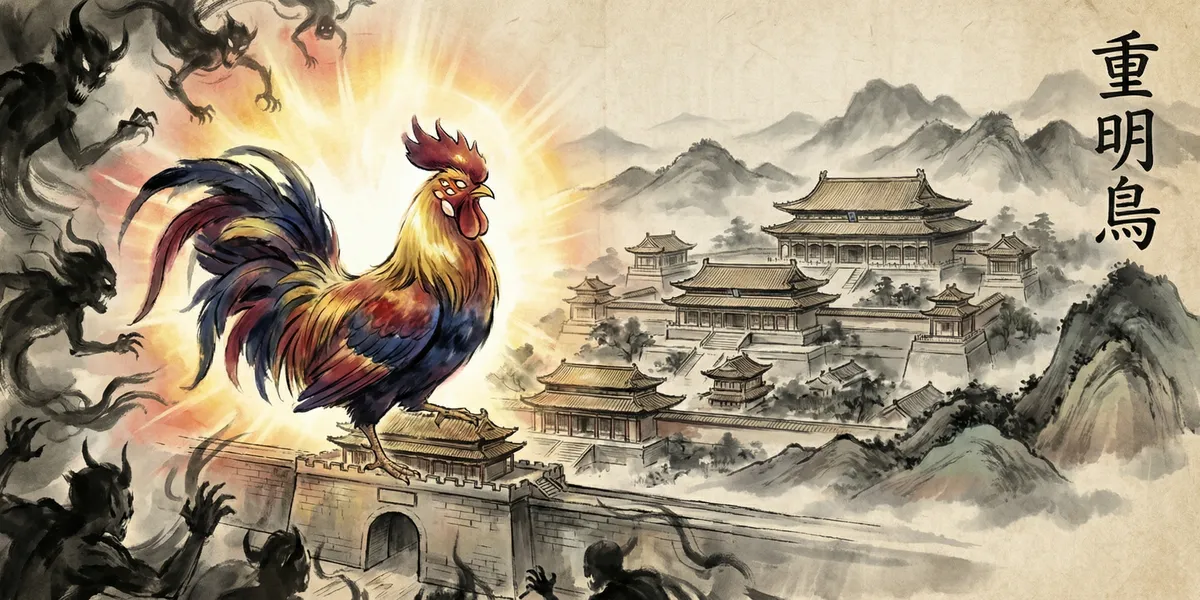
In the Chinese mythological "bird field guide," the Chongming Bird (Chongmingniǎo) is the most instantly recognizable — because it has four eyes. That is not a typo. Four eyes. Each eye contains two pupils, which is why it is called "Chongming" — double brightness, taking the concept of "fiery golden eyes" and literally doubling it.
The Chongming Bird first appears in the Jin Dynasty scholar Wang Jia's "Shiyi Ji" (Records of Gleanings). The text records that during the era of Emperor Shun (Di Shun), a strange bird flew from the distant east: "one eye with two pupils, shaped like a rooster, crying like a phoenix." Each eye had two pupils, it looked like a rooster, and its cry sounded like a phoenix. The bird's greatest ability was "driving away fierce beasts such as tigers and wolves, preventing demons, disasters, and all manner of evil from causing harm."
More intriguingly, the Chongming Bird could "shed its feathers and fly with flesh wings" — it could strip off its plumage and fly using bare, featherless wings. This detail is highly unique, meaning the Chongming Bird's power lies not in its external splendor (feathers) but in its inner essence (its physical body). Even stripped of all ornamentation, it can still soar. In Chinese culture, this is a profoundly resonant metaphor: true strength needs no packaging.
The Chongming Bird's visits followed a pattern — it came to China once a year. But some years, it did not come. What then? The ancients devised an ingenious solution: they carved the Chongming Bird's likeness in wood or metal and placed it before their doors as a substitute. After all, demons could not tell the difference — seeing a four-eyed bird-shaped carving, they were just as frightened and dared not approach. This custom is one of the important precursors to the later traditions of pasting door gods (menshen) and hanging rooster paintings (a common motif in New Year prints) during the Spring Festival.
Why a "rooster"? Because in traditional Chinese culture, the rooster is itself a symbol of yang energy (yang qi). The ancients believed the rooster possessed the "Five Virtues" (wu de): its comb on its head represents "Culture" (wen); the spurs on its feet represent "Martial prowess" (wu); its willingness to fight enemies represents "Courage" (yong); calling its flock when finding food represents "Benevolence" (ren); and crowing reliably at dawn represents "Faithfulness" (xin). The rooster crows at dawn, announcing the end of darkness and the arrival of light — this is itself the most powerful evil-banishing ritual. The Chongming Bird takes all these excellent qualities of the rooster and supercharges them: an ordinary rooster has two eyes, it has four; an ordinary rooster crows loudly, it cries like a phoenix; an ordinary rooster scares away petty ghosts, it can banish all demons. The Chongming Bird is the "ultimate upgraded rooster."
In the Daoist (Daojiao) tradition, the Chongming Bird is sometimes regarded as a messenger of the Green Emperor of the East (Dongfang Qingdi), representing heavenly surveillance over the human world. Its four eyes can see through every illusion and penetrate every disguise — the ultimate embodiment of "ming cha qiuhao" (perceiving the finest detail). For this reason, ancient scholars and incorruptible officials also adopted the Chongming Bird as a spiritual totem, aspiring to be like this four-eyed divine bird — seeing the world clearly and distinguishing right from wrong.
The Chongming Bird also carries a unique cultural significance: it connects the concepts of "bird" and "guardian." In most mythological systems, guardian deities are either ferocious beasts or imposing warriors. But the Chongming Bird tells us that a rooster-shaped bird can also serve as a guardian — the key is not how fierce you are, but how clearly you can see. This is a vivid footnote to the Chinese cultural ideal that "the pen is mightier than the sword" (wen sheng yu wu).
East vs West
In the West, the most famous multi-eyed guardian is Argus Panoptes from Greek mythology, whom the goddess Hera assigned to watch over Zeus's lover Io. Argus had one hundred eyes that never all closed at once, making him the perfect "surveillance system." But his story ends in tragedy — Hermes lulled him to sleep with his pipe and then killed him, and his hundred eyes were transplanted by Hera onto the peacock's tail. Argus's "many eyes" were a curse-like burden that ultimately led to his death. The Chongming Bird's "four eyes" are the complete opposite — they are a blessing, not a curse. The four eyes make it the most beloved guardian bird, and people actively invite it to descend, even crafting substitutes to retain its protection. Western multi-eyed-ness is a "passive surveillance tool"; Chinese multi-eyed-ness is an "active guardian force." The Rooster of Barcelos in Portuguese tradition also has supernatural qualities of justice, but that was a one-time miracle; the Chongming Bird provides continuous, ongoing protection.
Modern Influence
The Chongming Bird's cultural DNA remains active in Chinese Spring Festival traditions. Every New Year, rooster imagery commonly appears in the festival prints that adorn homes, and this tradition can be traced back to Chongming Bird worship. Some security companies incorporate multi-eyed or rooster elements into their brand design, echoing the Chongming Bird's ancient meaning of "all-around surveillance and evil banishment." In contemporary fantasy novels and games, the Chongming Bird is typically assigned unique abilities like "seeing through invisibility" and "piercing illusions," making it a popular archetype for reconnaissance-type characters. The rooster imagery in folk paper-cutting and traditional crafts silently carries forward the millennia-old guardian power of this four-eyed divine bird.
Related Characters
 Vermilion BirdBack to CompendiumDapeng
