
Vermilion Bird
Zhuque, The Vermilion Bird
The Radiant Flame Keeper of the Southern Heavens
Shanhaijing Original Text
南方火德,朱雀司之。展翅九天,火光烛照,主生长繁盛,启智明心。
The fire virtue of the south is governed by Zhuque. She spreads her wings across the nine heavens, her firelight illuminating all, presiding over growth and prosperity, enlightening wisdom and illuminating hearts.
The fire virtue of the south is governed by Zhuque. She spreads her wings across the nine heavens, her firelight illuminating all, presiding over growth and prosperity, enlightening wisdom and illuminating hearts.
Identity
Resplendent plumage, body entirely vermilion red, tail feathers dancing like flames, a towering phoenix crest, eyes bright as stars, a cry clear and resonant as a bell, sparks scattering when its wings spread — elegant yet majestic
Governs summer and the Fire element, commands flame and light, dispels darkness, brings passion and vitality, guards the south, bestows wisdom and inspiration, purifies evil
Represents summer, the south, the Fire element, passion, illumination, wisdom, the color red, the zenith of yang energy, flourishing prosperity, and the fullness of life force
Legend
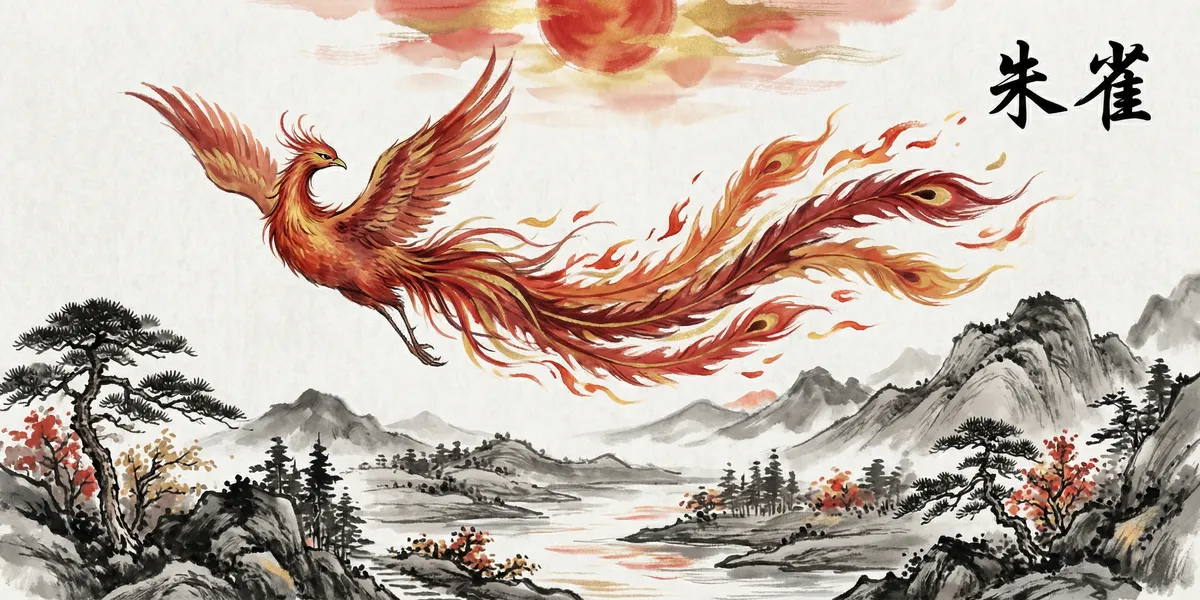
The Vermilion Bird (Zhuque) is probably the Four Symbols member most frequently "mistaken for someone else" — it is constantly confused with the Fenghuang. So before we tell its story, let us set the record straight: the Vermilion Bird is not the Fenghuang. They are indeed both magnificent fire birds, but the Vermilion Bird has its own distinct identity — it is one of the Four Symbols, the guardian divine beast of the south, presiding over the Fire element (huo) and summer. The Fenghuang symbolizes virtue and imperial authority, while the Vermilion Bird is the "Minister of the South" in the cosmic operating system. Clear job descriptions, no confusion allowed.
The Vermilion Bird's constellation corresponds to the seven southern mansions — Jing (Well), Gui (Ghost), Liu (Willow), Xing (Star), Zhang (Extended Net), Yi (Wings), and Zhen (Chariot). The seven star groups connect to form a bird in flight, another masterwork of astronomy and mythology intertwined. Its color is vermilion — the purest, most passionate red within the red spectrum, like cinnabar under the noon sun.
The Vermilion Bird's plumage is among the most spectacular visions in legend. Ancient texts describe its entire body in vermilion red, its tail feathers dancing like flames, sparks scattering when it spreads its wings, its cry clear and resonant as a bell. The sparks trailing behind it as it crosses the sky become the stars of summer nights. The "Huainanzi" records: "The fire virtue of the south is governed by Zhuque." It is fire incarnate, the source of light, the embodiment of passion.
In the Eight Trigrams (Bagua) system, the Vermilion Bird corresponds to the Li trigram (Li gua), symbolizing fire, illumination, and attachment. Li is fire, the sun, lightning — everything that glows and gives warmth. The philosophical meaning of the Li trigram is "ming" (brightness): seeing things clearly, perceiving truth, inspiring wisdom. So the Vermilion Bird does not merely govern "burning" — it governs "illumination," the kind of light that dispels darkness and enlightens the mind.
In ancient urban planning, the Vermilion Bird's directional significance was directly embodied in architectural naming. The main avenue of the Tang Dynasty capital Chang'an was called Vermilion Bird Avenue (Zhuque Dajie), and the city's south gate was called Vermilion Bird Gate (Zhuque Men) — these were not casually chosen names but strict adherence to Four Symbols directional principles. The south gate is the direction the palace faces, the direction of light, openness, and reception, and the Vermilion Bird is its perfect guardian. Today Xi'an's Zhuque Avenue still bears this name, and people walking upon it may not realize that they are treading on a cosmic order laid down fourteen hundred years ago.
In feng shui, the Vermilion Bird position is the front of a residence (the south when facing south), representing the "bright hall" (mingtang) — an open space where qi (qi) can gather. A good Vermilion Bird position should be open and bright, with low hills, water features, or structures responding to it — too crowded and qi stagnates, too open and qi disperses. A residence with a fine Vermilion Bird position means its occupant has good "prospects" — career opportunities and growing reputation.
The summer governed by the Vermilion Bird is the season when yang energy (yangqi) is at its peak. All things grow to their fullest, flowers bloom at their most vivid, days are longest, energy most abundant. On the Summer Solstice (xiazhi), yang energy reaches its zenith — the ancients would hold grand fire sacrifices, honoring the Vermilion Bird with music and dance. The warm southern wind (nanfeng) carries the fragrance of flowers and the promise of harvest, all under the shelter of the Vermilion Bird's wings.
In Daoist alchemy, the Vermilion Bird represents the "Li fire" (li huo) — the fire of refinement and purification, burning away impurities to preserve essence, smelting common iron into the Golden Elixir (jindan). This is not destructive fire but transformative fire — just as a potter knows, fire is not merely a destroyer but a creator.
In the TCM Five Elements framework, Fire corresponds to the heart, governing consciousness and mental activity (shenzhi). The Vermilion Bird embodies this "heart fire" — not the angry fire of rage but the creative fire of inspiration. Ancient scholars, poets, and painters often invoked the Vermilion Bird's power to ignite their own artistic inspiration (linggan).
The Vermilion Bird is the most passionate and extroverted of the Four Symbols. If the Azure Dragon is the steady manager of spring, Xuanwu the contemplative philosopher of winter, and the White Tiger the stern executor of autumn, then the Vermilion Bird is summer's endlessly energetic, irrepressibly enthusiastic friend — representing life force at its peak, blazing in uninhibited splendor.
East vs West
The Vermilion Bird is most easily compared with the Western Phoenix, but their differences far outweigh their similarities. The Phoenix's core narrative is death and rebirth — it self-immolates in fierce flames, then rises renewed from its ashes. This cycle is periodic, dramatic, and focused on the individual's transcendence of death. The Vermilion Bird need not undergo destruction to achieve renewal — it represents continuous, unbroken vitality, the kind of constant brightness that comes with every sunrise.
More importantly, the Phoenix is a solitary bird, completing its death-and-rebirth cycle alone. The Vermilion Bird is a team member — the southern guardian within the Four Symbols system, working in concert with the Azure Dragon, White Tiger, and Xuanwu. It is not about an individual's dramatic fate but about the faithful performance of a specific function within cosmic order. The Phoenix tells a story of "spectacular ending and rebirth"; the Vermilion Bird tells a story of "enduring radiance and steadfast duty." One is a myth about extraordinary moments; the other is a faith about constant order. Furthermore, the Vermilion Bird's precise correspondences within the Five Elements and Eight Trigrams frameworks (Fire element, Li trigram, south, summer, red) represent a systematic structure that the Phoenix entirely lacks.
Modern Influence
The Vermilion Bird's imprint on contemporary Chinese culture is everywhere. Xi'an's Vermilion Bird Avenue preserves its fourteen-hundred-year-old name, carrying hundreds of thousands of commuters daily. In Chinese fantasy literature and gaming, the Vermilion Bird is one of the most popular fire-type character archetypes — titles like "Honor of Kings," "Genshin Impact," and "Onmyoji" all feature characters or equipment inspired by it. In fashion design, Vermilion Bird red (vermilion) and flame motifs appear frequently in summer collections. In modern feng shui practice, the Vermilion Bird position remains a key metric for evaluating commercial property locations — a good "bright hall" means foot traffic and business opportunities. The Vermilion Bird is also widely referenced in China's creative industries as a symbol of illumination and creativity.
Related Characters
 White TigerBack to CompendiumChongming Bird
