
White Tiger
Baihu, The White Tiger
The War God of Western Metal and Righteous Judgment
Shanhaijing Original Text
白虎者,西方金德之兽也。主杀伐,司兵戈,镇西方,肃清万邪。
The White Tiger is the divine beast of western Metal virtue. It governs warfare and execution, presides over weapons and combat, guards the west, and eliminates all evil.
The White Tiger is the divine beast of western metal virtue. It governs warfare and execution, presides over weapons and combat, guards the west, and eliminates all evil.
Identity
A frame as imposing as a mountain, coat of pure snow-white with black stripes like ancient seal script, the character 'king' marked on its forehead, eyes flashing with golden light, claws sharp as blades, a long powerful tail, ferocious dignity radiating an aura of awe
Governs autumn and the Metal element, slays demons and banishes evil, guards the west, purges all wickedness, presides over war and justice, bestows martial valor and decisiveness, commands metal and the qi of severity
Represents autumn, the west, the Metal element, martial valor, justice, decisiveness, the color white, masculine vigor, warfare and conquest, harvest and severity
Legend
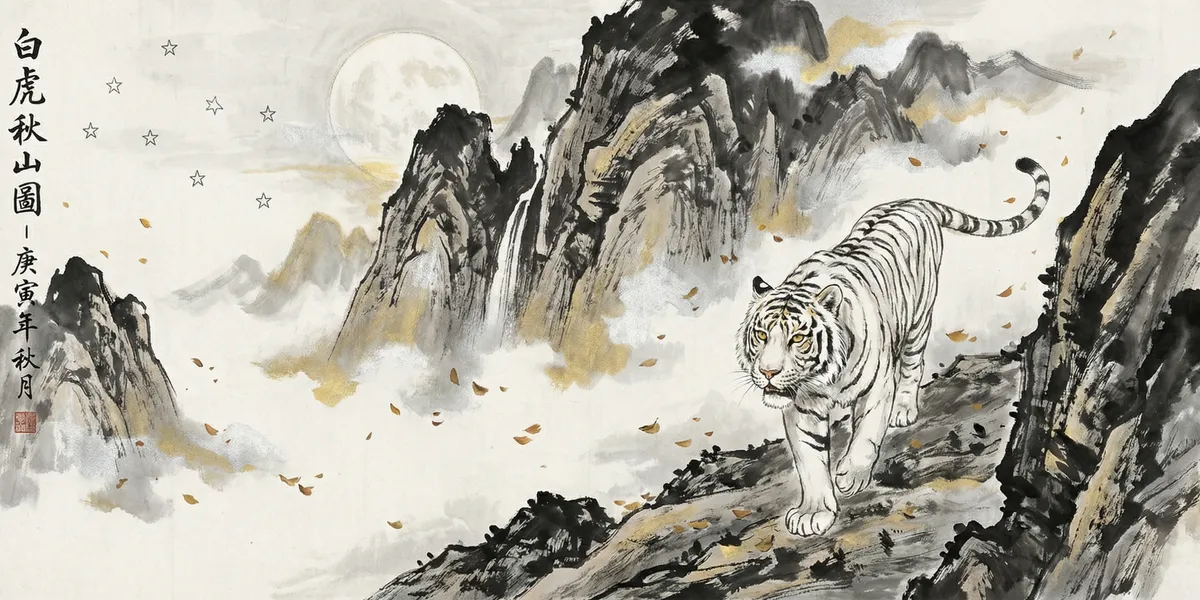
Among the Four Symbol divine beasts, the White Tiger (Baihu) is the most stern and severe. If the Azure Dragon is a gentle spring rain, then the White Tiger is the biting autumn wind — decisive, sharp, and brooking no hesitation. It guards the west, corresponding to autumn and the Metal element (jin), serving as the guardian of war and justice.
The White Tiger's "Metal" is not simply about metal. In the Five Elements system, Metal represents gathering, decisiveness, and the qi of stern severity (susha zhi qi). Autumn is the season of harvest, and also nature's season of "killing" — leaves fall, grass withers, all things transition from summer's peak abundance into winter's austere silence. What the White Tiger governs is this cosmic force of "what must be cut off, cut off." In modern parlance, it is heaven and earth's ultimate decluttering expert — except it does not discard old clothes but rather everything that runs contrary to the Way of Heaven.
The White Tiger's constellation corresponds to the seven western mansions — Kui (Legs), Lou (Bond), Wei (Stomach), Mao (Hairy Head), Bi (Net), Zi (Turtle Beak), and Shen (Three Stars). These seven mansions trace the form of a fierce tiger across the western autumn sky. Its fur is pure white — white being the color corresponding to Metal in the Five Elements — sometimes described as having a silvery moonlit quality. Most striking is the character "wang" (king) marked on its forehead: not mere decoration, but a heaven-bestowed mark of sovereignty.
In ancient Chinese military culture, the White Tiger held a position of supreme importance. The "tiger tally" (hufu) — a bronze tiger figure split in two halves, one held by the emperor and one by the general — was the highest credential for deploying troops. The White Tiger Banner (Baihu qi) was the flag of the right flank during marches, representing martial valor (wuyong) and righteousness (zhengyi). But interestingly, the White Tiger does not represent blind violence but "yizhan" — righteous warfare, fighting only when necessary and just. It is the type that "does not strike lightly, but when it does, draws blood."
The "Book of Rites" (Liji) records "the Vermilion Bird leads and the Black Tortoise guards the rear, the Azure Dragon on the left and the White Tiger on the right," firmly establishing the White Tiger's western position among the Four Symbols. The "Rites of Zhou" (Zhouli) frequently references the White Tiger in connection with military formations. Ancient emperors offered sacrifices to the White Tiger before military campaigns, praying for success in battle. In the minds of the ancients, the White Tiger was more than a powerful beast — it was the embodiment of military justice, governing not all wars, but only the wars that ought to be fought.
In Chinese folk belief, the White Tiger's image is somewhat complex. On one hand, it is a divine beast that wards off evil and banishes demons, able to "slay demons and eliminate evil" (zhan yao chu mo). Many Daoist temples place White Tiger statues on the right side, guarding the side of justice. On the other hand, folk tradition also speaks of the "Baihu Sha" (White Tiger Curse) — believing that the White Tiger's energy is so fierce that offending the White Tiger position might bring bloodshed. This contradiction precisely reflects the Chinese dialectical attitude toward "power": power is neither inherently good nor evil; what matters is whether it is applied properly and in moderation.
In Traditional Chinese Medicine (zhongyi) theory, the Metal element corresponds to the lungs and large intestine — the organs responsible for absorbing essence and expelling waste. The White Tiger performs the same function on a cosmic scale: preserving what is valuable and removing what is useless. Its decisiveness is not cruelty but a necessary cleansing.
In feng shui, the White Tiger position is on the right side of a residence (the west when facing south), representing protective force. But feng shui masters particularly emphasize that the White Tiger position should not be too high or too strong — if the White Tiger overpowers the Azure Dragon on the left, it creates an overly rigid energy field (gangying zhi qi), disturbing the household's peace. This is yet another iteration of that eternal Chinese theme: balance. Even the force of justice must be tempered.
The tiger in Chinese culture is itself an enormously important symbol. "Huhu shengfeng" (a tiger generating wind), "ru hu tianyi" (like a tiger with wings), "hu ju long pan" (tigers crouching and dragons coiling) — there are enough tiger idioms to fill a dictionary. But the White Tiger is no ordinary tiger — it is one that has been refined by the cosmos, elevated to the status of a celestial mansion, representing the supreme force of heaven's stern justice. An ordinary tiger is king of the mountain; the White Tiger is a judge of the heavens.
East vs West
The Nemean Lion of Greek mythology is perhaps the closest Western counterpart to the White Tiger — both are powerful beasts possessing divine power. But the distinction is fundamental: the Nemean Lion is a monster that Heracles must conquer, an obstacle in a hero's trial. After killing the lion, Heracles strips off its skin and wears it as a trophy. The White Tiger is a guardian and an enforcer of justice — it is not an object to be conquered by heroes; it is the hero itself.
In Western narratives, powerful animals are typically threats to be overcome; in Chinese narratives, they are guardians to be revered and aligned with. Heracles wears the lion's skin, declaring power through the stance of a conqueror; Chinese generals embroider the White Tiger on their banners, borrowing its righteous power through the stance of a follower. One says "I defeated it"; the other says "I walk alongside it" — this is the deep divide between the philosophy of conquest and the philosophy of harmony. Just as the relationship between the Qian and Kun hexagrams in the "Book of Changes" (Yijing) shows, the firm and the yielding are not opposites but mutually completing — the White Tiger's stern force, in Chinese philosophy, needs the Azure Dragon's generative energy for balance.
Modern Influence
The White Tiger has a lasting influence on Chinese martial arts culture. Many kung fu styles feature "White Tiger Fist" (Baihu Quan) or "tiger form" techniques, emphasizing fierce and decisive attacking styles. In the military sphere, the tiger has always been a spiritual symbol of the Chinese armed forces — from the ancient "tiger tally" to tiger-motif elements on modern military medals, the tradition runs unbroken. The White Tiger appears in various forms in contemporary games and media, usually as a guardian-type boss or a powerful ally. In business, the White Tiger image is used to convey strength and reliability — many companies incorporate "tiger" elements into their logos and brand names. Modern feng shui masters still carefully evaluate the height and strength of the White Tiger position when assessing residences and commercial properties.
Related Characters
 XuanwuBack to CompendiumVermilion Bird
