
Xuanwu
Xuanwu, The Black Tortoise-Serpent
The Entwined Tortoise and Serpent, Emperor of the North
Shanhaijing Original Text
玄武之位,镇北方,主冬藏。龟蛇相缠,阴阳调和,乃水德之精也。
Xuanwu's position is in the north, governing winter's storage and hibernation. The tortoise and snake intertwined represent the harmony of yin and yang, the very essence of water's virtue.
Xuanwu's position is in the north, governing winter's storage and hibernation. The tortoise and snake intertwined represent the harmony of yin and yang, the very essence of water's virtue.
Identity
Tortoise and serpent entwined, with the pattern of the Big Dipper carved on the dark tortoise shell, a great serpent coiled about its body with head raised high, stout tortoise legs, radiating deep blue or black light, eyes as deep and unfathomable as an abyss
Governs winter and the Water element, controls rivers, lakes, and seas, summons storms or calms waves, guards the north, bestows longevity and wisdom, wards off evil, symbolizes unyielding perseverance
Represents winter, the north, the Water element, defense, wisdom, longevity, the color black, the power of yin, and the balance of heaven and earth
Legend
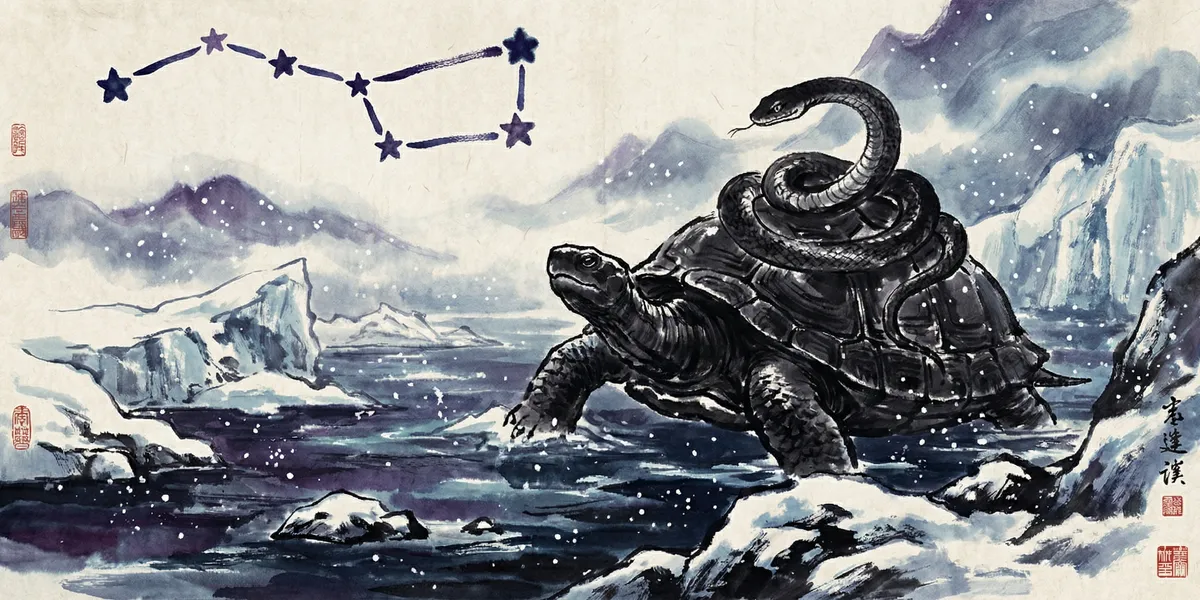
Among the Four Symbol divine beasts, Xuanwu (Xuanwu) may have the most unusual design — it is a tortoise and a serpent intertwined. That's right, two entirely different animals merged into a single deity. This is arguably the most successful "joint venture" in the history of mythology.
Xuanwu guards the north, corresponding to winter and the Water element (shui). In the Four Symbols system, the seven northern mansions — Dou (Dipper), Niu (Ox), Nu (Maiden), Xu (Emptiness), Wei (Danger), Shi (Encampment), and Bi (Wall) — form the constellation of Xuanwu. Its color is black (or deep xuan), corresponding to the depth of winter nights, the weight of northern earth, and the darkness of deep waters.
The combination of tortoise and serpent carries profoundly deep philosophical meaning. The tortoise's hard shell is the ultimate defense, symbolizing resilience, longevity, and the immovable stability of a mountain. The serpent is supple and agile, symbolizing wisdom, adaptability, and the swiftness of attack. United as one, they represent the fusion of hardness and softness — the state most exalted in Daoist philosophy. The "Songs of Chu" (Chuci) already mentions the name "Xuanwu," and the "Huainanzi" systematically establishes its place among the Four Symbols: "The north is Water... its spirit is Xuanwu."
As for why the tortoise and serpent merged, folk tradition offers several explanations. One legend says the tortoise and serpent were originally mortal enemies who fought for five hundred years, until both achieved enlightenment, buried the hatchet, and united as one — proving that even sworn rivals can learn to cooperate. Another version from Daoist tradition holds that Xuanwu was originally a prince who renounced his throne to cultivate himself in the mountains, and his loyal servants transformed into the tortoise and serpent to guard him. A third, even more extraordinary account claims that during deep meditation, a cultivator must expel the turbid energy from the five organs, and the stomach and intestines take the form of a tortoise and serpent that depart the body, while the cultivator's original form ascends to become a god — this is the process by which Xuanwu achieved divinity.
Xuanwu later experienced a meteoric rise within the Daoist system, being exalted as "Zhenwu Dadi" (the Perfected Warrior Emperor, also called "Xuantian Shangdi"), becoming a major deity with his own temples and a vast following. Wudang Mountain (Wudang Shan) is the sacred ground of Zhenwu Dadi — yes, the very same Wudang Mountain that produced Zhang Sanfeng and Tai Chi. The Ming Dynasty's Yongle Emperor undertook a massive construction of palace-temple complexes on Wudang Mountain to repay Zhenwu Dadi for his "divine assistance" during the Yongle Emperor's seizure of the throne in the Jingnan Campaign. That architectural complex remains a UNESCO World Heritage Site, attracting millions of pilgrims and tourists annually.
In feng shui, the Xuanwu position is the rear of a residence or tomb (the north when facing south), representing "kaoshan" (backing mountain) — the support and protection behind you. A good Xuanwu position — such as tall mountains, high buildings, or substantial terrain behind the property — means the inhabitant has solid backing and a secure career. This concept is so deeply embedded in the Chinese sense of space that "having a backing" has even extended into a metaphor for social connections.
The winter governed by Xuanwu is, in Chinese philosophy, not a season of death but a period of accumulation (xuji) and introspection (neixing). All things go into storage, the earth falls silent, but life's energy is quietly gathering underground, waiting for the eruption of next spring. Xuanwu represents this power of "still waters running deep" — calm and composed on the surface, surging currents beneath.
In martial arts culture, Xuanwu is deeply revered. The tortoise's solid defense and the serpent's agile offense are precisely the two most essential dimensions of martial arts. The interplay of hardness and softness, stillness and motion in Tai Chi (Taijiquan) deeply accords with the Way of Xuanwu. The founding of the Wudang school of martial arts is said to have been inspired by Zhenwu Dadi himself.
The "Book of Rites" lists the tortoise among the Four Sacred Creatures, calling it "the lord of all shelled creatures," testament to the ancients' reverence for the tortoise. And the serpent in Daoist cultivation is an important symbol representing the innate true qi that flows like a serpent through the body. United as one, hard and soft complementing each other, yin and yang mutually generating — this is the deepest equilibrium between heaven and earth. The ancients said "xuan zhi you xuan, zhong miao zhi men" (mysterious beyond mystery, the gate of all wonders) — the character "xuan" in Xuanwu's name echoes this sense of unfathomable depth.
East vs West
Western mythology has the concept of the "World Turtle" — from the Hindu Kurma to Native American legends of a great turtle bearing the earth on its back. But these cosmic turtles are essentially passive and structural: they carry the world but do not actively guard or fight. Xuanwu is fundamentally different — it does not merely support but actively governs and protects. It is a sacred warrior, not merely a platform.
The addition of the serpent makes Xuanwu even more unique; the West has no true counterpart to a "tortoise-and-serpent combined" deity. Western mythology does have the Ouroboros, the serpent eating its own tail symbolizing eternal cycles, but it does not combine with another creature to form a guardian spirit. Xuanwu represents the Daoist principle that "opposites can be complementary": the slow tortoise and the swift serpent, hard shell and supple body, defense and offense. This is a precise philosophical proposition wrapped in mythological form. In Norse mythology, the serpent Nidhogg coiled around the world tree Yggdrasil is a destructive force, forming a stark contrast with the harmonious coexistence of the Chinese tortoise and serpent.
Modern Influence
Xuanwu's influence on Chinese martial arts culture is immensely deep. Tai Chi's emphasis on the interplay of hardness and softness, stillness and motion, is the very embodiment of Xuanwu's tortoise-and-serpent Way. Wudang Mountain, as the sacred ground of Zhenwu Dadi, remains a world-class pilgrimage and tourist destination, with its ancient architectural complex listed as a UNESCO World Heritage Site. In modern feng shui practice, the "Xuanwu position" remains a core metric for evaluating residences and offices. In film, television, and gaming, Xuanwu appears in various forms — from the divine beast symbolizing ultimate defense and wisdom in martial arts novels to important characters in "Genshin Impact" and "Onmyoji." The "tortoise-and-serpent entwined" motif has also been adopted by contemporary environmental movements, symbolizing ecological balance and the wisdom of patience.
Related Characters
 Azure DragonBack to CompendiumWhite Tiger
