
Rulai (The Buddha)
Rulai, The Buddha (Tathagata)
The Supreme Awakened One of the Buddhist Universe
Domain
The Great Thunder Monastery on Spirit Mountain in the Western Paradise, supreme sovereign of the Buddhist universe
Role
Teacher of the Three Realms, compassionate father of all beings, guiding all through supreme wisdom
Weapon
Supreme Dharma -- one palm becomes Five Elements Mountain, six-syllable mantra seals the Great Sage Equal to Heaven
Appearance
Golden body standing tall, spiral-curled hair in sacred coils, face like a full moon, compassionate eyes gently lowered, seated in lotus position upon a lotus throne, radiating infinite Buddha-light
Legend
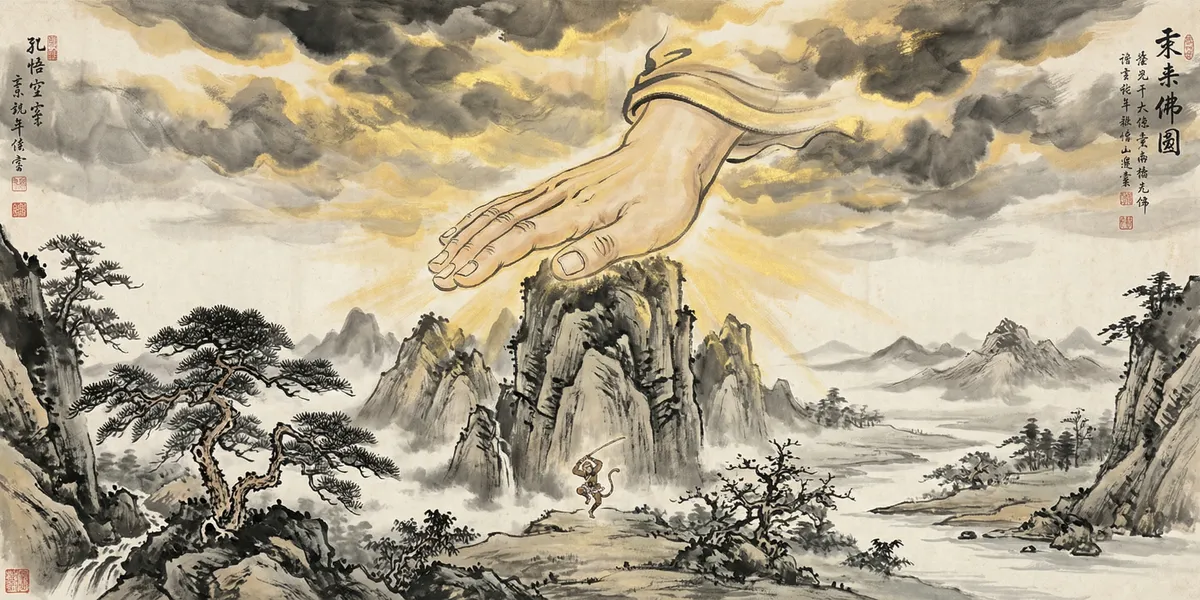
On the power map of Chinese mythology, Rulai Fozu (Rulai Fozu) -- the Buddha -- occupies a uniquely special position. He doesn't belong to the Jade Emperor's celestial bureaucracy, nor does he fall under the Daoist system represented by Taishang Laojun. He is the supreme sovereign of the Buddhist universe, a completely self-contained ultimate being. When the Celestial Court's elite hundred-thousand-strong heavenly army, their most formidable warrior god Erlang Shen, and the veteran Taishang Laojun all combined couldn't handle Sun Wukong, the person finally called in to clean up the mess was him.
Rulai Fozu's full title is "Namo our Original Teacher Shakyamuni Buddha" -- Shakyamuni being Sanskrit for "Sage of the Shakya Clan." "Rulai" is the Chinese translation of the Sanskrit Tathagata, meaning "one who has thus come, one who has thus gone" -- coming from nowhere, going to nowhere, neither increasing nor decreasing, simply being as it is. His historical prototype was Prince Siddhartha of the Kingdom of Kapilavastu (Jiapeiluowei Guo), a real historical figure who renounced his throne, practiced austerities for six years, and finally achieved complete enlightenment under the Bodhi tree upon seeing the morning star. But in Chinese folk culture, Rulai has long transcended the scope of the historical Buddha, becoming a cosmic-level supreme deity -- higher even than the Jade Emperor, because when the Jade Emperor couldn't handle a problem, it ultimately fell to him.
Rulai's most widely known set piece in China is, without question, the Five Elements Mountain scene from Journey to the West, where he traps the Monkey King. When the Great Sage Equal to Heaven ran riot through Heaven, turning the entire Celestial Palace upside down, the Jade Emperor finally admitted: his own people couldn't handle this monkey. Messengers were dispatched to the Western Paradise's Spirit Mountain to request Rulai. The Buddha arrived at the Hall of Miraculous Mist, and facing a monkey so arrogant he'd declared himself equal to heaven, showed no anger, drew no weapon -- just smiled slightly, extended his right hand, and offered what seemed like a simple wager:
"If you can somersault out of the palm of my hand, you win, and the Celestial Palace is yours. If you can't, you go down to earth and cultivate yourself properly."
Wukong's somersault cloud covers 108,000 li in a single flip. He flipped and flipped, all the way to five towering pillars that he assumed marked the edge of the universe. Smugly, he wrote "The Great Sage Equal to Heaven Was Here" on one pillar and left a puddle of monkey urine as a marker, then somersaulted back to announce his victory. Rulai opened his palm. At the base of his middle finger -- there was Wukong's graffiti. Between his fingers -- a faint, unmistakable odor.
Wukong had never left the Buddha's palm.
This scene is one of the most iconic in all of Chinese literature. It demonstrates not a clash of force against force, but a dimensional takedown -- a higher dimension effortlessly containing a lower one. Wukong's cloud could carry him 108,000 li, but the Buddha's palm was the entire universe -- the farther you run, the deeper into his palm you go. It's a brilliant metaphor for cognitive limitation: what we think is the "edge of the universe" might just be a crease between the fingers of a higher-dimensional being. Rulai then flipped his palm and pressed down, his five fingers transforming into Five Elements Mountain (Wuxing Shan), the five elements of metal, wood, water, fire, and earth condensed into a single peak, topped with a golden seal inscribed with the six-syllable mantra "Om Mani Padme Hum" (An ma ni ba mi hong). Despite all his heaven-and-earth-defying abilities, Sun Wukong couldn't budge a fraction of an inch for five hundred years.
But Rulai's most far-reaching arrangement wasn't trapping a monkey -- it was orchestrating the scripture pilgrimage. On the surface, he wanted the Great Vehicle sutras transported from the Western Paradise to the Tang Dynasty in the East to save all beings. On a deeper level, the true purpose was this: through the tempering of eighty-one trials, the three "troubled" characters -- Sun Wukong, Zhu Bajie, and Sha Wujing -- would achieve spiritual self-redemption. The scripture journey wasn't merely a geographical expedition; it was a journey of the soul. Rulai was the grand architect of this immense project -- he set the destination and arranged the process, but he wouldn't walk the road for you. You had to take every step to Spirit Mountain yourself.
In the Buddhist scriptural tradition, Rulai's status is absolute and supreme. The Diamond Sutra (Jingang Jing) says: "The Tathagata comes from nowhere and goes to nowhere; therefore he is called Tathagata." He isn't a deity who arrived from some particular place; he is truth itself. But interestingly, ordinary Chinese people's attitude toward Rulai isn't one of pure awe. Most folks feel he's too high, too remote, too abstract -- for practical matters, it's better to ask Guanyin first. Rulai is more like an ultimate authority who has retreated behind the scenes -- you know he's there, you know he's the most powerful, but you wouldn't casually bother him in daily life. Only when even Guanyin can't resolve something does someone say: "This one's probably only the Buddha himself can handle."
In the Lotus Sutra (Fahua Jing), Rulai describes his own attainment of Buddhahood as having occurred immeasurable kalpas ago. In this sutra, he uses a famous parable -- the Parable of the Phantom City (huacheng yu): imagine a group of travelers on an endless journey, so exhausted they want to give up. A wise leader conjures a magnificent city through divine power for them to rest in. Once they've recovered their strength, he tells them: that city was an illusion; the true destination lies ahead. Perhaps all of Rulai's teachings -- including the Five Elements Mountain that trapped Wukong, including the arrangement of eighty-one trials -- are such "phantom cities": temporary expedients serving the ultimate goal of awakening.
East vs West
East · Rulai (The Buddha)
Western counterpart: God / Zeus (supreme)
In Chinese culture, Rulai is most often compared to the Western God or the Greek Zeus, but the three differ fundamentally. Zeus wields thunderbolts, maintaining order through violence and fear, and his personal life is, to put it politely, a spectacular mess. The Christian God is an omniscient, omnipotent Creator who made the world by will and governs humanity through law and faith -- believe in me and be saved, disbelieve and face eternal death. Rulai uses neither violence (the Five Elements Mountain isn't violence; it's a teaching tool) nor law -- he doesn't require your belief; he requires your own awakening. He defeated Sun Wukong with a wager, but what he really did wasn't defeating Wukong -- it was showing Wukong his own limitations. It functioned more as a mirror than a hammer.
This reflects the fundamental East-West divergence on "supreme authority": Zeus demands obedience, God demands faith, Rulai asks you to figure it out for yourself. The Western supreme being rules the world; the Buddhist supreme being illuminates your true self.
Modern Influence
"Rulai" and "Fozu" (Buddha) are synonymous with ultimate authority in everyday Chinese speech. "The Palm of Rulai" has become a classic metaphor for overwhelming, inescapable power, recurring endlessly in film, games, and internet memes. In every screen adaptation of Journey to the West, the Five Elements Mountain scene trapping Wukong is the defining set piece. In xianxia games and cultivation web novels, Rulai or his variants are practically standard as either the "ultimate boss" or "hidden supreme being." In terms of physical culture, the Leshan Giant Buddha in Sichuan (71 meters tall) is the world's largest stone-carved Buddha statue, attracting millions of visitors and pilgrims annually. The murals and sculptures of Rulai teaching the dharma in the Mogao Caves at Dunhuang represent the pinnacle of Chinese Buddhist art. In international pop culture, the image of the Buddha's palm has even been incorporated into Western fantasy and science fiction, becoming a cross-cultural symbol of absolute power.
Related Characters
 GuanyinBack to CompendiumDizang Wang (Ksitigarbha)
