
Queen Mother of the West
Queen Mother of the West
Mistress of the Jade Pool and Keeper of the Peaches of Immortality
Domain
The Jade Pool on Mount Kunlun, keeper of the celestial Peaches of Immortality
Role
Guardian of the Peaches of Immortality, hostess of the Peach Banquet, sovereign of all female immortals
Weapon
Golden Hairpin — the divine hairpin that scratched the Milky Way across the sky
Appearance
Phoenix crown and cloud-patterned robes, stately and resplendent, dignified grace with an undercurrent of authority, often attended by auspicious birds and clouds
Legend
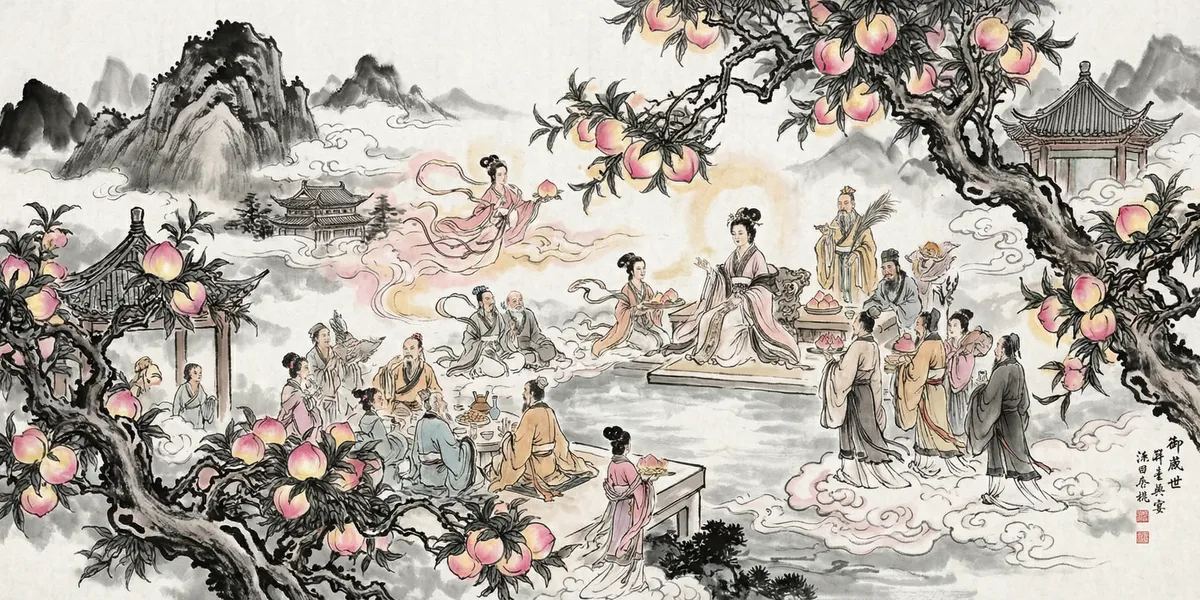
If the Jade Emperor is the CEO of the Three Realms, then the Queen Mother of the West (Wángmǔ Niángniang) is the Chairwoman of the Board — with her own independently operated subsidiary. She isn't merely the Jade Emperor's wife; she is an entity with her own sovereign territory, her own independent power, and her own mythological system. She presides over the Jade Pool on Mount Kunlun (Kūnlún Shān Yáochí), and in her hands she holds the scarcest strategic resource in the entire Chinese mythological universe: the Peaches of Immortality (pántáo) — the fruit that grants eternal life.
How important are these peaches? Consider this: in the worldview of Chinese mythology, virtually everyone — gods, demons, and mortals alike — is pursuing one thing above all else: immortality (chángshēng bùlǎo). The Peach Garden (Pántáo Yuán) produces three tiers of fruit. The lowest tier ripens once every three thousand years — eat one and you'll live longer. The middle tier ripens every six thousand years — eat one and you'll ascend to immortality, forever young. The highest tier ripens every nine thousand years — eat one and you'll live as long as heaven and earth themselves. In a mythological system where everyone is desperately chasing eternal life, the person who monopolizes the supply of immortality is — without the slightest exaggeration — the true holder of supreme power.
The Queen Mother knows exactly what cards she holds. Every few thousand years, she hosts the Peach Banquet (Pántáo Huì), the most exclusive, most prestigious, most face-giving social event in all of heaven. Receiving an invitation to the Peach Banquet is the equivalent of getting tickets to the Oscars, the Davos Forum, and a state dinner all rolled into one. The guest list is carefully curated, the seating arrangement strictly follows the celestial hierarchy, and the centerpiece of the feast is, of course, those legendary peaches.
The most famous Peach Banquet in Chinese literary history is also the one that went most spectacularly wrong. In "Journey to the West," Sun Wukong was assigned to guard the Peach Garden — which is essentially like putting a monkey in charge of a fruit stand. The outcome was predictable. He first gorged himself on the finest peaches, then got drunk on the celestial wine prepared for the banquet, then stumbled into Lord Laozi's (Tàishàng Lǎojūn) alchemy lab and scarfed down his elixirs of immortality like candy. Then he figured he might as well go all in and trashed the entire Heavenly Court. This cascade of disasters — the Great Havoc in Heaven (dà nào tiāngōng) — became one of the most celebrated episodes in Chinese literary history, and the spark that set it all off was the irresistible allure of the Queen Mother's Peach Banquet.
But the Queen Mother's image goes far beyond that of a banquet hostess. In far more ancient texts, she was an entirely different being. The "Shanhai Jing" (Shānhǎi Jīng) describes her with "a leopard's tail, tiger's teeth, and a talent for whistling" — tiger-fanged, leopard-tailed, dwelling in the western wilderness, with three divine birds serving as her messengers. Back then, she was not an elegant celestial queen but a wild, mysterious goddess of the wastelands, presiding over pestilence and punishment. Over centuries of cultural evolution, her image gradually transformed from a fierce divine woman of the west into a stately, resplendent queen of heaven — but that primal, independent spirit, beholden to no male authority, never truly disappeared.
The relationship between the Queen Mother and the Jade Emperor is also unique in world mythology. She is not his accessory. She has her own territory (Mount Kunlun), her own court, her own power base, and her own independent mythological storyline. The Jade Emperor holds court in the Heavenly Palace; the Queen Mother hosts banquets at the Jade Pool — two parallel systems. In many stories, the Queen Mother independently makes decisions about immortality and celestial affairs without needing the Jade Emperor's approval at all.
The Queen Mother also plays a pivotal role in one of China's most romantic legends: the tale of the Cowherd and the Weaver Girl (Niúláng Zhīnǚ). It was she who used her golden hairpin to scratch a river across the sky — the Milky Way (Yínhé) — separating the two lovers on opposite banks, permitting them to reunite only once a year, on the seventh day of the seventh lunar month (the Qixi Festival). In this story, she is the stern elder who tears apart a pair of lovers to uphold celestial order and social hierarchy — this image of the mother or grandmother who "beats the mandarin ducks apart" resonates deeply within Chinese family culture.
East vs West
East · Queen Mother of the West
Western counterpart: hera
The Queen Mother's most natural Western counterpart is Hera from Greek mythology. Both are consorts of the supreme god. But Hera's stories revolve almost entirely around her relationship with Zeus — jealousy, rage, hunting down her husband's lovers and their illegitimate children. Hera's power derives fundamentally from her identity as "Zeus's wife"; without Zeus, she has virtually no independent storyline. The Queen Mother is entirely different: she possesses her own territory, her own mythological lineage, and her own source of power. Her authority comes not from marriage but from her monopoly over the resource of immortality — in the entire mythological system, no one can bypass her to achieve true eternal life. In a sense, the Queen Mother is more like a fusion of Hera and Demeter — combining the dignity of a celestial queen with the strategic power of controlling a critical resource. This reflects an intriguing cultural difference: in Greek mythology, a goddess's power is often overshadowed by her husband's; in Chinese mythology, at least in the Queen Mother's case, the celestial queen can exist entirely independently of the celestial emperor, and in certain respects wields unique authority that even the emperor cannot replicate.
Modern Influence
The Queen Mother's influence on everyday Chinese life is pervasive. The tradition of giving longevity peaches (shòutáo) to elders on their birthdays comes directly from the legend of the Peach Garden — bakeries across China sell peach-shaped buns, the quintessential auspicious food at Chinese birthday banquets. "Peach Banquet" has become a byword for any high-end gathering or grand feast. In film and television, the Queen Mother appears in every adaptation of "Journey to the West" and is the most common female celestial character in the xianxia (immortal hero) genre. The imagery of the Jade Pool on Mount Kunlun has profoundly shaped the visual imagination of paradise in Chinese fantasy literature and film — whenever you see a celestial palace wreathed in mist above shimmering waters, there's a good chance the Queen Mother's influence is behind it.
Related Characters
 The Jade EmperorBack to CompendiumErlang Shen
