
Hou Yi
Hou Yi, The Divine Archer
The Supreme Bowman Who Shot Down Nine Suns
Domain
Sun-shooting hero
Role
Divine archer
Weapon
The Divine Bow
Appearance
A mighty archer in hunting garb, bow in hand
Legend
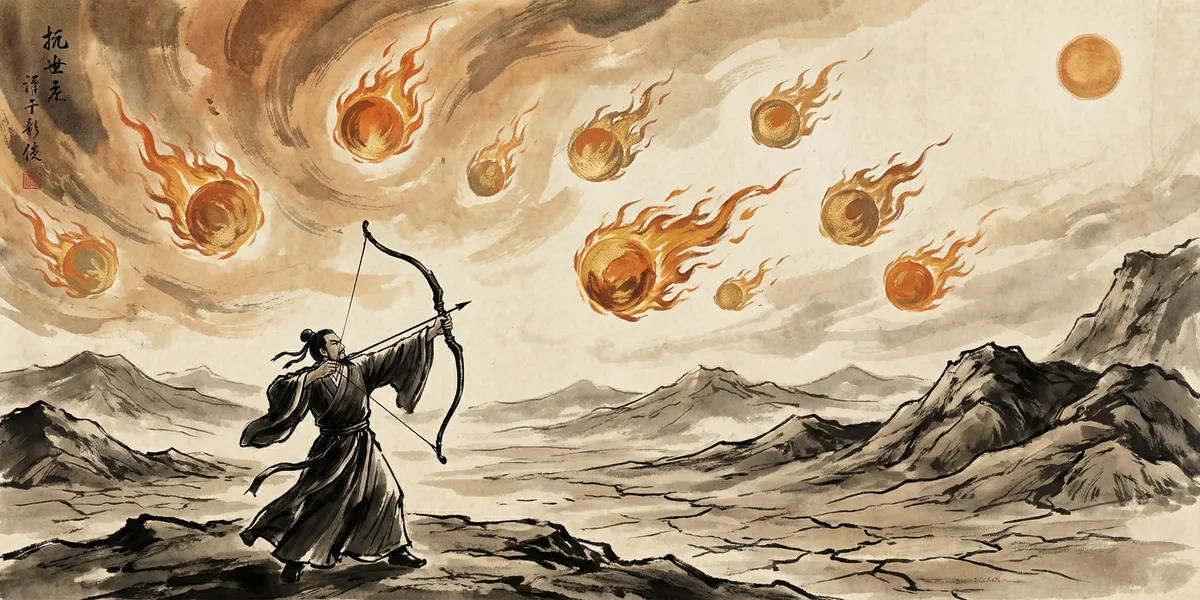
If you had to pick the most hard-done-by hero in all of Chinese mythology, Hou Yi (Hòu Yì) would easily make the top three. This man saved all of humanity, and in return he got fired by his boss, "abandoned" by his wife, and bludgeoned to death with a peach-wood club by his own student. His story teaches us a brutal lesson: doing good doesn't always pay off, but the story will definitely live on for a thousand years.
Let's start from the beginning. In the primordial age, there were ten suns in the sky. That's right — ten. They were the ten sons of the Celestial Emperor Di Jun, and they were supposed to take turns on duty, one per day, lighting up the earth. But one day these little hellraisers decided to go on strike — or rather, they all showed up to work at once, all ten suns blazing in the sky simultaneously. What happened on the ground? According to the *Huainanzi* (Classic of the Master of Huainan): "Ten suns appeared together, scorching the crops, killing the vegetation, and leaving the people with nothing to eat." In plain English: the fields were incinerated, the rivers evaporated, and humans were about to become barbecue.
In this prehistoric version of "global warming," Hou Yi made his entrance. He was originally an immortal in heaven, an archer of godlike skill, sent down to earth by the Celestial Emperor to handle this "solar crisis." The Emperor probably intended for him to scare his boys into going back to their rotation schedule. But Hou Yi clearly didn't get that memo.
He took up his divine bow (shén gōng), nocked a white-feathered arrow, and opened fire on the suns. The first arrow flew and a fireball plummeted from the sky, transforming upon impact into a three-legged golden crow (sān zú jīn wū) — the true form of the suns, a mythical three-legged bird. The crowd went wild. Hou Yi kept drawing and loosing — one arrow, one sun, every shot a hit. Nine suns fell in succession, the sky finally darkened, temperatures plummeted, and the people wept with joy.
As for why the last sun was spared, there's a rather entertaining detail. Reportedly, just as Hou Yi was about to fire the tenth arrow, Emperor Yao secretly had someone remove one arrow from his quiver. After all, if they had zero suns left, everyone would have to eat hot pot in eternal darkness. This detail is very Chinese wisdom — the hero charges in, but someone sensible always has to be standing nearby, riding the brakes.
But the price of saving the world was devastating. Those nine suns were all the Celestial Emperor's own sons. The Emperor was furious and immediately stripped Hou Yi and his wife Chang'e (Cháng'é) of their immortal status, banishing them to the mortal world. From that point on, this once-divine couple began their bitter days as ordinary humans.
Unwilling to accept aging and death, Hou Yi set off on a quest for the elixir of immortality (bù sǐ yào). After enduring countless hardships, he finally obtained a dose from the Queen Mother of the West (Xī Wáng Mǔ). She told him: if two people share it, both gain eternal life; if one person takes it all, that person ascends to heaven as an immortal. Hou Yi brought the elixir home, planning to choose an auspicious day to take it together with Chang'e.
But fate never follows the script. Hou Yi had a student named Peng Meng (Péng Méng), a man with a rotten heart, who broke into their home while Hou Yi was out hunting and tried to force Chang'e to hand over the elixir. In desperation, Chang'e swallowed it all in one gulp. What happened next you've probably heard — her body grew lighter and lighter, she floated out the window, drifted higher and higher toward the moon, and became the immortal goddess of the Lunar Palace.
When Hou Yi returned home and found his wife had flown to the moon, he picked up his bow, wanting to shoot down the moon to get closer to her. But even his world-shattering archery couldn't reach the moon. All he could do was set out Chang'e's favorite sweets and fruits in the courtyard and gaze at the moon in silent grief. This, it is said, is the origin of the Mid-Autumn Festival (Zhōng Qiū Jié) tradition of moon worship.
Hou Yi's ending varies across different versions. The most tragic account says Peng Meng later killed Hou Yi with a peach-wood club. A peerless archer who could shoot down suns, ultimately killed by a stick. The irony is so sharp it makes you wonder if fate has a dark sense of humor.
The *Huainanzi* sums up Hou Yi's life with devastating precision: he shot down nine suns to save humanity, and lost everything as a result. Hou Yi's story is not a simple hero narrative — it is a parable about the cost of heroism. Saving the world is never free, and behind the hero's glory there is often a loneliness no ordinary person could bear.
East vs West
East · Hou Yi
Western counterpart: Apollo (archer)
Hou Yi is often compared to Apollo from Greek mythology, but this comparison is rather superficial. Apollo is the sun god — he drives the sun chariot and represents light and the arts; Hou Yi is the man who shot down the suns. Their relationship is more oppositional than parallel. If you must find a Western counterpart, Hou Yi is more like Prometheus — both made enormous contributions to humanity, and both suffered severe punishment from the supreme deity as a result. Prometheus stole fire and was chained to a rock in the Caucasus, having his liver eaten by an eagle every day; Hou Yi shot down the suns and was stripped of his divine status, ultimately losing his wife and his life.
But there is a key distinction: Prometheus's suffering is viewed by the Greeks as noble martyrdom — he remains a purely tragic hero throughout. Hou Yi's story is more complex and morally ambiguous — in some versions, after losing Chang'e, he becomes tyrannical and degenerate, falling from hero to despot. This kind of moral ambiguity perfectly aligns with the Chinese philosophical concept of yin-yang transformation: there may be only a thin line between hero and tyrant, and decline following the peak of power is a natural law of the cosmos. Western narratives tend toward black-and-white hero definitions; Chinese narratives are more willing to acknowledge the grey zones of human nature.
Modern Influence
The tale of Hou Yi Shooting the Suns (Hòu Yì shè rì) is a classic piece in Chinese elementary school textbooks — virtually every Chinese child can recite the basic story. Every Mid-Autumn Festival, the story of Hou Yi and Chang'e is retold again and again, serving as the foundational cultural narrative for this festival of reunion. In gaming, Hou Yi is a popular marksman hero in *Honor of Kings*, with skill designs that perfectly capture the imagery of "shooting down suns." In film and animation, from the cartoon *Lotus Lantern* to various mythology TV series, Hou Yi is a recurring character. The wave of Chinese animation revival since 2020 has continually reinterpreted his image — from the traditional rugged warrior to the lonely tragic hero — and his story finds new resonance in every era. It's worth noting that "Hou Yi shooting the suns" has entered everyday Chinese as a metaphor for "solving the root problem" — even if the solution might be a tad drastic.
Related Characters
 ZhurongBack to CompendiumChang'e
