
Zhurong
Zhurong, God of Fire and Light
The Guardian of Order Who Fights with Fire
Domain
Fire, Light, Order
Role
War god and guardian of civilization who commands Fire Virtue
Weapon
The Fire Whip
Appearance
Majestic and imposing, wreathed in controlled flames, holding a fire whip, radiating authority
Legend
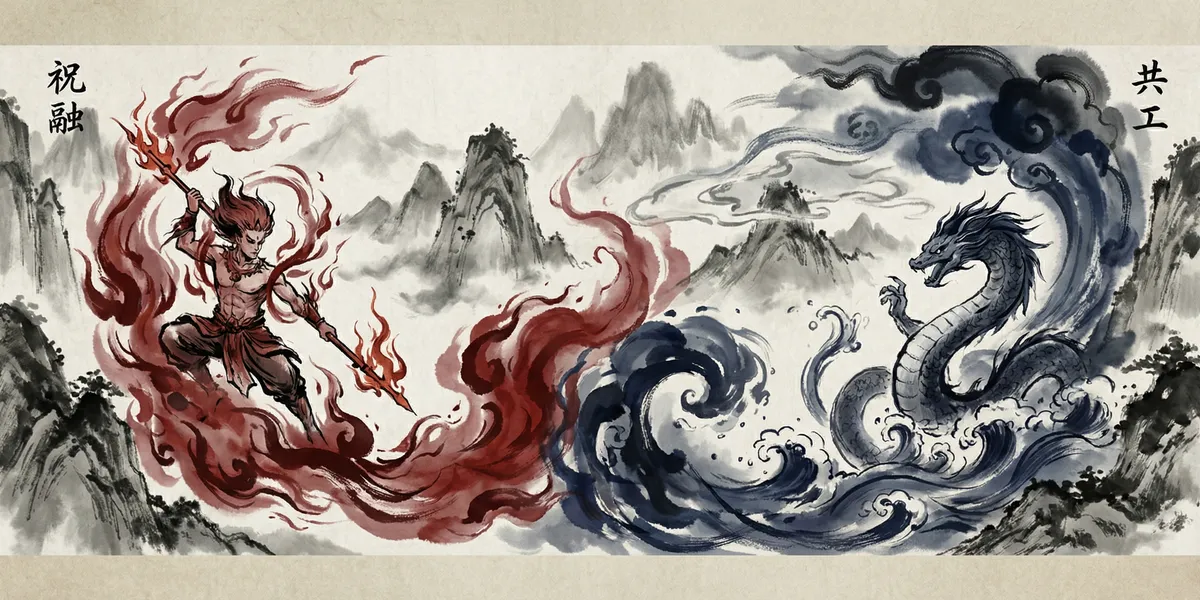
In most mythological traditions, fire gods tend to be volatile, dangerous, and best avoided. But Zhurong (Zhurong) breaks the mold. He's probably the most dependable fire god in Chinese mythology -- formidable in battle, effective as an administrator, able to hold down the fort, and his temper is actually pretty stable. If Gonggong represents uncontrolled natural force, Zhurong represents power harnessed by wisdom and discipline.
Zhurong served as the Fire Minister under the Flame Emperor (Yandi), the official in charge of all fire-related affairs. His job wasn't just about "setting things on fire" -- he managed the entire fire system: how to safely use fire for warmth, how to smelt and forge with fire, how to cook with fire, and how to prevent wildfires from spreading. He transformed fire from a dangerous natural force into a cornerstone of civilization. In this sense, Zhurong's contribution rivals that of Suiren's "invention of fire" -- Suiren taught humans how to ignite fire; Zhurong taught them how to use it properly.
Zhurong's most widely known story is, of course, his epic showdown with Gonggong (Gonggong) -- the God of Water. This was the ultimate elemental face-off in Chinese mythology. Gonggong unleashed world-drowning floods and raging storms; Zhurong countered with soaring flames and scorching drought. Steam blanketed the entire battlefield; every clash was like a miniature collapse of heaven and earth. The battle raged from the celestial realm to the mortal world, from east to west, with neither side giving ground.
Zhurong's weapon was the Fire Whip (huo bian) -- a divine whip burning with eternal flame, igniting everything it touched, unstoppable in its path. He cracked the Fire Whip to cleave through floods, evaporate rivers, and turn the battlefield into scorched earth. Crucially, Zhurong didn't fight with brute force alone -- he had strategy and discipline. He leveraged terrain, chose his moments, and concentrated his firepower at critical junctures, ultimately suppressing Gonggong's flood tide.
Zhurong won. Fire triumphed over water, order overcame chaos. But the victory came at a devastating cost -- Gonggong, enraged by defeat, rammed into Mount Buzhou and broke the sky. In a sense, Zhurong won the battle but couldn't prevent the loser's insane act of retaliation. This adds a layer of complexity to his victory: even if you're on the side of justice, even if you win, you can't fully control the consequences.
But Zhurong's identity extends far beyond "the one who beat Gonggong." In the ancient Chinese Five Elements (wuxing) cosmology, Zhurong corresponds to the south and to summer, representing Fire Virtue (huo de) -- the qualities of passion, energy, transformation, and illumination. He isn't merely a war god but the personification of a fundamental cosmic force. Within this cosmological framework, Zhurong's role is to maintain the balance of the Five Elements, ensuring that fire fulfills its constructive potential (warmth, light, smelting) without spiraling out of control.
In folk tradition, Zhurong is also revered as the god of Mount Heng, the Southern Peak. Mount Heng is one of China's Five Great Mountains, located in Hunan Province. The mountain still has Zhurong Peak and Zhurong Hall, which have been important sites for fire god worship across dynasties. Every year, vast numbers of devotees climb the mountain to pay tribute and pray for peace and illumination.
Zhurong's image in art is typically stern and resolute -- wreathed in controlled flames, holding his Fire Whip, his expression composed and determined. Unlike many wild, out-of-control fire deities, Zhurong always appears calm and methodical -- fire in his hands is a domesticated tool, not an uncontrolled disaster. This precisely reflects the Chinese cultural understanding of power: the truly strong person isn't the one who can cause the most destruction, but the one who can make power serve their purpose and benefit everyone.
Notably, Zhurong is also a central symbol in the ancient Chinese theory of dynastic succession through the Five Virtues (wude zhongshi shuo). According to this theory, each dynasty corresponds to an elemental virtue. Dynasties that claimed to carry the "Fire Virtue" often used Zhurong as a symbol of their mythological legitimacy. The state of Chu, for example, considered itself descended from Zhurong, and this ancestral identification profoundly influenced Chu culture's passionate and exuberant aesthetic. From mythological legend to political identity, Zhurong's influence far exceeds the simple definition of a "fire god."
East vs West
East · Zhurong
Western counterpart: Hephaestus
Zhurong's closest Western counterpart is Hephaestus, the Greek god of fire and the forge. Both are associated with controlled, constructive fire, and both are closely linked to craftsmanship and civilizational progress. But Hephaestus in Greek mythology often carries a tragic air -- he was thrown from Mount Olympus by his mother Hera for his ugliness and betrayed by his wife Aphrodite. Zhurong, by contrast, is a respected victor and guardian who never appears as a victim.
Another comparison is Apollo -- as the sun god, Apollo also represents light, order, and cosmic harmony. Both are champions defending sacred order against chaotic forces. But Apollo leans more toward art, prophecy, and philosophy, while Zhurong is more martial and elemental -- a warrior-engineer who directly commands flame. This difference reflects the two cultures' divergent imaginations of "fire": Western fire gods often carry some form of imperfection, while China's fire god is a complete, awe-inspiring embodiment of power.
Modern Influence
Zhurong's biggest moment in contemporary pop culture came in 2021, when China's first Mars rover was named "Zhurong" (Zhurong Hao). Naming a rover exploring the Red Planet after the God of Fire was a stroke of poetic genius. The naming brought Zhurong back into public consciousness as a cultural symbol of China's space program. In civilian life, fire departments and fire prevention campaigns sometimes reference Zhurong's name and image -- after all, he was the original deity who "taught humanity to use fire safely." Zhurong Peak on Mount Heng in Hunan remains a popular tourist and pilgrimage destination, attracting millions of visitors annually. The name "Zhurong" is also occasionally used in modern Chinese as an elegant synonym for fire disaster -- "a calamity of Zhurong" means a fire, a usage that preserves cultural heritage while reflecting reverence for natural forces. In games and film, Zhurong frequently appears as a fire-element war deity, ranking among the most popular characters in mythology-themed works.
Related Characters
 Beidou XingjunBack to CompendiumHou Yi
