
Suiren
Suiren, God of Fire
The Spark That Ignited Civilization
Domain
Fire, the Dawn of Civilization, Survival Skills
Role
The culture hero who brought fire to humanity
Weapon
The Sui-wood Fire Drill
Appearance
Rugged and resolute, holding a torch or fire-drilling tool, wreathed in firelight
Legend
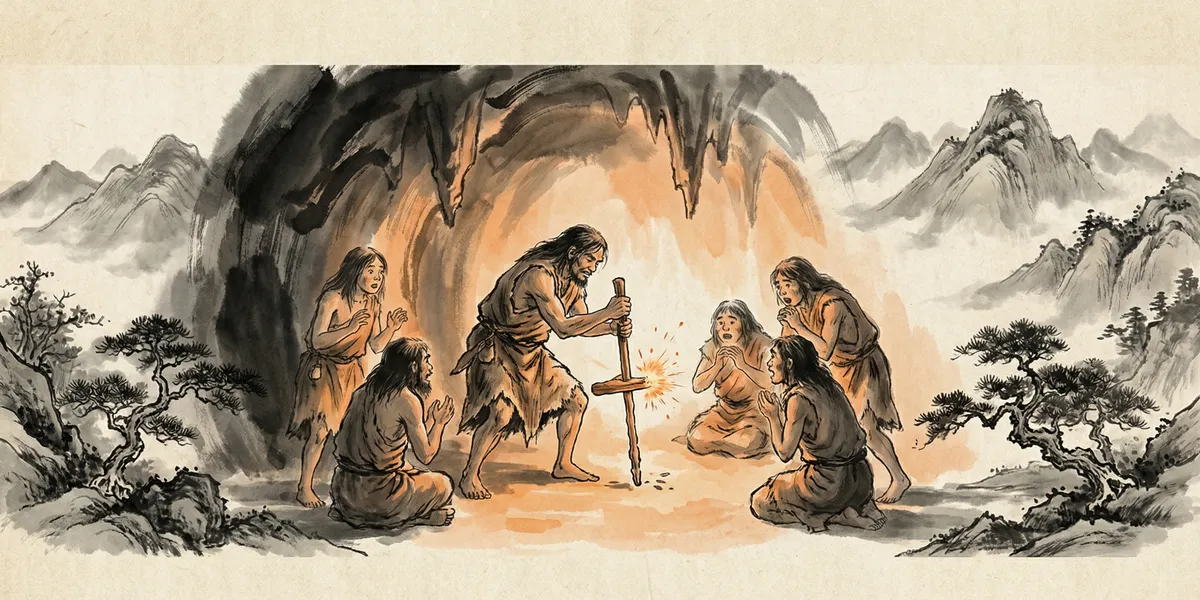
If Pangu gave humanity heaven and earth, Nuwa gave humanity life, and Fuxi gave humanity wisdom, then what Suiren Shi (Suiren Shi) gave -- while seemingly the most humble of gifts -- may have been the most important of all: fire.
What was life like before Suiren? Three words: cold, dark, raw. Cold, because there was no way to generate warmth, and winter meant huddling together for shared body heat. Dark, because once the sun went down, there was nothing but pitch blackness. Raw, because all food had to be eaten uncooked -- raw meat, raw fish, raw fruit, and if you were unlucky enough to eat something spoiled, food poisoning was your reward. Ancient texts sum up this era in four characters: ru mao yin xue (ru mao yin xue), meaning "eating fur and drinking blood."
How miserable was this existence? The Hanfeizi says that in high antiquity, "people ate raw fruits, shellfish, and clams, which were foul-smelling and harmful to the stomach, and many fell ill." The Baihu Tongyi adds: "Suiren first drilled wood to make fire, cooked raw food into cooked, freed people from stomach ailments, and distinguished humans from beasts." In other words, before Suiren invented fire, the line between humans and animals was disturbingly thin.
So how did Suiren discover fire? The most widely told version comes from the Shiyi Ji: in the far west, there was a place called the Land of Suiming (Suiming Guo), where an enormous tree called the sui-tree (suimu) grew, its canopy stretching endlessly across the sky. A great bird perched in this tree year-round, and it had a peculiar habit -- it would peck at the tree trunk with its beak, and with each strike, brilliant sparks would fly out like lightning, illuminating everything around.
A sage from a distant land witnessed this scene, and inspiration struck: if a bird pecking wood can produce sparks, could a human create fire through friction too? He broke off a branch of the sui-tree, took a thin pointed stick, and rapidly twirled it into another piece of wood -- this was drilling wood to make fire (zuanmu quhuo). The wood shavings grew hotter and hotter from the rapid friction, first smoking, then sparking, and finally -- a small flame danced to life.
Fire had been mastered by human hands for the first time.
This man was honored by later generations as "Suiren Shi" -- "sui" being the word for fire-starting tools. The Shangshu Dazhuan records: "Suiren was the Sui Sovereign, Fuxi was the Xi Sovereign, Shennong was the Nong Sovereign." Suiren, Fuxi, and Shennong are collectively called the "Three Sovereigns," with Suiren placed first, because fire is the starting point of all civilization.
What did the arrival of fire mean? It meant everything changed.
First, food. With fire, meat could be roasted, fish could be made into soup, plants could be stewed -- not only was the taste transformed beyond recognition, but more importantly, cooked food was far easier to digest and absorb, dramatically increasing nutritional efficiency. Modern anthropologists believe that mastering fire and cooking was one of the key factors in the rapid development of the human brain. Put another way, the reason humanity became so intelligent owes no small debt to roasted meat.
Next, safety. Wild animals fear fire -- a bonfire at the cave entrance at night was more effective than any fence. Humans could finally stop spending every nightfall in terror.
Then, socialization. With fire came the campfire. With the campfire, people gathered in circles. And what did they do sitting around a fire? They talked, told stories, sang songs. Humanity's earliest "social network" was a ring of stones around a pile of burning wood. Fire didn't just illuminate the darkness -- it ignited human social life.
Later, fire gave rise to pottery (firing clay), metallurgy (smelting ore), construction (firing bricks) -- virtually every subsequent technological revolution was built upon the foundational ability to control fire.
Besides drilling wood for fire, Suiren is credited with another major invention: knot-tying record keeping (jie sheng ji shi). Though this invention is also attributed to Fuxi, many ancient texts credit Suiren. Different knots represented different events and quantities -- large knots for major events, small knots for minor ones -- constituting humanity's earliest information recording system, a "database" predating the invention of writing.
In ancient literature, Suiren is typically depicted as a rough, rugged primordial human, holding a torch or fire-drilling tool, surrounded by firelight. He doesn't look like the gold-bedecked, cloud-riding celestial immortals of later mythology -- he looks more like a real wilderness explorer, with calloused hands and a soot-blackened face, trying again and again until flames finally leaped to life in his hands.
Suiren's story lacks the epic self-sacrifice of Pangu, the tender guardianship of Nuwa, or the philosophical grandeur of Fuxi -- but it possesses a unique, understated greatness. It tells us that what changes the world isn't always a monumental feat. Sometimes it's just a curious thought, a patient attempt, and a tiny flickering flame.
East vs West
East · Suiren
Western counterpart: Prometheus (fire-bringer)
Suiren's most direct Western counterpart is, of course, Prometheus -- both are the central "bringers of fire to humanity." But the tone of the two stories is completely opposite, and this contrast reveals the deepest cultural divide between Eastern and Western mythology.
Prometheus's fire was "stolen." He pilfered the divine fire that Zeus kept exclusively for the gods, hiding it in a fennel stalk to bring to mortals. This act directly violated divine authority. An enraged Zeus chained him to Mount Caucasus, where an eagle devoured his liver every day, over and over, for eternity. In the Greek narrative, human progress is an act of "theft," and the price of progress is "punishment." Knowledge and power belong to the gods, and for humans to obtain them carries an inherent taint of "original sin."
Suiren's fire was "discovered." He observed a natural phenomenon (a bird pecking wood producing sparks), and through his own thinking and experimentation, independently invented fire-making technology. No theft, no divine wrath, no eternal punishment. In the Chinese narrative, human progress is "natural" -- the laws of the universe are simply there, and a perceptive person noticed them and shared the knowledge with everyone. This isn't an offense against the Heavenly Way; it's alignment with the Heavenly Way.
The cultural implications of this difference are profound. The deeply rooted Western anxiety of "knowledge as transgression" -- from the forbidden fruit of Eden to Faust's bargain -- is virtually nonexistent in Chinese culture. Chinese cultural heroes acquire knowledge and spread civilization without ever paying the "price of punishment," because the basic premise of Chinese philosophy is this: the Way of Heaven and the Way of Humanity are not in conflict; human progress is simply the unfolding of the Heavenly Way.
Modern Influence
"Drilling wood to make fire" (zuanmu quhuo) is one of the most universally known ancient legends in China and a staple of elementary school textbooks. In modern contexts, it's frequently used as a metaphor for grassroots innovation and entrepreneurial spirit built from scratch. Shangqiu in Henan Province is considered Suiren's hometown, home to the Sui Emperor's Mausoleum and Fire Culture Plaza, with an annual "Fire Culture Festival." On a broader cultural level, China's reverence for fire runs through the entire span of its civilization -- from the fireworks and firecrackers of Spring Festival, to Olympic torch relays, to the space program's use of "huojian" (literally "fire arrow," meaning rocket). The torch-lighting ceremonies of both the 2008 Beijing Olympics and the 2022 Winter Olympics were, in a sense, reenactments of Suiren's ancient legend of drilling wood for fire. Every time humanity ignites a flame, it is, in a way, paying tribute to this primordial inventor.
Related Characters
 ShennongBack to CompendiumGuan Yu
