
Guan Yu
Guan Yu (Lord Guan)
The Martial Saint Whose Righteousness Pierces the Heavens
Domain
Loyalty, righteousness, and martial valor; protector of the people and the God of Wealth in martial form
Role
The Martial Saint Lord Guan, Great Deity Who Subdues Demons Across the Three Realms, the mortal world's warrior-god of timeless loyalty
Weapon
The Green Dragon Crescent Blade — weighing eighty-two pounds, engraved with a dragon motif, also called the Cold Beauty Saw, the greatest blade under heaven
Appearance
A face as red as a ripe date, phoenix eyes, silkworm-brow eyebrows, five flowing wisps of beard cascading to his chest, wearing a green robe and golden armor, Green Dragon Crescent Blade in hand, mounted on Red Hare
Legend
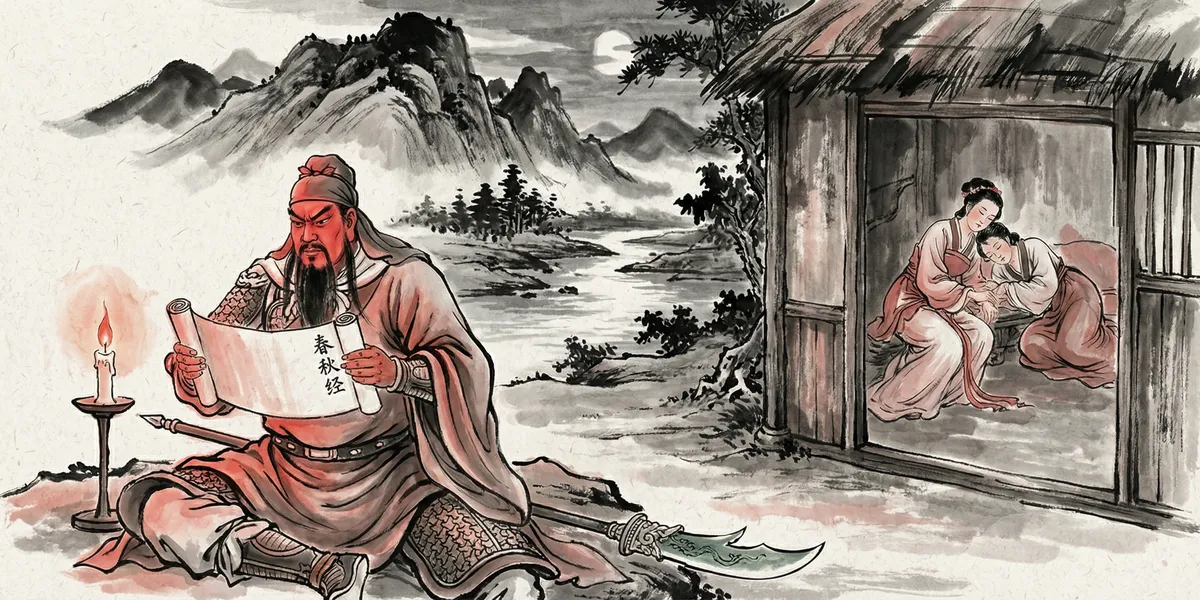
In Chinese culture, there is one figure who was a general in life and became a god in death. His temples outnumber Confucius's, his fan base stretches from triad bosses to Buddhist monks, and his image shows up everywhere from Guan Di temples to Hong Kong-style diners. He is Guan Yu (Guān Yǔ), courtesy name Yunchang — the ultimate embodiment of "yi" (righteousness) in the Chinese heart.
Guan Yu was an actual historical person. According to the *Records of the Three Kingdoms* (Sānguó Zhì), he was from Jieliang in Hedong (modern-day Yuncheng, Shanxi) during the late Eastern Han Dynasty. But what transformed him from a historical figure into a cultural phenomenon was Luo Guanzhong's novel *Romance of the Three Kingdoms* (Sānguó Yǎnyì). In this novel — one of China's Four Great Classical Novels — Guan Yu was sculpted into a near-perfect embodiment of loyalty and righteousness: a face as red as a ripe date, phoenix eyes, silkworm-brow eyebrows, five flowing wisps of beard cascading to his chest, standing nine feet tall, mounted on the legendary Red Hare horse (Chìtù Mǎ), wielding the eighty-two-pound Green Dragon Crescent Blade (Qīnglóng Yǎnyuè Dāo). This image is so deeply embedded in the national consciousness that if you asked ten Chinese people to draw Guan Yu, you'd get ten nearly identical portraits.
The core of Guan Yu's story is one word: "yi" — righteousness. He, Liu Bei (Liú Bèi), and Zhang Fei (Zhāng Fēi) swore the Oath of the Peach Garden (Táoyuán Sān Jiéyì), cutting their fingers and mixing their blood, vowing: "We seek not to be born on the same day, but we wish to die on the same day." Guan Yu honored that brotherhood with his entire life, unwavering to the end.
The episode that best demonstrates Guan Yu's "yi" at its absolute peak is his Lone Ride Over a Thousand Miles (Qiānlǐ Zǒu Dānqí). In the year 200 CE, Liu Bei was defeated in battle, and Guan Yu was forced to surrender to Cao Cao (Cáo Cāo). Now, Cao Cao knew talent when he saw it, and he showered Guan Yu with every conceivable incentive — titles, gold, silver, beautiful women, a luxury residence, and even Lu Bu's legendary warhorse Red Hare. Anyone else would have been living the dream. But Guan Yu said, in essence: "I'll accept these, but I made a promise to Liu Bei first. The moment I learn where he is, I must go back to him." Cao Cao heard this and, though displeased, found his respect for the man growing even deeper.
When Guan Yu learned that Liu Bei was with Yuan Shao, he didn't hesitate for a second. He returned every seal and all the gold Cao Cao had given him, took Liu Bei's two wives under his protection, and set off — one man, one blade, one horse — on a journey of a thousand miles. When Cao Cao's generals refused him passage, he fought through them — passing through five checkpoints and cutting down six commanders (guò wǔ guān, zhǎn liù jiàng), carving a bloody path forward. What makes this story so stunning isn't the martial prowess — it's the values: when forced to choose between wealth and power on one hand and brotherhood on the other, Guan Yu didn't even pause to think.
Another legendary scene is "Scraping the Bone to Treat the Poison" (guā gǔ liáo dú). Guan Yu was struck in the right arm by a poisoned arrow on the battlefield, and the toxin had seeped deep into the bone. The divine physician Hua Tuo (Huà Tuó) arrived and said the flesh had to be cut open and the poison scraped off the bone with a knife. No anesthesia was available. What did Guan Yu do? While Hua Tuo scraped, he sat there drinking wine and playing chess, his expression unchanged, chatting and laughing as if nothing were happening. Hua Tuo sweated profusely through the procedure; Guan Yu won the chess game. This scene became the ultimate definition of "tough guy" in Chinese culture.
But Guan Yu was not without flaws. His pride was his fatal weakness. When Sun Quan (Sūn Quán) proposed a marriage alliance, Guan Yu fired back: "How could the daughter of a tiger marry the son of a dog?" That one sentence mortally offended the entire kingdom of Eastern Wu. In the year 219 CE, while Guan Yu was defending Jingzhou, he grew overconfident. Lu Meng (Lǚ Méng) crossed the river disguised in white and launched a surprise attack. Guan Yu was routed and fled to Maicheng (Zǒu Màichéng), where he was captured and executed. "Losing Jingzhou through carelessness" (Dàyì shī Jīngzhōu) has since become the classic Chinese expression for suffering catastrophic losses due to arrogance and complacency.
After Guan Yu's death, his true "apotheosis" was only beginning. The common people spontaneously built temples and made offerings to him. Successive emperors piled on the honors — the Song Dynasty granted him the rank of Marquis, the Yuan Dynasty elevated him to King, the Ming Dynasty's Wanli Emperor bestowed upon him the title "Lord Guan the Holy Emperor, Great Deity Who Subdues Demons Across the Three Realms, Whose Awesome Spirit Shakes the Heavens," and the Qing Dynasty formally elevated him to "Martial Saint" (Wǔ Shèng), placing him on equal footing with the "Literary Saint" Confucius. From a general who died on the battlefield to a sage ranked alongside Confucius himself — this journey of deification took nearly eighteen hundred years. Buddhism got in on the action too — Guan Yu was incorporated into the Buddhist system as the "Sangharama Bodhisattva" (Qiélán Púsà), a guardian deity of Buddhist temples. Daoism was not to be outdone, honoring him as "Lord Guan the Holy Emperor" (Guān Shèng Dìjūn), Great Deity Who Subdues Demons Across the Three Realms. And just like that, Guan Yu became the simultaneous holder of VIP cards from all three of China's philosophical-religious traditions — Confucianism, Buddhism, and Daoism — something absolutely unique in the Chinese divine hierarchy.
Today, there are over thirty thousand Guan Di temples (Guān Dì Miào) worldwide, outnumbering even Confucius temples. In Chinese shops, corporations, martial arts schools, and even police stations, you'll find a statue of Lord Guan — because the "yi" he represents transcends all factions and affiliations as a universal value in Chinese culture. Merchants worship him seeking to balance righteousness with profit, warriors worship him seeking courage united with righteousness, and even those in grey-area businesses worship him — because even on the wrong side of the law, you still have to be righteous about it.
East vs West
East · Guan Yu
Western counterpart: Ares / Saint George
Guan Yu's closest Western parallel is a combination of the war god Ares's martial ferocity with Saint George's sacred status. Like Ares, Guan Yu is a terrifying presence on the battlefield — where his Green Dragon Crescent Blade sweeps, ten thousand soldiers scatter. But unlike Ares's negative reputation in Greek mythology (violent, reckless, disliked by the other gods), Guan Yu is an entirely positive warrior figure. He is closer to Saint George — a warrior who was canonized, elevated from historical figure to object of worship. However, Saint George's core tale (slaying a dragon to rescue a princess) is essentially legend, while Guan Yu's stories are deeply rooted in real history. Saint George is venerated for his piety toward God; Guan Yu is venerated for his loyalty to his sworn brothers. This precisely reflects the fundamental difference between Western and Chinese "canonization" logic: the West values devotion to the divine, while China values loyalty between people. Guan Yu didn't become a god by believing in one — he became a god because he lived the word "yi" until it became a faith in itself.
Modern Influence
Lord Guan is one of the most influential Chinese folk deities in the world today. Over thirty thousand Guan Di temples span five continents, from New York's Chinatown to Yokohama in Tokyo, from Bangkok to Sydney. In Chinese business culture, Guan Gong statues are enshrined in corporate lobbies and shop entrances as symbols of integrity and trustworthy dealing. Hong Kong's financial industry is especially devoted to Lord Guan — because in the business world, "yi" means "credit," and credit is everything. In gaming, Guan Yu is one of the most iconic warrior characters in *Honor of Kings* (Wang Zhe Rongyao). Continuous adaptations of *Romance of the Three Kingdoms* in film and television ensure each new generation knows his story. The word "yi" remains one of the most esteemed qualities in Chinese interpersonal relationships to this day.
Related Characters
 SuirenBack to CompendiumYue Fei
