
Yue Fei
Yue Fei
The Eternal Loyal Soul Who Served His Country with Absolute Devotion
Domain
Defending the homeland, fighting the Jin invaders to reclaim lost territory, loyalty for all eternity
Role
Southern Song anti-Jin general, national hero, Prince Wumu, revered by later generations as a Martial Saint
Weapon
The Liquan Spear — Yue Fei's signature long spear, wielded with transcendent mastery, invincible when combined with the Yue Family Army's formations
Appearance
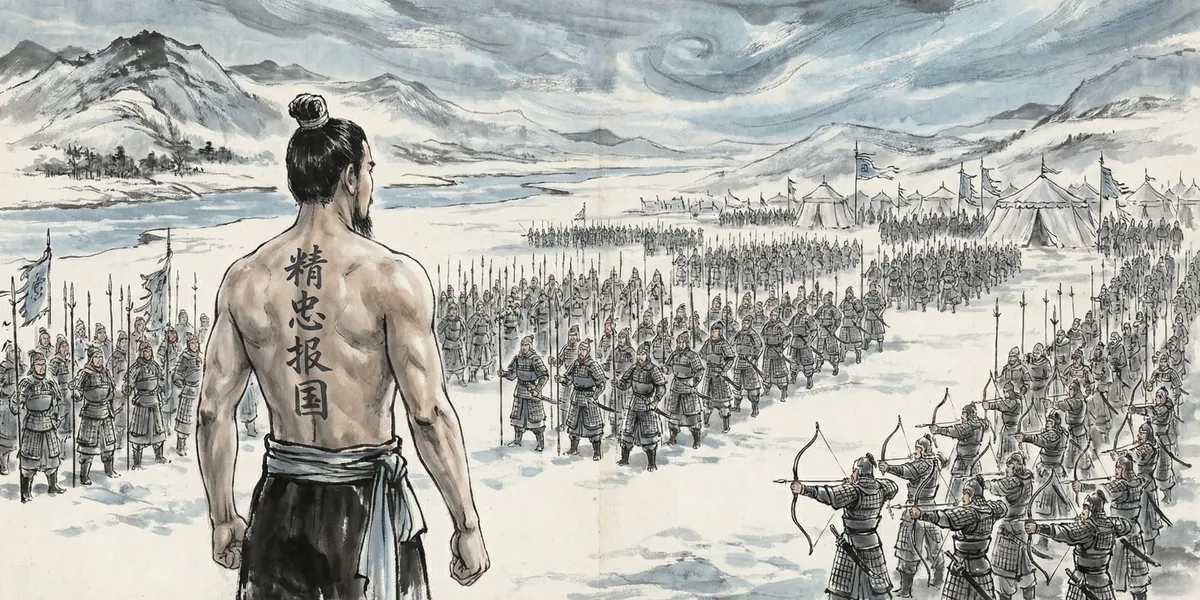
White robe and silver armor, the four characters 'Serve the Country with Absolute Loyalty' tattooed on his back, a resolute and heroic countenance, Liquan Spear in hand, standing tall and straight as a pine
Legend
In Chinese history, if there is one name that inspires both supreme reverence and supreme heartbreak in equal measure, it is Yue Fei (Yuè Fēi). He was the greatest military genius of the Southern Song Dynasty, the ultimate totem of Chinese patriotism, and the most tragic hero in the Chinese consciousness — bar none. His is not a story about victory. It is a story about loyalty betrayed.
Yue Fei, courtesy name Pengju (Péngjǔ), was born in the second year of Emperor Huizong's Chongning reign (1103 CE) in Tangyin, Henan. Legend says a great roc bird (Dàpéng Niǎo) swept over the rooftop at the moment of his birth, hence his courtesy name "Pengju" — the great roc takes flight, its ambition set among the clouds. He came from humble origins but was extraordinarily gifted, studying martial arts and military strategy under the renowned master Zhou Tong (Zhōu Tóng), mastering devastating spear techniques at a young age.
Yue Fei's most famous mark is the four characters tattooed on his back — "Serve the Country with Absolute Loyalty" (Jīng Zhōng Bào Guó). Legend has it that before he enlisted, his mother, Lady Yao (Yáo Shì), took an embroidery needle and pricked these four characters into the skin of his back, one stroke at a time. Every needle drew blood, every stroke drew tears. This is the story of "Yue Fei's Mother Tattoos His Back" (Yuèmǔ cì zì) — the greatest act of maternal education in Chinese history: your life does not belong to you; it belongs to your country and your people. Yue Fei lived those four characters his entire life and redeemed them with his death.
In the second year of the Jingkang era (1127), the Jurchen Jin armies breached Kaifeng, the eastern capital, and abducted Emperor Huizong and Emperor Qinzong — an event known as the "Humiliation of Jingkang" (Jìngkāng zhī Chǐ), one of the most disgraceful episodes in Chinese history. Zhao Gou fled south and established the Southern Song Dynasty, clinging to the Jiangnan region. In this moment of shattered mountains and rivers, the twenty-four-year-old Yue Fei stepped forward and began his magnificent campaign against the Jin invaders.
Yue Fei was a rare military genius. He forged the fearsome "Yue Family Army" (Yuè Jiā Jūn), whose iron discipline was legendary: "Freeze to death rather than tear down houses for firewood; starve to death rather than loot the people" — a miracle in an era when the line between soldiers and bandits barely existed. Among the Jin troops, a saying circulated: "It is easier to shake a mountain than to shake the Yue Family Army" (Hàn shān yì, hàn Yuè Jiā Jūn nán).
In the tenth year of the Shaoxing era (1140), Yue Fei reached the zenith of his military career — the Battle of Yancheng (Yǎnchéng zhī Zhàn). The Jin Empire's supreme commander Wanyan Zongbi (known as Jin Wuzhu) committed his elite forces: the "Iron Pagodas" (heavy cavalry) and the "Kidnapper Cavalry" (flanking light cavalry). Yue Fei deployed infantry against cavalry, ordering his soldiers to wield long axes aimed exclusively at the horses' legs, shattering the Jin ironclad cavalry. Jin Wuzhu looked to the sky and lamented: "Since we first raised our armies from the coast, we have always prevailed with this tactic. Now it is finished!" The Jin military's invincible cavalry — their trump card since the beginning — had been utterly dismantled by Yue Fei.
Victory was within grasp. Yue Fei was preparing to march north and drive straight to Huanglong Prefecture (the Jin capital) to rescue the captured emperors. He declared to his soldiers with words that have echoed through the centuries: "Drive straight to Huanglong, and drink with you all until we can drink no more!" (Zhí dǎo Huánglóng, yǔ zhūjūn tòng yǐn ěr!)
But fate played its cruelest joke right here. Just as Yue Fei was on the verge of completing the epochal achievement of recovering the Central Plains, the Southern Song court issued twelve gold medallion orders (jīn pái, emergency military commands) in succession, demanding his immediate return. The reason? Emperor Gaozong Zhao Gou and Chancellor Qin Hui (Qín Huì) had decided to sue for peace with the Jin. What they feared was not the Jin army — what they feared was Yue Fei winning. If the northern expedition succeeded and the captured emperors were brought home, Zhao Gou's throne would be in jeopardy.
When Yue Fei received the gold medallions, his anguish was boundless. He looked to the sky and cried: "Ten years of effort, destroyed in a single day! All the territories we recovered, lost in a single morning!" But he was, in the end, a soldier. Military orders are like mountains. He chose to obey.
Back in Lin'an (the Southern Song capital, modern-day Hangzhou), what awaited him was not the glory of triumph but a carefully orchestrated murder. Qin Hui fabricated charges and condemned Yue Fei to death with just three characters — "mo xu you" (mò xū yǒu), meaning "perhaps there are" or "maybe." When the general Han Shizhong (Hán Shìzhōng) confronted Qin Hui demanding to know what crime Yue Fei had actually committed, Qin Hui answered with those three words. Han Shizhong thundered: "Three characters — 'perhaps there are' — how can this convince anyone under heaven!"
On New Year's Eve of the eleventh year of the Shaoxing era (January 27, 1142), Yue Fei was poisoned at Wind-Wave Pavilion (Fēngbō Tíng). He was thirty-nine years old. His eldest son Yue Yun and his lieutenant Zhang Xian were killed the same day. A god of war, extinguished.
But Yue Fei's story did not end there. Twenty years later, Emperor Xiaozong ascended the throne and posthumously rehabilitated Yue Fei, granting him the posthumous title "Wumu" (Wǔmù, meaning "Martial and Reverent"), and later the noble title "Prince of E" (È Wáng). At Yue Fei's tomb beside the West Lake in Hangzhou, iron statues of Qin Hui and his wife have knelt before Yue Fei's grave for centuries. Countless visitors come to spit upon Qin Hui and pay tribute to Yue Fei. The iron statues have been so corroded by saliva and recast so many times that no one can count the iterations — this is the Chinese people's most visceral way of expressing their fury at loyal ministers being martyred and treacherous ministers holding power.
Yue Fei's most powerful legacy to posterity is his ci poem *Man Jiang Hong* (Mǎn Jiāng Hóng): "My hair bristles in my helmet; standing by the railing, the pattering rain has stopped. I raise my eyes, look up to the sky, and let out a long, fierce cry — my heroic passions surge. Thirty years of fame and achievement, mere dust and dirt; eight thousand miles of road, under cloud and moon..." This poem remains the most recognized patriotic verse in the Chinese language. Whenever the nation faces peril, someone recites it, and someone weeps.
East vs West
East · Yue Fei
Western counterpart: Joan of Arc
Yue Fei's closest Western counterpart is Joan of Arc. The parallels in their fates are strikingly similar: both were young heroes who emerged from nowhere when their nation teetered on the brink of destruction; both reversed the course of war through genius-level military ability and won decisive victories; both were betrayed by their own side at the moment of triumph — Joan was sold to the English by the Burgundians, Yue Fei was framed by Qin Hui on fabricated charges; both were executed on trumped-up accusations — Joan was burned at the stake as a "heretic," Yue Fei was poisoned at Wind-Wave Pavilion on grounds of "perhaps"; and both were posthumously rehabilitated and effectively canonized — Joan was declared a saint by the Catholic Church in 1920, Yue Fei was rehabilitated and honored as Prince of E twenty years after his death. Yet the deepest commonality is also the most heartbreaking: their tragedies were not caused by the enemy being too strong, but by political betrayal from their own side. Their lives laid bare a cruel pattern of history — the purest patriots are often destroyed by the very regimes they pledged their loyalty to.
Modern Influence
Yue Fei is a central symbol in Chinese patriotic education. *Man Jiang Hong* is a mandatory memorization piece in middle school Chinese language classes, and the four characters "Serve the Country with Absolute Loyalty" remain the most frequently cited allusion when Chinese people express patriotic sentiment. The Yue Fei Temple in Hangzhou is a National Key Cultural Heritage site, receiving millions of visitors each year. Zhang Yimou's 2023 film *Full River Red* grossed over 4.5 billion yuan at the box office, reigniting collective memory and cultural discussion of Yue Fei's spirit across the nation. The three characters "mo xu you" (perhaps there are) have become standard vocabulary in Chinese for describing wrongful convictions and baseless accusations. Yue Fei's story carries the highest respect Chinese culture can offer for loyalty, justice, and the spirit of sacrifice — he is not merely a historical hero, but a spiritual totem.
Related Characters
 Guan YuBack to CompendiumWeituo
