
Weituo
Weituo, The Guardian of Dharma
The Fierce Vajra Protector of the Buddhist Gate
Domain
The sacred grounds of Buddhism -- wherever the dharma is transmitted falls within his protective domain
Role
Chief guardian deity of Buddhism, vanquishing demons and evil, protecting the Three Treasures of Buddha, Dharma, and Sangha
Weapon
Demon-Subduing Pestle (Vajra Pestle) -- a sacred guardian artifact that suppresses all heterodox demons
Appearance
A jade-faced young general, clad in divine golden armor, waist bound with dragon sash, wielding the demon-subduing pestle, dashingly heroic, radiating righteous authority beneath his majestic bearing
Legend
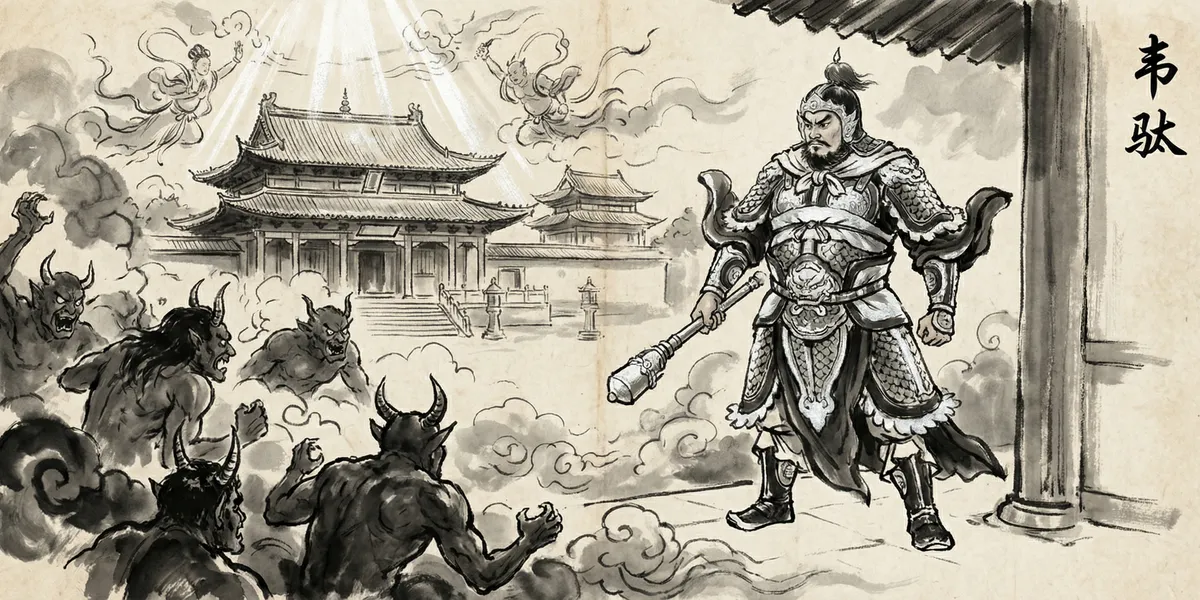
In every Chinese Mahayana Buddhist temple, there is an ironclad spatial rule: you walk into the Hall of Heavenly Kings, and facing you head-on is Maitreya Buddha's grinning round face. But behind Maitreya, facing toward the Great Hero Hall, there invariably stands a young general in full armor, gripping a demon-subduing pestle, his expression stern and resolute -- this is Weituo Pusa (Weituo Pusa), the most important dharma protector deity in the Buddhist world. Maitreya smiles to welcome all guests; Weituo glares to guard the Buddhist gate -- one soft, one hard, one yielding, one fierce, forming the most classic spatial narrative in Chinese Buddhism.
Weituo's full title is "General Weituo" or "Weituo Honored Heavenly Bodhisattva." In the hierarchy of Buddhist guardian deities, he is the chief of eight generals under the Southern Heavenly King of Growth (Zengzhang Tianwang), and simultaneously the foremost among the thirty-two generals of the Four Heavenly Kings. His job can be summed up in four characters: protect the dharma, subdue demons. If Guanyin is the compassionate face of Buddhism and Rulai is the wisdom face, then Weituo is the power face -- when compassion and wisdom can't solve the problem, someone needs to step up and use force, and that someone is him.
Weituo's most widely told story takes place at the moment of Shakyamuni Buddha's parinirvana (niepan). After the Buddha passed away, his relics (sheli, sacred bone remains) were distributed for veneration. A demon called the Swift Ghost (Jieji Gui) seized the chaos to steal two of the Buddha's tooth relics, intending to keep the supreme holy objects for himself. Weituo heard the news, grabbed his demon-subduing pestle (xiangmo chu), and gave chase. How fast was this deity? Reportedly as fast as a meteor streaking across the sky. He pursued the thief to the ends of the earth, finally intercepted the Swift Ghost, and recovered the Buddha's tooth relics. From that day forward, Weituo was universally recognized as the most loyal guardian of the Buddhist faith -- Shakyamuni Buddha himself conferred upon him the title of "Guardian Deity of the Dharma."
The demon-subduing pestle (also called the vajra pestle, jingang chu) in Weituo's hand isn't merely a weapon -- it's also an ingenious temple sign-language system, and this may be the most obscure yet fascinating piece of Chinese Buddhist cultural trivia. In ancient times, wandering monks (yunyou sengren) traveled from temple to temple seeking teachings. When they arrived at an unfamiliar monastery, how could they tell whether they'd be offered lodging (guadan)? The answer was in Weituo's hand gesture.
If Weituo stood with palms pressed together, the pestle resting horizontally across both forearms -- congratulations, this is a "ten-direction monastery" (shifang conglin), open to all comers, where any traveling monk could receive free food and shelter. If Weituo held the pestle in one hand with the tip pointing upward over his shoulder -- a mid-sized temple, short-term lodging available. If Weituo held the pestle in one hand with the tip pointing toward the ground -- this is a "hereditary temple" (zisun miao), a small privately-run monastery that doesn't accept outside monks. This silent visual code system was essentially the ancient world's version of a hotel star rating.
Weituo has one strikingly distinctive physical feature: he is eternally young. In Chinese Buddhist sculptural art, Weituo always appears as a jade-faced, spirited young general -- no beard, no wrinkles, clad in magnificent divine golden armor, waist cinched with a dragon-patterned sash, feet in war boots, dashingly heroic. This "ageless" design isn't arbitrary. It symbolizes Weituo's tireless spirit of guardianship -- like a young warrior who never grows weary and never grows old, he guards the dharma day and night, kalpa after kalpa, without a single moment of slack.
Within the grand timeline of Buddhist cultivation, Weituo has a deeply moving character arc. He made a vow spanning the entire Worthy Kalpa -- across the immense stretch of time during which one thousand Buddhas will appear in succession, he will serve as dharma protector for each and every one. Only after the one-thousandth Buddha (Louzhi Fo) has appeared and completed his mission will Weituo himself finally attain Buddhahood. This path mirrors Dizang Wang Bodhisattva's: accomplish everyone else first, accomplish yourself last. He is the eternal guardian -- always standing behind the Buddha, never competing for the front position, always putting himself at the very end.
In Chinese folk belief, Weituo protects not only the dharma but is also regarded as a protective deity against evil and misfortune. Many families and shops enshrine Weituo statues to ward off malevolent spirits. Martial artists and soldiers often look to Weituo as a spiritual exemplar, because he represents the highest realm of martial power -- not used for killing, not used for conquest, but used for protection.
Perhaps this is Weituo's deepest significance. In a religious system that champions individual enlightenment and the pursuit of personal Buddhahood, he chose to be an eternal supporting character -- someone who always stands behind others, someone who is never the first to catch your eye. His greatness lies not in how powerful he is, but in his willingness to devote all his strength to guardianship rather than conquest.
East vs West
East · Weituo
Western counterpart: Archangel Michael
Weituo's most direct Western counterpart is the Archangel Michael. The similarities are remarkably strong: both are the mightiest warrior-guardians in their respective religious systems; both have demon-vanquishing as their core duty -- Michael leads the angelic host against Satan, while Weituo wields his pestle to drive out all evil; both carry signature weapons (Michael's flaming sword, Weituo's vajra pestle); and their visual representations are strikingly alike -- both appear as youthful, martial, fully-armored divine warriors.
But the key distinction lies in status and role. Michael is an archangel, second only to God in the Christian hierarchy -- he's a leader figure who takes initiative, commands armies, and judges souls. Weituo, by contrast, consistently positions himself as a "protector" -- he guards the dharma but doesn't lead it; all his power serves the Three Treasures of Buddha, Dharma, and Sangha, and he never tries to become the protagonist. Michael is a general; Weituo is a sentinel. One leads armies and goes on the offensive; the other stands guard and responds defensively. This reflects fundamentally different understandings of "sacred martial force" in Christianity versus Buddhism: the former emphasizes proactively conquering evil; the latter emphasizes passively protecting the righteous path.
Modern Influence
Weituo Bodhisattva statues are standard fixtures in every Chinese Mahayana Buddhist temple -- with tens of thousands of temples across the nation, he may possess more "incarnations" in sculptural form than any other Buddhist figure in China. The hand-gesture code of "how Weituo holds his pestle" is still observed by some traditional temples and has become a popular knowledge point in Buddhist tourism and cultural education. In martial arts culture, "Weituo's Pestle" and "Weituo's Palm" are classic technique names in wuxia novels and period dramas, especially prevalent in Shaolin Temple-themed works. Weituo's youthful, heroic image also holds some influence in anime culture and mobile gaming markets, with several mythology-themed games (such as Fantasy Westward Journey and Tale of the Night Wanderers) featuring dharma protector warrior characters based on Weituo. Additionally, the vajra pestle form from Buddhist ritual implements has been widely adopted in contemporary jewelry design, becoming a cultural symbol that combines religious significance with aesthetic value.
Related Characters
 Yue FeiBack to CompendiumXingtian
