
Xingtian
Xingtian, The Headless Warrior
The Decapitated Warrior Who Refused to Fall
Domain
Battle, Defiance, Vengeance
Role
The headless war god who never surrenders
Weapon
Axe and Shield
Appearance
Headless giant with nipples for eyes and navel for mouth, wielding axe and shield
Legend
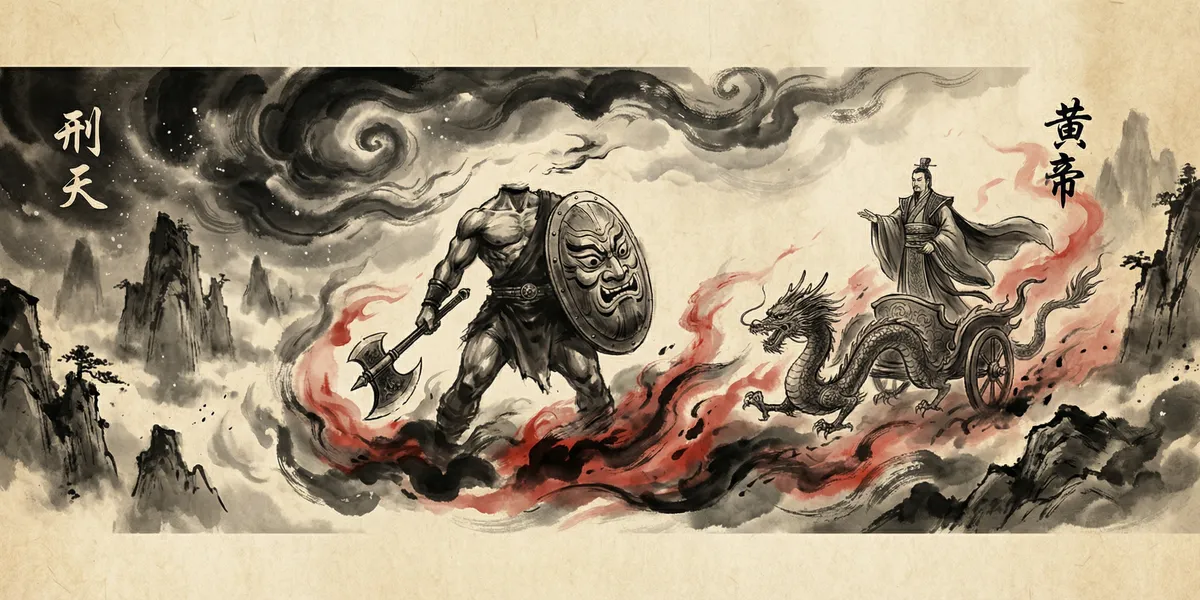
Imagine this: your head has been chopped off, but you refuse to go down. You use your nipples as eyes, your navel as a mouth, and keep swinging your axe and shield in a war dance. That is Xingtian (Xingtian), the most hardcore being in all of Chinese mythology.
Xingtian was a colossal war god of the primordial era, loyal to the Flame Emperor (Yandi). When the Flame Emperor lost the great war for dominion to the Yellow Emperor (Huangdi), most of his followers accepted their fate and surrendered. Not Xingtian. He could not accept the outcome. Burning with rage, he grabbed his giant axe and shield and marched off, alone, to challenge the Yellow Emperor to single combat.
Objectively speaking, this was not a smart decision. The Yellow Emperor was the supreme ruler of all under heaven, the ultimate victor who had defeated every rival, the highest authority in the cosmos. But Xingtian didn't care about smart -- he cared about loyalty, about honor, about defiance.
The battle was unimaginably brutal. Xingtian fought with staggering martial skill and a reckless fury that darkened the skies, but the Yellow Emperor ultimately proved superior. In the final moment of their duel, the Yellow Emperor swung his sword and severed Xingtian's head. The head rolled to the ground, and the Yellow Emperor, knowing Xingtian's spirit was too powerful to risk reuniting head with body, buried the head beneath Mount Changyang (Changyang Shan), using the mountain as a seal.
In any normal mythological narrative, the story would end here. Hero challenges the supreme god, hero loses his head, hero dies. Done. But Xingtian was not normal. His headless body swayed on the ground, and then -- stood up. Without a head, he had no eyes and couldn't see; no mouth, and couldn't cry out. So what did he do? He made nipples into eyes and navel into mouth (yi ru wei mu, yi qi wei kou) -- fashioning a new "face" directly on his torso by sheer force of will. Then he bent down, picked up his axe and shield, and kept fighting.
This image -- a headless giant with features on his chest, whirling axe and shield in a war dance -- became one of the most electrifying figures in Chinese mythology. The Classic of Mountains and Seas (Shanhai Jing) records it thus: "Xingtian contested with the Supreme Emperor for divine supremacy. The Emperor severed his head and buried it at Mount Changyang. Thereupon, using nipples as eyes and navel as mouth, he wielded shield and axe in dance." A few spare sentences, monumental in their power.
The great Eastern Jin poet Tao Yuanming immortalized Xingtian in his poem "Reading the Classic of Mountains and Seas": "Xingtian dances with shield and axe -- his fierce resolve endures forever." These lines elevated Xingtian from a mythological character to a spiritual symbol: the embodiment of indomitable will (buqu bunao).
The deeper significance of Xingtian's story lies in what he represents -- a spirit that transcends victory and defeat. He lost. He lost completely. He lost his very head. But he refused to accept defeat. Even transformed into a grotesque, twisted version of himself, he continued to fight. He wasn't fighting to win -- he was fighting to not lose. Or more precisely, he was fighting to make the entire universe understand: you can kill me, but you can never defeat me.
This spirit resonates profoundly in Chinese culture. Countless "glorious defeats" throughout Chinese history, countless moments of "doing what you know cannot be done," all trace their archetype back to Xingtian. He is the spiritual ancestor of everyone who refuses to back down, knowing full well they cannot prevail.
Some scholars interpret Xingtian's story as a mythologized memory of ancient tribal warfare -- after the Flame Emperor's tribes were defeated by the Yellow Emperor's coalition, defiant warriors continued to resist, and this spirit of resistance was mythologized into Xingtian's image. The name "Xingtian" itself is telling: "xing" means to punish by decapitation, "tian" refers to the Heavenly Emperor -- so "Xingtian" literally means "the one beheaded by the Heavenly Emperor." His name is his fate, but his actions transcend his name.
In artistic representation, Xingtian has always been one of the most visually arresting figures in Chinese culture. The headless giant with a face on his torso is simultaneously grotesque and majestic, terrifying and awe-inspiring. This paradoxical beauty is precisely why Xingtian has remained unforgettable for millennia. Whatever the historical origins may be, the core message of Xingtian's story is clear: some things matter more than victory, and some spirits endure beyond life and death.
East vs West
East · Xingtian
Western counterpart: Titans
Xingtian's closest Western parallel might be Sisyphus -- both are figures locked in eternal, seemingly futile struggle. Sisyphus was condemned to push a boulder up a hill forever, only to watch it roll back down; Xingtian, decapitated, forever dances a war dance with no opponent. But the difference in motivation is crucial: Sisyphus was punished for his cunning and deceit, and his struggle is divine punishment inflicted upon a mortal; Xingtian was beheaded for loyalty and courage, and his struggle is a freely chosen act of defiance. Sisyphus's story is about absurdity and meaninglessness -- Camus built existentialist philosophy upon it, declaring that "one must imagine Sisyphus happy." Xingtian's story is about perseverance and integrity -- the Chinese never need to "imagine" whether he's happy, because his battle itself is the value.
One might also compare Xingtian to Satan in Milton's Paradise Lost -- "Better to reign in Hell than serve in Heaven" -- but Xingtian doesn't want to reign anywhere. He simply won't stop fighting. His rebellion stems not from ambition or pride, but from a defiance more tenacious than life itself.
Modern Influence
Xingtian has become synonymous with "never give up" in Chinese culture. The phrase "Xingtian Spirit" (Xingtian jingshen) is commonly used to describe those who persist in the face of impossible odds -- exam candidates, entrepreneurs, and athletes alike may earn this label. Tao Yuanming's line "Xingtian dances with shield and axe, his fierce resolve endures forever" is among the most recognized classical verses for Chinese students, frequently appearing in language textbooks and college entrance exam essay material. In games and anime, Xingtian is a classic boss figure -- the headless giant with a face on its chest is a recurring visual in fantasy works ranging from Shanhai Jing-inspired mobile games to Western MOBA titles, where Xingtian's image has long crossed cultural boundaries. He reminds everyone: sometimes the meaning isn't in whether you win, but in whether you refuse to fall.
Related Characters
 WeituoBack to CompendiumGonggong
