
Beidou Xingjun
Beidou Xingjun (Lord of the Northern Dipper)
Star Lord of the Northern Sky, Governor of Life and Death
Domain
The Star Palace of the Northern Sky, governing human life, death, fate, and the rise and fall of fortune
Role
Collective title for the Seven Original Star Lords of the Northern Dipper; ordainer of lifespans, keeper of the death registry, arbiter of destiny's ebb and flow
Weapon
The Seven-Star Sword — a divine blade forged with the power of the Big Dipper's seven stars, capable of severing karmic ties, cutting through spiritual obstacles, and altering fate
Appearance
Daoist robes and star crown, draped in the map of the Northern Dipper, surrounded by the radiance of seven brilliant stars, Seven-Star Sword in hand, face solemn and majestic
Legend
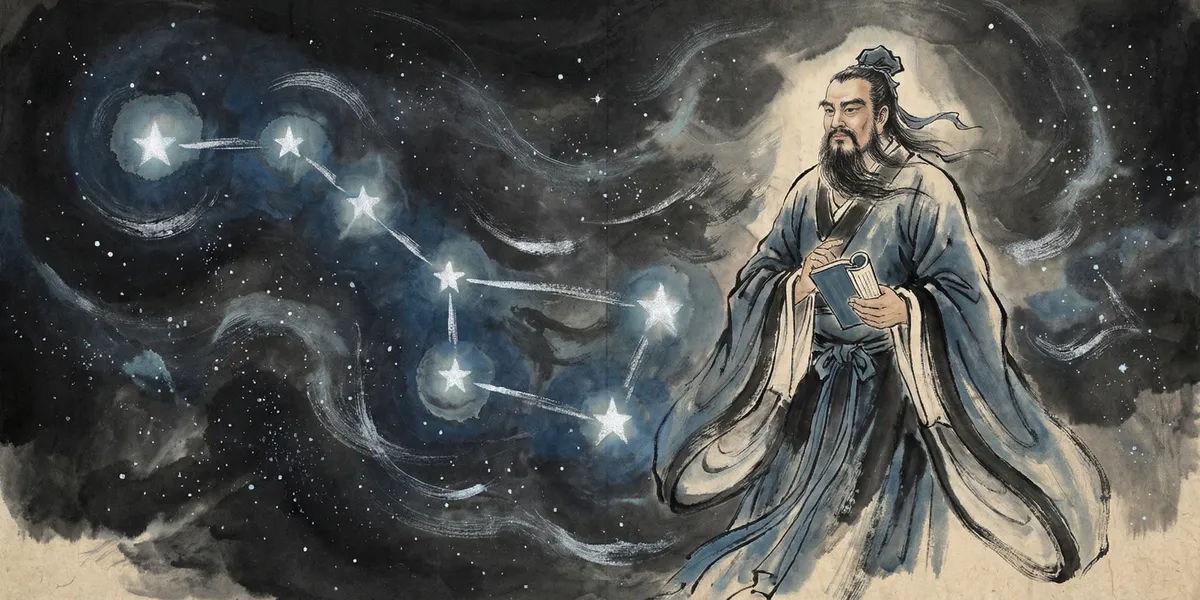
If Nanji Xianweng is the kindly old grandfather who adds years to your life, then Beidou Xingjun (Běidǒu Xīngjūn) is the ultimate judge who decides how long you get to live in the first place. He sits in his star palace in the northern sky, holding a book that nobody wants to see their name in — the Book of Life and Death (Shēngsǐ Bù). He doesn't just determine how many years you'll live; he invisibly governs the rise and fall of your fortunes throughout your entire lifetime.
The roots of Beidou Xingjun's worship come from ancient Chinese veneration of the Big Dipper (Ursa Major). In an era without GPS or compasses, the Big Dipper was the most reliable "navigation system" in the night sky. These seven stars — Tianshu (Tiānshū), Tianxuan (Tiānxuán), Tianji (Tiānjī), Tianquan (Tiānquán), Yuheng (Yùhéng), Kaiyang (Kāiyáng), and Yaoguang (Yáoguāng) — arrange themselves in the shape of a ladle, rotating around the North Star, with the handle pointing in different directions according to the seasons: east in spring, south in summer, west in autumn, north in winter. The ancients relied on it not only to determine direction and season but also regarded it as the "Chariot of the Celestial Emperor" (tiāndì zhī chē) — the vehicle in which the Heavenly Emperor patrols the universe. This supreme astronomical status directly established Beidou Xingjun's paramount authority in religious belief.
In the Daoist theological system, the seven stars of the Big Dipper are personified as seven Star Lords, each with their own title: the Greedy Wolf Star Lord (Tānláng), the Giant Gate Star Lord (Jùmén), the Salary Keeper Star Lord (Lùcún), the Literary Melody Star Lord (Wénqǔ), the Honest and Chaste Star Lord (Liánzhēn), the Martial Melody Star Lord (Wǔqǔ), and the Army Breaker Star Lord (Pòjūn). Together, these seven are called the "Seven Original Star Lords of the Northern Dipper" (Běidǒu Qīyuán Xīngjūn), each with distinct responsibilities, collectively governing the fate of life and death in the mortal world. Of these, the Literary Melody Star and Martial Melody Star are probably the most familiar to the general public — folk wisdom often says a child who excels at studies is "the Literary Star descended to earth," and a person of extraordinary martial prowess is "the reincarnation of the Martial Star."
Beidou Xingjun's most essential divine function is "registering death" — determining the time of death. Daoist scriptures state explicitly: "The Southern Dipper governs birth, the Northern Dipper governs death" (Nándǒu zhù shēng, Běidǒu zhù sǐ). The very moment a person is born, their name is simultaneously written into the ledgers of both the Southern and Northern Dippers: the Southern Dipper records when you arrive in the mortal world, and the Northern Dipper records when you leave. Together, these two ledgers form a person's complete dossier of fate.
This "star-ordained destiny" belief system gave rise to one of the most important rituals in Daoism — "Worshipping the Dipper" (bài dǒu), also called "Paying Respects to the True and Honoring the Dipper." On the first through ninth days of the ninth lunar month (during the "Nine Emperors Festival"), Daoist devotees hold solemn Dipper-worship rituals (kēyí) in temples, lighting lamps and paying reverence to the seven stars of the Big Dipper, praying for the removal of calamities and the extension of life. The most essential ritual implement is the "Dipper Lamp" (dǒu dēng) — a wooden bushel filled with rice, scissors, a ruler, a mirror, and a scale, with a flame lit in the center, symbolizing the seven stars of the Big Dipper illuminating the mortal world. This ceremony has been transmitted within Daoism for over a thousand years and is still regularly performed in Daoist temples across the country.
The most classic Beidou Xingjun story is the legend of Guan Lu (Guǎn Lù) altering fate. Guan Lu, the legendary fortune-teller of the Three Kingdoms period, once encountered a young man named Zhao Yan. After casting his fortune, he discovered the young man bore the mark of death and wouldn't live past nineteen. Moved by compassion, Guan Lu taught Zhao Yan a method to "steal years": prepare fine wine and dried deer meat, and go find two old men playing chess beneath a great mulberry tree south of the city. Zhao Yan followed the instructions. The two elders were so absorbed in their game that they ate and drank everything while playing. Only after finishing did they realize — this kid came to beg for more years. The one seated on the north side was visibly displeased; the one on the south side said: "We ate the man's food, we should at least give him some face." So the northern elder — who was none other than an incarnation of Beidou Xingjun — opened the Book of Life and Death and flipped Zhao Yan's "nineteen" to "ninety-nine." Eighty extra years of life, just like that.
This story is widely known throughout Chinese folk culture, and its core message is this: though fate may be ordained by heaven, it is not absolutely immutable. Through sincerity, good deeds, and the right opportunity, a person can influence the course of their destiny. While Beidou Xingjun governs death, he is not the cold, emotionless "Grim Reaper" of the West — he has a human side, and can be moved by genuine sincerity. This belief that "fate can be changed" is the most optimistic core spirit of Chinese Daoist faith.
Beidou Xingjun has also profoundly influenced Chinese fortune-telling. Purple Star Astrology (Zǐwēi Dǒushù) — one of the most sophisticated destiny-calculation systems in China — is built around the "Purple Star" at the center of the Big Dipper. Daoism holds that each person, based on their birth year, has a corresponding "natal star lord" (běnmìng xīngjūn), and regular worship can help avert life's destined calamities. The *Northern Dipper Natal Life-Extending True Scripture* is the core text specifically for venerating Beidou Xingjun.
Interestingly, in folk stories, Beidou Xingjun often carries a charming contrast — stern-faced on the outside, but secretly soft-hearted. He'll look utterly serious, then let a pot of good wine make his hand tremble just enough to "accidentally" add a few decades to someone's life. This personality quirk transforms what should be a terrifying figure holding the power of life and death into a surprisingly relatable being with a very human touch.
East vs West
East · Beidou Xingjun
Western counterpart: Grim Reaper (fate)
Beidou Xingjun's closest counterpart in Western culture is the Grim Reaper — both are directly associated with death and fate. But their imagery and meaning could not be more different. The Western Grim Reaper is a skeleton in a black cloak wielding a scythe; his arrival signifies the end of life, non-negotiable, irreversible, unbribable. He is the embodiment of fear itself, representing humanity's deepest helplessness in the face of death. Beidou Xingjun's image is the polar opposite: he wears magnificent Daoist robes and a star crown, wields a Seven-Star Sword, and is surrounded by the radiance of celestial bodies — majestic and awe-inspiring but not horrifying. More crucially, the Grim Reaper's verdict is absolute — he comes to reap your soul with zero room for negotiation. But Beidou Xingjun's Book of Life and Death can be "amended" — through cultivation, accumulated virtue, devout worship, or even just a pot of fine wine and a piece of dried meat, you might earn his mercy. This embodies the fundamental divergence between Western and Chinese cultures when facing death: the West tends to accept the absolute, irreversible nature of death, while Chinese culture maintains a flexible optimism that "there's always a way out." In Greek mythology, the three Fates (Moirai), once they cut the thread of life, cannot be undone. In Beidou Xingjun's Book of Life and Death, numbers can be added and subtracted — even if the reason is simply that he ate your dinner.
Modern Influence
Beidou worship continues to exert influence in contemporary China in multiple forms. Purple Star Astrology remains one of the most popular fortune-telling systems in China, with countless people using it annually to calculate their prospects in marriage, career, and health. The Daoist "Worshipping the Dipper" ritual is regularly held at major Daoist temples across the country, and is an even grander occasion in overseas Chinese communities — particularly during the Nine Emperor Gods Festival in Malaysia and Singapore, where devotees observe nine days of vegetarian fasting in honor of the Northern Dipper. China's independently developed BeiDou Navigation Satellite System was named directly after the Big Dipper — the cultural symbolism of "guiding the way and illuminating the path ahead" merging perfectly with modern technology. From ancient star worship to modern space navigation, the name "BeiDou" has always carried the core mission of "showing people the way."
Related Characters
 Nanji XianwengBack to CompendiumZhurong
