
Nanji Xianweng
Nanji Xianweng (The Old Immortal of the South Pole)
The Old Immortal of Boundless Longevity
Domain
The South Pole Star Palace, governing human lifespans, fortune and longevity
Role
Star deity governing life and death, one of the Three Stars of Fortune-Prosperity-Longevity, bestower of years
Weapon
The Dragon-Headed Staff — a celestial walking stick adorned with a dragon's head, symbolizing longevity and authority, capable of granting extra years to mortals
Appearance
A towering, bulging forehead (the Longevity Star brow), white beard cascading to his chest, a warm and kindly face, one hand holding a dragon-headed staff, the other cradling a peach of immortality, often accompanied by a crane and a white deer
Legend
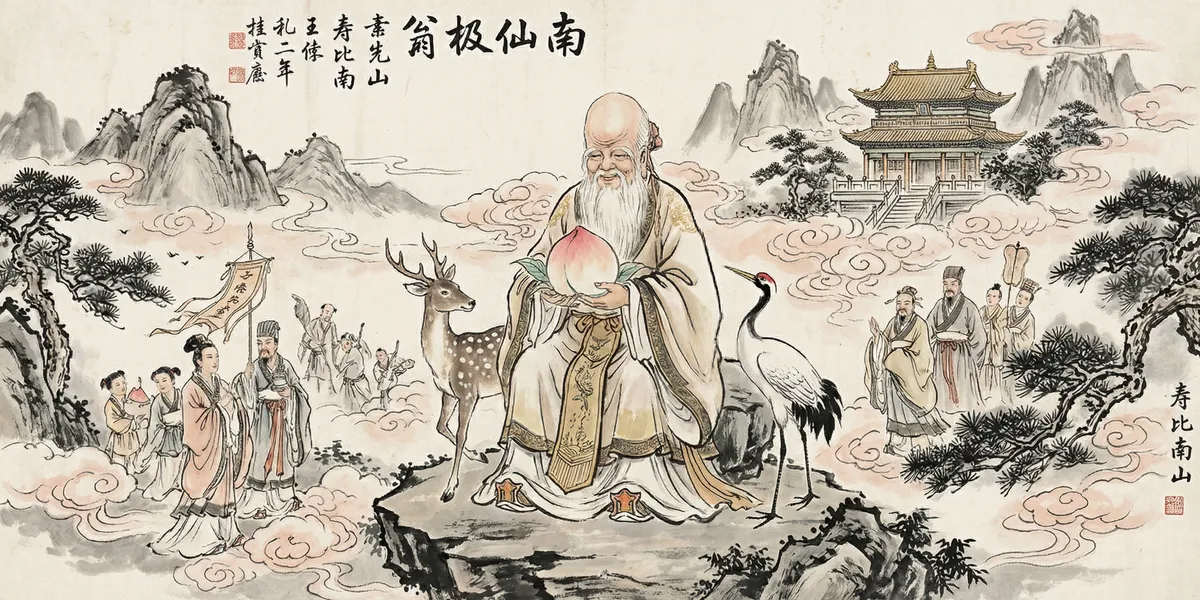
In the pantheon of Chinese folk deities, there is one old gentleman whose popularity can only be described as "national idol" — and that's Nanji Xianweng (Nánjí Xiānwēng), known to ordinary folk as the "God of Longevity" (Shòuxīng). When you say "May you live to be a hundred" at someone's birthday, you're basically invoking this guy's protection.
Nanji Xianweng's formal Daoist title is the "Great Emperor of the Southern Pole of Eternal Life" (Nánjí Chángshēng Dàdì), a deity of extremely high status in the Daoist divine hierarchy. His name derives from astronomy — the South Pole Old Man Star (Canopus), the second brightest star in the entire sky. Ancient Chinese astronomers noticed this star long ago and believed it governed human lifespans. The *Records of the Grand Historian* notes: "When the Old Man Star appears, there is peace and stability; when it cannot be seen, war breaks out." In other words, as long as the South Pole Old Man Star hangs brightly at the horizon, the world is at peace; if you can't see this star, trouble is brewing. Because of this, from the Han Dynasty onward, the imperial court held special rituals to honor the South Pole Old Man Star, praying for national prosperity and public welfare.
When it comes to Nanji Xianweng's appearance, he is one of the most instantly recognizable figures in the history of Chinese art. A kindly old man with a flowing white beard, his most striking feature is that extravagantly bulging forehead — technically called a "longevity peach brow," rising high and taking up nearly two-thirds of his face, as if he's balancing an enormous peach on top of his head. This isn't considered ugly — it's the ultimate version of a "full heavenly court" forehead, which in Chinese physiognomy represents both great fortune and long life. He leans on a dragon-headed walking staff (lóngtóu guǎizhàng) in one hand and cradles a peach of immortality in the other — yes, the very kind from the Queen Mother of the West's Peach Garden, the kind that extends your life with every bite. He's usually flanked by two "bodyguards": a crane and a spotted deer. The crane symbolizes longevity, and the deer is a homophone for "lu" (lù), meaning official rank and prosperity. The whole image is essentially a walking billboard for "fortune, prosperity, and long life."
Nanji Xianweng's most significant literary appearance is in *Investiture of the Gods* (Fēngshén Yǎnyì). During King Wu's epic war to overthrow the tyrannical King Zhou, he appears as one of the immortals of the Elucidation Sect under the Primordial Heavenly Worthy (Yuánshǐ Tiānzūn). He's not the kind of battle-ready deity who can split mountains with a single palm strike, but his venerable status allows him to serve as a mediator and wise counselor among the various warring factions. Whenever he shows up, the tension eases — perfectly consistent with his persona of "bestowing blessings and longevity."
The most widely circulated folk story about Nanji Xianweng involves Guan Lu (Guǎn Lù), the legendary fortune-teller of the Three Kingdoms period. Guan Lu once encountered a young man named Zhao Yan on the road. One look at his face told Guan Lu everything — the young man bore the mark of death and had only nineteen years to live. Moved by compassion, Guan Lu taught the young man a method to "extend his life": prepare fine wine and dried meat, then go to the great mulberry tree south of the city to find two old men playing chess. The young man did as he was told. The two elders were so engrossed in their game that they absentmindedly ate and drank everything. Only after finishing did they realize — blast, this kid came to beg for more years. The two old men were actually incarnations of the Southern Dipper Star Lord and the Northern Dipper Star Lord. Daoism teaches: "The Southern Dipper governs birth, the Northern Dipper governs death" (Nándǒu zhù shēng, Běidǒu zhù sǐ). The Northern Dipper Star Lord controlled the death registry, and having been softened by accepting the food, he had no choice but to flip Zhao Yan's "nineteen" to "ninety-nine." This story portrays Nanji Xianweng (whose domain frequently overlaps with the Southern Dipper's function) as a "reasonable" god of longevity — not a rigid, unfeeling judge, but a kindly grandfather who's willing to put in a good word for you after eating your food.
In Chinese daily life, Nanji Xianweng is most present at longevity banquets (shòuyàn). In Chinese tradition, celebrating an elder's birthday is an extraordinarily important family ritual, especially milestone birthdays like the 60th or 80th. At these banquets, a painting or figurine of Nanji Xianweng is practically standard equipment. Longevity peaches (peach-shaped buns or cakes) are required fare, and "May your fortune be as vast as the Eastern Sea, and your longevity rival the Southern Mountain" (Fú rú dōnghǎi, shòu bǐ Nánshān) is the most classic birthday couplet — where "Southern Mountain" refers to where Nanji Xianweng resides. Longevity noodles (chángshòu miàn) are another staple — you must not break them, as unbroken noodles symbolize a long, unbroken life. The entire birthday banquet culture is, at its core, a devout prayer to Nanji Xianweng.
Nanji Xianweng, together with two other beloved folk deities, forms the most iconic "divine dream team" in Chinese culture — the Three Stars of Fortune, Prosperity, and Longevity (Fú Lù Shòu Sānxīng). The Fortune Star governs happiness, the Prosperity Star governs career success, and the Longevity Star (Nanji Xianweng) governs long life. "When the Three Stars shine bright" (sānxīng gāo zhào) represents the entirety of what Chinese people imagine as the good life: good fortune, a bright future, and good health. In Chinese New Year prints, porcelain, and embroidery, these three old deities appear with extraordinary frequency, making them the "Big Three" of Chinese folk art.
Interestingly, Nanji Xianweng isn't always the gentle "nice old man." In some local legends, he occasionally descends to the mortal world disguised as an ordinary old man, walking through the streets and secretly evaluating people's character. Families with filial children and virtuous deeds get a few extra years quietly added to their ledger; those who are unfilial or wicked get a few years silently struck off. This "secret inspection" storyline transforms him from a remote astral deity into a relatable neighborhood grandpa.
East vs West
East · Nanji Xianweng
Western counterpart: Father Time
In Western culture, the figure closest to Nanji Xianweng is Father Time — both are white-bearded elders, and both are closely associated with time and the passage of life. But their temperaments and meanings are diametrically opposed. Father Time carries an hourglass and a scythe, projecting a solemn, even melancholic aura. His appearance reminds people that time flies and life must end — he is essentially a metaphor for the inescapability of death. Nanji Xianweng is the exact opposite: he smiles warmly, cradling a peach of immortality and leaning on his cane, representing the continuation of life and the gift of blessings. In his worldview, a lifespan is not a countdown timer but an account that can be "topped up": as long as you accumulate virtue and cultivate yourself, your years can potentially be extended. The Western god of time tells you death is unavoidable; the Chinese God of Longevity tells you long life can be earned. This difference profoundly reflects two cultures' attitudes toward finite life: the West tends to accept the tragic finality of death, while Chinese culture leans toward seeking continuation and transcendence. Additionally, in Greek mythology, the Moirai (three Fates) spin the thread of life, and once it is cut, there is no reversal. In China's star-lord system, the Book of Life and Death can be rewritten. This "fate-can-be-changed" philosophy is one of the most optimistic core beliefs in Chinese folk religion.
Modern Influence
Nanji Xianweng's image remains deeply rooted in Chinese daily life to this day. Every time an elder celebrates a birthday, longevity peach cakes, "May your fortune be vast as the Eastern Sea" couplets, and longevity noodles are all standard fare. Figurines of the Three Stars of Fortune, Prosperity, and Longevity can be found everywhere in Chinese craft shops, from Jingdezhen porcelain to wood and ivory carvings. "Old God of Longevity" has become the universal affectionate nickname for any remarkably long-lived person. In Spring Festival prints, birthday ceremonies, and traditional celebrations, Nanji Xianweng's image has never been absent. In gaming and animation, he frequently appears as a "blessing-type NPC" — the kindly elder who hands out key items or healing buffs. It can safely be said that as long as Chinese people are still celebrating their elders' birthdays, Nanji Xianweng's cultural vitality will never fade.
Related Characters
 Zhang TianshiBack to CompendiumBeidou Xingjun
