
Zhang Tianshi
Zhang Tianshi (Celestial Master Zhang)
Founder of Orthodox Unity Daoism, Supreme Demon Vanquisher
Domain
Ancestral seat at Mount Longhu, presiding over the Orthodox Unity Daoist lineage, vanquishing demons and evil
Role
Founder of Orthodox Unity Daoism, the First Celestial Master, supreme authority for acting on heaven's behalf and subduing ghosts and demons
Weapon
The Celestial Master Sword and Talismans — the sword slays demons, the talismans command divine soldiers and seal evil spirits; the two work in perfect concert
Appearance
Wearing a lotus ritual crown, draped in ceremonial robes embroidered with sun, moon and stars, one hand wielding the Celestial Master Sword, the other forming mudras to trace talismans, feet stepping Yu's Ritual Paces
Legend
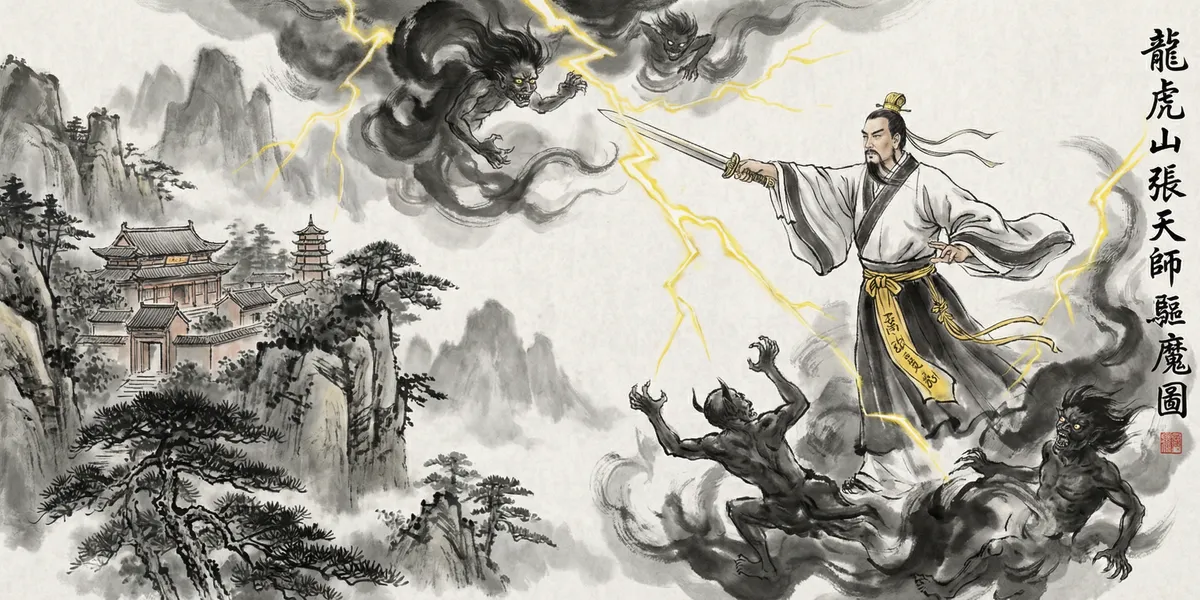
If there were a profession in Chinese mythology called "professional ghost-hunter," then the founder of the industry, the person who wrote all the industry standards, and the most powerful practitioner in history would all be the same person — Zhang Tianshi (Zhāng Tiānshī), also known as Zhang Daoling (Zhāng Dàolíng).
Zhang Daoling, courtesy name Fuhan, was born in Feng County in the State of Pei during the Eastern Han Dynasty (modern-day Feng County, Jiangsu). Legend has it he was the eighth-generation descendant of Zhang Liang (Zhāng Liáng), one of the founding heroes of the Western Han Dynasty — now that's a pedigree. He was brilliant from childhood, reading the *Dao De Jing* by age seven and mastering astronomy, geography, and the mystical arts. In an era when Confucian scholarship reigned supreme, Zhang Daoling chose not to take the standard path of official examinations. Instead, he threw himself headlong into Daoist cultivation and alchemy. At the time, this decision was roughly equivalent to a Harvard graduate turning down a job at Google to go grow mushrooms in the mountains — widely misunderstood, but he couldn't have cared less.
He first practiced on Mount Beimang (Běimáng Shān) — a place later famous for its imperial tombs covering the mountainside, suggesting Zhang Daoling had a certain affinity with the netherworld from the very start. Later, hearing that the Shu region (Sichuan) was abundant in spiritual energy and traces of immortals, he journeyed thousands of miles westward and eventually settled on Mount Heming (Hèmíng Shān).
What happened on Mount Heming directly altered the course of Chinese religious history. According to Daoist scriptures, after decades of secluded cultivation on the mountain, Zhang Daoling received a personal visitation from Taishang Laojun (Tàishàng Lǎojūn), who transmitted to him the "Way of the Orthodox Unity Covenant with Authority" (Zhèngyī Méngwēi zhī Dào) — note those two characters "Zhengyi" (Orthodox Unity), which would become the name of the entire religious movement — along with the Celestial Master Sword (tiānshī jiàn), the Dugong Seal (dōugōng yìn), the Male and Female Evil-Slaying Swords, and the secret arts of talismans and registers (fúlù mìfǎ). From that moment on, Zhang Daoling was honored as the "Celestial Master," and Orthodox Unity Daoism — China's first organized religion with formal doctrine, hierarchy, and ritual — was officially born.
Zhang Tianshi's most awe-inspiring ability was his mastery of demon vanquishing. Legend has it that the Shu region at the time was overrun by the Six Heavens Ghost Kings (liùtiān gùguǐ) — all manner of spirits and demons had taken up residence in the mountains and valleys, tormenting the populace, spreading plagues, and causing untold suffering. After Zhang Daoling arrived, armed with talismans, ritual swords, and thunder magic (léifǎ), he waged a massive campaign of righteous warfare against the six great demon kings.
He established his ritual altar on Mount Qingcheng (Qīngchéng Shān) — the very mountain that would later become one of Daoism's holiest sites was Zhang Tianshi's primary battlefield. He summoned celestial soldiers, unleashed the awesome power of thunder magic, and subdued the six demon kings one by one. Legend says the battle was so intense that Mount Qingcheng itself trembled, and the wailing of ghosts could be heard for a hundred miles across the Shu region. In the end, the six demon kings submitted, and Zhang Tianshi established the Twenty-Four Parishes (èrshísì zhì) — an early Daoist administrative system where each "parish" had its own headquarters and staff responsible for local religious affairs and demon suppression.
This great battle is known in Daoist history as the "Celestial Master's Demon Subjugation." But Zhang Tianshi did far more than just fight. He established an entire "regulatory framework" for dealing with ghosts and spirits: which departed souls could be given salvation, which evil entities had to be suppressed, which righteous deities should be worshipped — even including the specific procedures for various Daoist rituals (kēyí) and the standardized formats for writing talismans. Everything was documented, everything had rules. He transformed exorcism from a chaotic form of primitive shamanism into a systematic, standardized, transmissible religious technology. In modern terms: he wasn't just a great hunter — he was an entrepreneur who wrote the entire industry playbook and built a training system.
Zhang Tianshi also established an institution that is virtually unique in the history of world religion: the position of Celestial Master is hereditary, passed down through the Zhang family. From Zhang Daoling in the Eastern Han Dynasty, through the Wei, Jin, Northern and Southern Dynasties, Tang, Song, Yuan, Ming, and Qing, down to the present day, the lineage has been transmitted for over sixty generations across nearly two thousand years. Each successive Celestial Master is regarded as the supreme leader of Orthodox Unity Daoism, wielding the legitimate authority to "act on behalf of Heaven." The only comparable institution for continuity in world religion is the papal succession of Rome — but popes are elected, while Celestial Masters inherit by blood. The two systems operate on entirely different logic.
Zhang Tianshi's iconic image is deeply embedded in Chinese folk consciousness: wearing a lotus ritual crown, dressed in ceremonial robes embroidered with patterns of sun, moon, and stars, one hand gripping the Celestial Master Sword, the other forming mudras to draw talismans, feet stepping the ritual patterns of Yu's Paces (yǔbù gāngdǒu, a magical walking technique derived from the Great Yu). In folk belief, paintings of Zhang Tianshi are often hung on doors or inside homes — serving a function similar to the crucifix in Western Christianity — to ward off evil and protect the household. During the Dragon Boat Festival (Duānwǔ Jié), southern Chinese regions still maintain the tradition of hanging Zhang Tianshi's portrait to repel the Five Venomous Creatures (scorpions, snakes, centipedes, geckos, and toads), a custom that endures to this day.
Zhang Daoling is said to have ascended to immortality at Mount Longhu (Lónghǔ Shān, in modern-day Yingtan, Jiangxi) at the legendary age of 123. Longhu Mountain has since become the ancestral holy site of Orthodox Unity Daoism, where Zhang Tianshi's descendants have resided for generations. The mountain is now one of the most important Daoist pilgrimage destinations in China. The Celestial Master's Mansion on the mountain remains well-preserved and is the largest Daoist residential complex in the country.
East vs West
East · Zhang Tianshi
Western counterpart: Van Helsing
Zhang Tianshi's closest cultural counterpart in the West is Van Helsing — the erudite, well-equipped professor who professionally hunts vampires in Bram Stoker's *Dracula*. Both are the archetypal "professional monster hunters" of their respective cultures: both possess a systematic methodology for vanquishing evil, both rely on knowledge and technique rather than brute force, and both use specific sacred implements (Van Helsing uses crucifixes, holy water, and garlic; Zhang Tianshi uses the Celestial Master Sword, talismans, and ritual seals). But the crucial difference lies in the legacy they left behind. Van Helsing is a lone hero — his knowledge and skills are essentially tied to him personally; while he has students, he never established an institutional system of succession. Zhang Tianshi, on the other hand, built an institutional framework spanning nearly two thousand years: standardized talisman formats, complete ritual procedures, organizational structures for his religious order, and hereditary succession of the Celestial Master position — an entire "monster-hunting industry chain" that has lasted over sixty generations. Van Helsing is a hunter; Zhang Tianshi is the creator of an entire industry. This reflects a deep cultural difference between West and East: Western culture celebrates individual heroism, placing hope in a single extraordinary individual; Chinese culture places greater value on institutional building and intergenerational transmission, trusting the power of systems over the power of any one person.
Modern Influence
Zhang Tianshi's cultural influence remains strong in contemporary China. Mount Longhu is a National 5A Tourist Attraction and UNESCO Global Geopark, and the Celestial Master's Mansion and its suspended coffins attract millions of visitors each year. Orthodox Unity Daoism's talisman arts appear with extremely high frequency in Chinese-language film and television — from the jiangshi (zombie) film genre pioneered by Lam Ching-ying to modern web series about demon-hunting, the two characters "Tianshi" (Celestial Master) are practically a gold-standard brand for exorcism-themed entertainment. In gaming, "Celestial Master," "Talisman Master," and "Exorcist" are among the most popular class designs in Chinese-developed games, with titles like *Onmyoji* and *Moonlight Blade* featuring characters and systems directly or indirectly drawn from Zhang Tianshi's legend. The folk custom of hanging Zhang Tianshi's portrait during the Dragon Boat Festival to repel the Five Venomous Creatures is still widely practiced in rural areas of Jiangxi, Fujian, and Guangdong. On an academic level, the Orthodox Unity Daoist tradition of Mount Longhu and its ritual heritage have been inscribed on the National Intangible Cultural Heritage list.
Related Characters
 Lu DongbinBack to CompendiumNanji Xianweng
